
Property Management Compliance Software for Multifamily: A Buyer's Map of the Five Categories for Apartment Operators
For COOs and marketing, leasing and compliance leads at multifamily operators who have been asked to buy compliance software.
Property management compliance software for multifamily falls into five categories: affordable housing certification (LIHTC, HUD, USDA), building and safety violation tracking, vendor insurance (COI) tracking, leasing and fair housing process workflow, and digital advertising compliance. The fifth checks what renters see: advertised fees, fair housing language, website accessibility, listing accuracy and photos. Only that one reads the published page.
- Ask a vendor which of the five categories it sells before you compare features; most demos only cover one.
- Affordable housing tools verify tenant eligibility and report to agencies; they do not read your Zillow listing or your pricing page.
- Digital advertising compliance is a grid of five surfaces against five rule sets, scored per property.
- In Brynson's analysis of 6,000 properties, nearly 89% of communities described themselves differently across listing sites, so a one-time audit decays fast.
- Nightly monitoring with a verified re-scan is what turns a finding into proof that it stayed fixed.
This guide is general information, not legal advice. Laws and regulator guidance change; check the current rules for your properties with your counsel before acting.
The five categories of multifamily compliance software at a glance
"Compliance software" means five different products in multifamily, bought by five different people. Search results for the phrase mix them freely: an affordable housing certification suite sits next to an insurance certificate tracker's buyer's guide. Sort the market first, then compare vendors inside one category.
| Category | What it checks | Usual buyer | Example vendors | Blind spot |
|---|---|---|---|---|
| 1. Affordable housing certification | Tenant income eligibility, recertifications, income limits, agency submissions (HUD, LIHTC, HOME, USDA RD) | Affordable compliance director | MRI Affordable Housing, ResMan Affordable | Anything published to renters |
| 2. Building, safety and violations | Agency violations, inspections, preventive maintenance, work orders | Facilities and asset management | SiteCompli by Inhabit (NYC agencies) | Marketing and leasing |
| 3. Vendor insurance (COI) | Certificates of insurance and endorsements against your coverage requirements | Risk management, procurement | Jones, TrustLayer | Residents and renters entirely |
| 4. Leasing and fair housing workflow | Whether staff ran the procedure: screening steps, accommodation requests, training sign-offs, approvals | Operations, training | Process Street | What the published ad or listing actually says |
| 5. Digital advertising compliance | Advertised fees, fair housing language, website accessibility, listing accuracy, photo integrity, evidence of what renters saw | Marketing, compliance, legal | Compliance360 | Income certification, buildings, COIs |
The test for any demo: ask the vendor to open one of your live listings on a third-party site and show what its product flags on it. Categories 1 to 4 cannot, because they work on records inside your systems. Category 5 starts from the published page.
The five categories, with what each does and does not cover
One honest line on what each category is for, what it leaves out, and the question that tells you whether you need it.
- 01
Affordable housing and LIHTC certification software
Manages eligibility and reporting for subsidised units. MRI Affordable Housing lists compliance support for HUD Multi-Family, Tax Credit, HOME and USDA Rural Development programs, and its voucher management covers "eligibility, lease-up, and recertification through simplified rent calculations, inspection tracking, and TRACS submissions". ResMan Affordable automates income limit updates and recertification notices, and checks TRACS data against vouchers before submission. Does not cover: the rent and fees your market-rate units advertise, or anything on a listing site. You need it if any unit carries an income or rent restriction.
- 02
Building, safety and violation tracking
Watches agency violations and routes repair work. SiteCompli by Inhabit monitors New York City agency alerts including DOB, HPD and FDNY, and adds work orders, property walks and preventive maintenance scheduling. Does not cover: marketing, leasing or renter-facing pages. You need it if you hold buildings in cities with heavy agency enforcement and open violations reach your desk by mail.
- 03
Vendor insurance and COI tracking
Reads certificates of insurance and endorsements from vendors and contractors and checks them against your requirements. Jones and TrustLayer both sell this to real estate teams. Does not cover: residents, renters or advertising. You need it if vendor coverage gaps are a recurring finding in your risk reviews.
- 04
Leasing and fair housing workflow
Proves staff followed the procedure. Process Street, for example, turns screening, accommodation requests, training acknowledgments and approvals into assigned workflows with audit history, sitting around your PMS rather than replacing it. Does not cover: what the published listing actually says. A completed "ad reviewed" checklist does not stop an ILS from showing last month's fee. You need it if your exposure is process: inconsistent screening or undocumented accommodation decisions.
- 05
Digital advertising compliance
Reads what renters see: the property website, each ILS listing, ads and social, photos and the application flow, and checks them against fee, fair housing, accessibility and image rules for the property's address. Does not cover: income certification, building violations or COIs. You need it if you advertise rent online in any market with a fee, source-of-income or photo-disclosure rule. In Brynson's analysis, nearly 89% of communities described themselves differently across listing sites.
Category 5 in depth: why advertising compliance is its own category
The rules for categories 1 to 4 attach to records you control: a tenant file, a building, a certificate, a task. Advertising rules attach to what was published, wherever it was published. That is why a back-office tool cannot cover them.
Two primary sources show how wide "published" is:
- Fair housing. The Fair Housing Act makes it unlawful to publish any notice, statement or advertisement for the rental of a dwelling "that indicates any preference, limitation, or discrimination" on a protected basis (42 U.S.C. 3604(c)). HUD's regulation names "words, phrases, photographs, illustrations, symbols or forms" and also the selection of "media or locations for advertising" that deny segments of the market information (24 CFR 100.75(c)). Photos and ad targeting are in scope, not only copy.
- Fees. In the FTC and Colorado case that Greystar agreed to settle for $24 million in December 2025, the FTC alleged the company added "hidden fees on top of advertised prices." The order requires Greystar to "more prominently disclose the total monthly leasing price" when advertising base rent, and to disclose each fee's amount, purpose and whether it is mandatory before collecting payment (FTC, December 2, 2025). In March 2026 the FTC opened an advance notice of proposed rulemaking on rental housing fees, covering total rent disclosure, application fees and billing practices (FTC, March 12, 2026). Details are in our FTC rental fee guide.
States and cities add their own rules on top. Colorado's HB 25-1090, signed in April 2025, bars advertising pricing information without clearly and conspicuously disclosing the total price (Colorado General Assembly). Washington bars any rental advertisement that "indicates a preference, limitation, or requirement based on any source of income" (RCW 59.18.255), a rule federal law does not have. The same listing can be fine in one market and a problem in the next. The state detail lives in the bucket pillars: rental junk fee laws by state, fair housing advertising for apartments, ADA website compliance for apartments and the apartment listing accuracy report.
The surface by rule matrix: what to check where
Digital advertising compliance is easiest to scope as a grid. Rows are the surfaces a renter sees; columns are the rule sets. Each cell is one check. A tool that covers a column but not a row (fair housing copy on the website, but not on ILS listings) leaves a blind cell.
| Surface | Fee disclosure | Fair housing | Accessibility | Image disclosure | Evidence |
|---|---|---|---|---|---|
| Property website | "Starting at" rent includes required recurring fees; fee guide matches pricing cards | Copy free of protected-class preferences for that jurisdiction | Key pages tested against WCAG 2.1 AA, plus manual checks | Virtually staged or edited photos labelled | Dated capture of each pricing page |
| ILS listings | Fees on each ILS match the PMS | Syndicated descriptions checked, not just the source copy | Owned by the ILS; record what you supplied | Same photo set and labels as the website | What each ILS displayed, by date |
| Paid and organic social | Any price in an ad carries its mandatory fees | Copy, images and audience choices (24 CFR 100.75(c)(3)) | Alt text and captions on posts | Edited imagery disclosed | Ad copy and run dates kept |
| Imagery | Not applicable | What photos convey about who lives there | Text alternatives that describe the unit | Each photo traced to its original | Reviewer decision on file |
| Application flow | All fees shown before payment or personal details | Screening language and questions | Forms usable by keyboard and screen reader | Not applicable | Capture of the flow as a renter saw it |
Twenty-three live cells per property is the real scope. Multiply by your property count and the reason spreadsheets fail is visible before you open one.
What 6,000 properties show about drift across listing sites
In an analysis of 6,000 properties and 1.6 million units on its platform, Brynson found that at origination nearly 89% of apartment communities described themselves differently depending on which listing site a renter visited. Although 97% of listings had been updated within the previous 90 days, properties still showed conflicting mandatory fees, missing amenities and contradictory terms across channels. Brynson published the figures on October 22, 2026; the method and field breakdown are in the apartment listing accuracy report.
The second number matters more for buying decisions. "Recently updated" is not the same as "consistent": each ILS maps, caches and overrides feed data its own way, so a fix in the PMS does not prove the fix reached every site.
A 40-property portfolio publishes on a website plus four ILSs: 200 listing surfaces. If the PMS raises a mandatory trash fee from $25 to $35, the change has to land 200 times. If one ILS keeps the cached $25 for three weeks at 12 properties, that is 12 advertised prices that understate the real minimum, each one a fee-disclosure question and a surprise at move-in.
Continuous website compliance monitoring vs periodic audits
A quarterly audit is a photograph. Website compliance monitoring is a nightly re-check of the same pages and listings, so the question becomes "when did this change?" rather than "is it wrong today?"
| Question | Quarterly manual audit | Nightly monitoring |
|---|---|---|
| A fee changes on one ILS last Tuesday. When is it found? | At the next audit, up to about 90 days later, if that ILS is in the sample | The next morning |
| Can you show what the page said on a past date? | Only if someone took a screenshot that day | Yes, from the dated capture |
| Did the fix hold? | Unknown until the next audit | The next scan agrees or the alert reopens |
| Which properties were never checked? | Rarely recorded | Shown as unmonitored cells |
Audits still have a place: a one-off audit is how you size the problem before buying anything, and manual review is still needed for accessibility criteria a scanner cannot judge (focus order, keyboard traps, whether alt text is meaningful). See the accessibility checklist for those.
Suite or point tools inside category 5
A single point tool is enough when one surface carries almost all your exposure: for example, a portfolio entirely in one fee-regulated state that only needs pricing pages checked. A suite earns its cost when three things are true:
- The same fact appears on several surfaces. A fee on the website and on Zillow is one problem; two tools make it two tickets with two owners.
- Rules differ by property address. Jurisdiction logic set up once and reused by every check is cheaper than configuring it per tool.
- You will need evidence. A demand letter asks what a page said on a date. If findings and captures live in different systems, someone has to reconcile them under deadline.
For vendor-by-vendor detail on fee, fair housing and archiving tools, see apartment marketing compliance tools. For an RFP structure, see the multifamily compliance RFP template.
Self-assessment: score your portfolio on the matrix
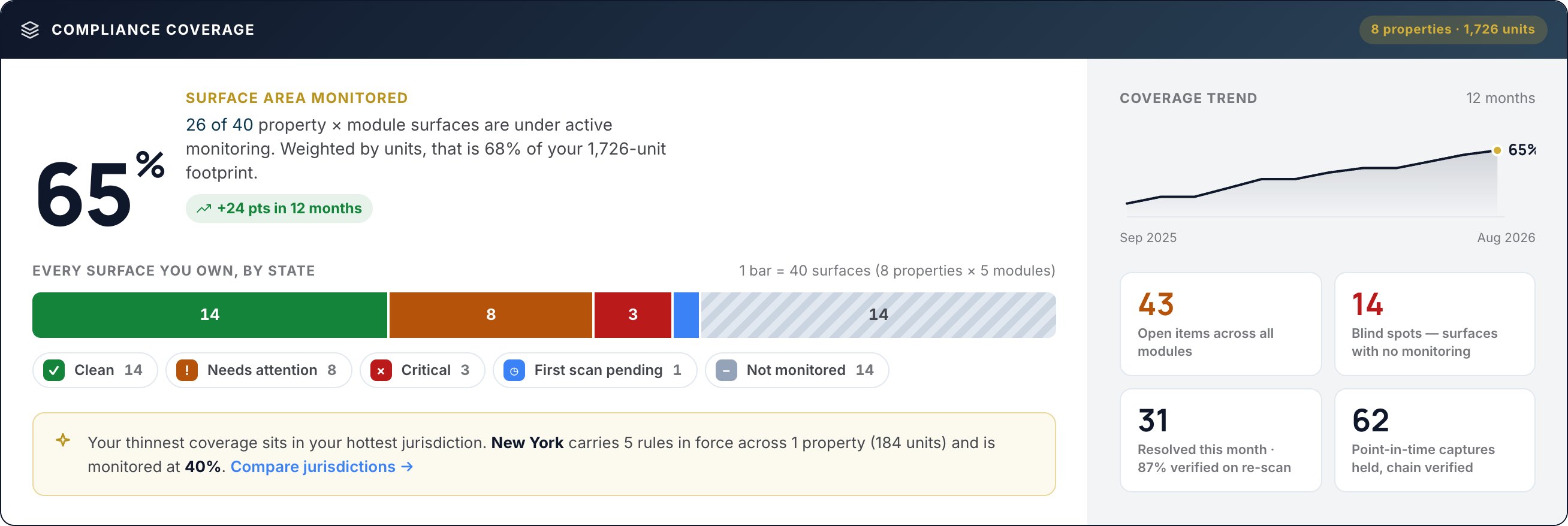
Copy this grid for one property, then score each cell with one of four marks. Unchecked cells count: an unwatched surface is where the next complaint usually comes from.
| Mark | Meaning | Example |
|---|---|---|
| Clean | Checked in the last 30 days, no issue, evidence kept | Pricing page includes all required recurring fees; capture saved |
| Attention | Issue found that is inconsistent or unclear but not yet a clear rule breach | Amenity list differs between the website and one ILS |
| Critical | Likely breach of a rule in force at that address | "Starting at" rent omits a mandatory monthly fee; "no vouchers" where source of income is protected |
| Not checked | Nobody looked, or no record exists | Paid social ads never reviewed for fair housing |
| Surface | Fee disclosure | Fair housing | Accessibility | Image disclosure | Evidence |
|---|---|---|---|---|---|
| Property website | |||||
| ILS listings | |||||
| Paid and organic social | |||||
| Imagery | n/a | ||||
| Application flow | n/a |
Scored honestly, a typical first pass might read 4 clean, 3 attention, 1 critical and 15 not checked. The 15 is the finding: it tells you the buying question is coverage, not a single bad phrase.
How to run the self-assessment on one property
One property, one afternoon, one grid. Repeat on your highest-exposure properties before you talk to vendors.
Time needed: 4 hours
- 1
Pick the property and list its surfaces
Choose a property in your strictest jurisdiction. List the website pages that show price, every ILS it syndicates to, active ad campaigns, and the application flow.
- 2
Pull the PMS record as the source of truth
Export rent ranges, every mandatory fee, pet policy and amenities from the PMS. This is what every surface should match.
- 3
Check each fee cell
Compare the advertised rent and fees on each surface with the PMS. Mark Critical if a mandatory recurring fee is missing from an advertised price.
- 4
Check fair housing and image cells
Read each description and ad for protected-class preferences under the property's state and city rules. Confirm edited or staged photos are labelled.
- 5
Check accessibility cells
Run a free automated scanner on the pricing page and application, then tab through the application by keyboard. Record what fails.
- 6
Capture evidence and score
Save a dated capture of every page you checked, then mark each cell Clean, Attention, Critical or Not checked. Count the Not checked cells first.
Compliance360 is a category 5 product. Its six services, Fair Housing, Fee Transparency, Listing Consistency, Web Accessibility, FrameCheck and SiteArchiver, resolve federal, state and city rules per property and score every property by service cell as clean, attention, critical or unmonitored, the same grid as the self-assessment above. Listing Consistency compares five sources (Apartments.com, Apartment List, Zillow, Zumper and HelloData) with your PMS nightly; Brynson works with Apartments.com, Apartment List, Zillow and Zumper as partners. In the Resolution Center, "resolved" means the next scan agreed. Compliance360 does not do LIHTC certification, building violation tracking or COI tracking; keep those tools.
You only need to size the problem
Run the self-assessment above on three properties. If most cells come back clean and checked, a periodic manual audit may be enough for now.
One surface carries your exposure
A single service, such as Fee Transparency for pricing pages, covers one column of the grid. Add services as the grid shows other gaps.
You need one view and one trail
When the same fee appears on your website and four ILSs, a shared Resolution Center and SiteArchiver captures keep the finding, fix and evidence on one record. Results roll into scheduled compliance reports.
Frequently asked questions
Affordable housing compliance software manages tenant eligibility, recertifications and agency reporting for income-restricted units under programs such as LIHTC, HUD and USDA. Marketing compliance software checks what you publish to renters: advertised fees, fair housing language, accessibility and listing accuracy. An operator with affordable units usually needs both, and neither covers the other.
Your PMS holds the rent, fee and amenity data that feeds your listings, which makes it the source of truth. It does not see what each listing site displays after that site maps, caches or overrides the feed. Advertising compliance means checking the published page against the PMS and against the rules at the property's address.
It depends on the scan schedule. Compliance360 checks pricing pages and pulls ILS listings nightly, so a fee that changed on one site yesterday shows up the next morning. A quarterly manual audit can miss the same change for up to about 90 days.
Not necessarily. Separate tools work if one surface carries most of your exposure, but the same fee or phrase usually appears on your website, several ILSs and ads at once. A suite that shares properties, jurisdictions and one audit trail avoids reconciling three sets of findings when you need evidence.
Start from your exposure. Income-restricted units need affordable certification software; buildings in heavy-enforcement cities need violation tracking; vendor-heavy operations need COI tracking. Any operator advertising rent online needs digital advertising compliance, because fee disclosure and fair housing rules apply to the published ad.
No. Software finds and documents issues, shows the rule each finding rests on and confirms when a fix holds, but your team makes the changes and counsel decides legal questions. Treat a clean scan as evidence of diligence, not a legal opinion.
How we checked this
Written by the Brynson Research Team and checked against the primary sources below. Each source shows the date we last read it. We update this page when the rules change; see the change log.
- 42 U.S. Code 3604: Discrimination in the sale or rental of housing and other prohibited practices, Legal Information Institute, Cornell Law School, current. Accessed 2026-10-22.
- 24 CFR 100.75: Discriminatory advertisements, statements and notices, Legal Information Institute, Cornell Law School, current. Accessed 2026-10-22.
- Greystar Agrees to Pay $24 Million and Stop Deceptive Advertising Practices as a Result of FTC and Colorado Lawsuit Alleging the Firm Deceived Consumers About Rent Prices, Federal Trade Commission, 2025-12-02. Accessed 2026-10-22.
- FTC Seeks Public Comment on a Proposed Rulemaking Regarding Unfair or Deceptive Rental Housing Fee Practices, Federal Trade Commission, 2026-03-12. Accessed 2026-10-22.
- HB25-1090: Protections Against Deceptive Pricing Practices, Colorado General Assembly, 2025-04-21. Accessed 2026-10-22.
- RCW 59.18.255: Source of income, discrimination prohibited, Washington State Legislature, current. Accessed 2026-10-22.
- Brynson, the Multifamily Intelligence Platform, Launches Compliance360 to Automate Digital Compliance Across Every Listing and Channel, Brynson, 2026-10-22. Accessed 2026-10-22.
- MRI Affordable Housing, MRI Software. Accessed 2026-10-22.
- Affordable Housing Compliance Software, ResMan. Accessed 2026-10-22.
- SiteCompli, Inhabit. Accessed 2026-10-22.
- Jones: Insurance Compliance at Scale for the Built World, Jones. Accessed 2026-10-22.
- TrustLayer: Third-party risk management, TrustLayer. Accessed 2026-10-22.
- Fair Housing Compliance Software for Property Managers, Process Street. Accessed 2026-10-22.
Change log
- First published.
This guide is general information, not legal advice. Laws and regulator guidance change; check the current rules for your properties with your counsel before acting.