
Rental Junk Fee Laws by State: The 2026 All-In Rent Table for Apartment and Multifamily Operators
For compliance, legal, revenue and marketing leads at multi-state multifamily operators.
As of October 22, 2026, Colorado, Connecticut, Massachusetts and Minnesota require advertised apartment rent to carry mandatory fees, each with different exclusions. Illinois adds listing disclosure and a fee ban for leases from January 1, 2027. New York City requires listings to disclose tenant-paid fees, and the FTC treats omitting mandatory fees as deceptive.
- Connecticut counts fees billed by default even when renters can opt out, which is stricter than most national pricing templates.
- Illinois, Minnesota and Connecticut also regulate the first page of the lease, not just the ad.
- The FTC rental fee rulemaking and the NYC all-in pricing rule are proposals, kept separate from enacted law.
- In Brynson's 6,000-property analysis, although 97% of listings had been updated within the previous 90 days, conflicting mandatory fees, missing amenities and contradictory terms persisted.
This guide is general information, not legal advice. Laws and regulator guidance change; check the current rules for your properties with your counsel before acting.
The federal layer: deception law, one order and a rulemaking
No federal statute or final FTC rule sets apartment fee disclosure. There is the FTC Act's ban on deceptive practices, one order showing how the FTC applies it to rent, and an early rulemaking.
- The Greystar order (December 2, 2025). Greystar agreed to pay $24 million ($23 million to the FTC, $1 million to Colorado) over advertised rents that left out fixed, mandatory monthly fees. Under the proposed stipulated order, any base-rent ad must more prominently show the total monthly leasing price, and before taking payment it must disclose each fee's amount, purpose and whether it is mandatory. FTC release.
- The rental fee ANPRM (announced March 12, 2026). An advance notice, not a proposed or final rule. It asks about total rent display, fee disclosure, application fees, security deposits, billing and consumer choice. It was published in the Federal Register on March 13, 2026 and comments closed April 13, 2026; no proposed rule has followed there as of October 22, 2026. FTC release, Federal Register notice.
The order covers one company, but its spec is the clearest signal of what the FTC expects. See the FTC rental junk fee guide.
The state table: enacted all-in rent laws
Only enacted laws whose statute, regulation or code text we read are in this table. Each row links to that text.
| State and law | In force | What the advertised rent must carry | What may sit outside it | Bans, caps and lease rules | Enforcement | Primary source |
|---|---|---|---|---|---|---|
| Colorado, HB25-1090 (C.R.S. 6-1-737) | January 1, 2026 | One total price, more prominent than any other price, covering every amount that must be paid or is not reasonably avoidable. | Government and shipping charges; the actual cost a utility provider charges for service to the unit. | Bans fees for property taxes, common-area maintenance, habitability obligations and services not provided. Fees may not rise over 2% during a lease of a year or less, utilities excepted. | Deceptive, unfair and unconscionable practice. If a tenant's written demand is not met within 14 days: actual damages plus 18% annual interest. No demand is needed to sue. | Signed act, Sec. 2 |
| Connecticut, Public Act 25-44, Sec. 9 | October 1, 2025 (lease summary page from April 1, 2026) | Every fee the tenant must pay on a periodic basis, prorated into the advertised rent. A fee charged monthly by default counts even if the tenant can opt out. | Processing fees at cost with a free alternative; pet fees; submetered or variable direct-paid utilities; damage fees; one-off service fees such as lockouts. | From April 1, 2026, lease page 1 must be the state's standardized rental terms summary, showing total periodic rent. | Civil penalty to the tenant equal to one month's rent, plus attorney's fees and costs. | PA 25-44, Sec. 9 |
| Massachusetts, 940 CMR 38.00 | Practices in force as of September 2, 2025 | Total Price at every presentation of a price, more prominent than other pricing. A monthly figure is allowed if the full lease period is disclosed. | Government and shipping charges. Optional or waivable fees must be labelled so, with how to avoid them. | Total Price before any personal or billing information is requested, with narrow exceptions. | Unfair and deceptive practice under M.G.L. c. 93A, section 2. | 940 CMR 38.03 to 38.04, 38.09 |
| Minnesota, Minn. Stat. 504B.120 | In force (2023 Minn. Laws ch. 52, art. 19, sec. 84) | Advertisements must disclose nonoptional fees with the rent, and whether utilities are included. | No listed exclusions; optional fees fall outside it. | Rent plus all nonoptional fees must appear as the "Total Monthly Payment" on the first page of the lease. | Treble damages to the tenant; the court may award attorney fees. | 504B.120 |
| Illinois, Public Act 104-0479 (765 ILCS 705/35) | January 1, 2027 per the ILGA record (the Act's Section 99 reads July 1, 2026) | All non-optional fees, one-time or recurring, clearly and conspicuously in the listing or a linked page, plus whether utilities are included. | Optional fees. Owner-occupied buildings of 6 units or fewer are exempt. | Non-optional fees must be on page 1 of the lease or the tenant is not liable for them. Application fee capped at $50 (third-party background check exception). Eleven fee types banned, including renewal, after-hours and routine maintenance fees. | Private civil action: injunctive and monetary relief, attorney's fees and costs. | PA 104-0479 |
| California, SB 478 (Civ. Code 1770(a)(29)) | July 1, 2024 | Bars advertising, displaying or offering a price that does not include all mandatory fees or charges, other than government taxes and fees and actual shipping costs. | Government taxes and fees; shipping. The Attorney General's guidance covers tickets, hotels, food delivery and short-term rentals, not residential leases. | None specific to apartments. | Part of the Consumers Legal Remedies Act, which covers the "sale or lease of goods or services." Whether a residential lease counts is unsettled; see our SB 478 guide. | Civ. Code 1770(a)(29), CA AG guidance |
Still being checked against primary text, so not yet in the table: Nevada, Oregon, Washington state and the District of Columbia. A state missing from this table may still have a fee law.
City rules: where the strictest rule is local
Two of the most specific listing rules are municipal, so a state-level policy can still miss a property.
| City and rule | In force | Listing and ad requirement | Fee rules | Enforcement | Primary source |
|---|---|---|---|---|---|
| New York City, FARE Act (Local Law 119 of 2024) | June 11, 2025 | Every ad and listing must clearly and conspicuously disclose all fees a tenant must pay to rent. The tenant signs an itemized fee disclosure before the lease. | A landlord's agent, including a listing agent, may not charge fees to prospective tenants, and no listing may include an unlawful broker fee. | DCWP investigates; civil penalties and restitution; private right of action. Cases heard at OATH. | DCWP FARE Act FAQ |
| Ferndale, Washington, Municipal Code ch. 5.44 | Adopted by voter initiative 25-01, November 2025 | Every ad, listing and application form must show monthly rent, each utility the tenant pays and the amount of every optional or mandatory fee, unless size limits make it infeasible. | Only listed fees, plus those state law expressly permits: screening up to $50 per tenant, refundable deposit up to one month's rent, pet damage deposit up to 25% of rent, late fee up to 1.5% of past-due rent, utilities at actual cost, and optional fees only with a written opt-in. Fees to pay by check, money order or ACH are banned. | Private action for the greater of three times actual damages or $1,000, double any unlawful deposit, and attorney's fees; from January 1, 2027, $250 for each prohibited lease provision. | FMC 5.44.020 to 5.44.080 |
For broker fees, the fee disclosure form and OATH enforcement, see the NYC FARE Act guide.
8 places these laws disagree, and how each one breaks a single template
The fee-by-fee differences that make one national pricing card fail somewhere.
- 01
Opt-out fees still count in Connecticut
Connecticut puts any fee charged monthly by default into advertised rent, "regardless of whether the tenant may opt out" (Sec. 9(a)). A technology package billed by default belongs in the Connecticut headline even if your national policy calls it optional.
- 02
Utilities: three different rules
Colorado lets the actual utility-provider cost sit outside the total (6-1-737(2)(d)). Connecticut excludes only submetered utilities or variable ones paid directly to a utility. Minnesota and Illinois instead require the listing to say whether utilities are included. See the fee-by-fee guide.
- 03
One-time fees: Illinois, Massachusetts and the NYC proposal reach them
Connecticut's rule covers periodic fees. Illinois requires all non-optional fees, "regardless of whether they are one-time fees or recurring fees," in the listing or a linked page (705/35(b)). Massachusetts requires each fee's nature, purpose and amount when the Total Price is first shown (940 CMR 38.04(2)(a)). The NYC proposal would put a one-time fee total in the ad. See apartment admin fees.
- 04
Periodic pricing needs a stated term in Massachusetts
Massachusetts allows Total Price as a monthly amount only if the full rental period is disclosed clearly and conspicuously (940 CMR 38.04). A per-month price card with no lease term is the gap.
- 05
Payment processing fees: conditional, or banned
Connecticut allows a processing fee outside the advertised rent only at actual cost and only if a free payment method exists (Sec. 9(b)(1)). Colorado bars processing fees when no cost-free method is reasonably accessible (6-1-737(4)(d)). Ferndale bans any fee to pay by check, money order, cashier's check or ACH (5.44.050).
- 06
Application fee caps: one state, one city
Illinois caps application fees at $50; a higher third-party background check cost is allowed only if billed with receipts within 14 days (705/35(c)(1)). Ferndale caps screening at $50 per tenant (5.44.030).
- 07
The lease first page is now regulated
Minnesota requires a "Total Monthly Payment" on lease page 1 (504B.120). Connecticut requires the state rental terms summary as page 1 from April 1, 2026. In Illinois a non-optional fee missing from page 1 is not owed.
- 08
Renaming a fee does not move it
Illinois says a landlord "may not rename a fee or charge to avoid application" of the law (705/35(e)), and Colorado's total price covers anything "not reasonably avoidable." Calling a mandatory charge a "package" or "additional rent" does not take it out of the headline.
Proposed, not law: the two rules to watch
| Proposal | Stage | What it would require | Source |
|---|---|---|---|
| FTC rental housing fee rulemaking | Advance notice published March 13, 2026; comments closed April 13, 2026. No proposed rule in the Federal Register as of October 22, 2026. | Not yet defined. The notice asks about total rent display, fee disclosure, application fees, security deposits, billing and consumer choice. | Federal Register notice |
| NYC DCWP general fee disclosure rule (proposed 6 RCNY 5-16) | Proposed; hearing and comment deadline August 7, 2026. Still listed as proposed on NYC Rules as of October 22, 2026. | Industry-neutral all-in pricing for anyone advertising in New York City. Where charges are periodic, ads must show the total for one period and the total of non-recurring mandatory fees, each at least as prominent as other pricing. Rental housing is named among the industries using junk fees. | DCWP notice of hearing, NYC Rules status page |
If adopted as written, a New York City ad would need one combined total of one-time mandatory fees, as prominent as the monthly rent. Illinois and Massachusetts require one-time fees to be disclosed, but not as a single figure.
What 6,000 properties show about fee drift
The laws assume one advertised price. In practice it is copied to a website, floor plan cards, an application flow and several listing sites, each caching it differently. In Brynson's analysis of 6,000 properties and 1.6 million units, although 97% of listings had been updated within the previous 90 days, conflicting mandatory fees, missing amenities and contradictory terms persisted. A recent update is not evidence of a correct one. The method and fee-type breakdown are in the apartment listing accuracy report.
A Hartford community lists base rent of $1,800 with a $45 monthly technology fee that renters can opt out of, and a $25 monthly trash fee. Under Connecticut Sec. 9 both are charged monthly by default, so the advertised rent should read $1,870. The website shows $1,870, one listing site shows $1,800 from a cached feed, and another shows $1,825. Two of three understate rent.
One standard for a multi-state portfolio
Most multi-state operators adopt the strictest common denominator: a higher headline number where it is not yet required, in exchange for one template, one script and one audit test.
| Standard | Driven by | Audit test |
|---|---|---|
| Headline rent includes every mandatory recurring fee, including default opt-out fees | CT Sec. 9(a), CO 6-1-737(2)(a) | Headline number equals base rent plus every fee billed monthly by default. |
| Total shown as one number, more prominent than any other price | CO 6-1-737(2)(a), 940 CMR 38.04(6) | No "rent + fees" split; base rent is never larger than the total. |
| Lease period stated next to a monthly total | 940 CMR 38.04 | "12-month lease" or similar appears with the monthly figure. |
| Every non-optional fee, including one-time fees, disclosed in or linked from the listing | IL 765 ILCS 705/35(b)(1), Ferndale 5.44.020 | A fee page link sits on every listing and pricing card. |
| Utilities status stated on every listing | MN 504B.120, IL 705/35(b)(2) | Each listing says which utilities are included. |
| Total and itemized fees shown before personal or payment details | 940 CMR 38.04(4), Greystar order | The fee breakdown appears before the first form field. |
| Total monthly payment on lease page 1 | MN 504B.120, CT Sec. 9(d), IL 705/35(b) | Lease page 1 shows rent plus nonoptional fees as one figure. |
Fee bans and caps (Illinois, Colorado, Ferndale) remove revenue rather than change display, so they stay per-jurisdiction in the PMS fee schedule. The fee transparency audit checklist turns each row into a pass or fail test by surface.
How to roll out one all-in rent standard across your portfolio
For compliance and marketing leads moving a multi-state portfolio to the strictest common denominator.
- 1
Map properties to jurisdictions
Tag every property with its state and city, and flag those in Colorado, Connecticut, Massachusetts, Minnesota, Illinois, California, New York City and Ferndale.
- 2
Export the fee schedule from the PMS
Pull every fee by property with its amount, frequency and whether it is billed by default, and mark each recurring, one-time, optional or contingent.
- 3
Compute the headline total per unit type
Add base rent and every recurring fee billed by default, prorated monthly, applying only the exclusions the property's strictest law allows.
- 4
Rebuild templates once
Show the total as one prominent number on pricing cards, floor plan pages and listing feeds, with the lease term, a fee page link and utilities status.
- 5
Gate the application flow
Put the total and the itemized fee list before the first personal-information field.
- 6
Update lease page 1
Add the total monthly payment to page 1 of every lease template. For Connecticut properties, page 1 must be the state's standardized rental terms summary.
- 7
Check every surface and keep dated evidence
After every fee change, compare the website and each listing site with the PMS total and keep a dated capture of what each surface showed.
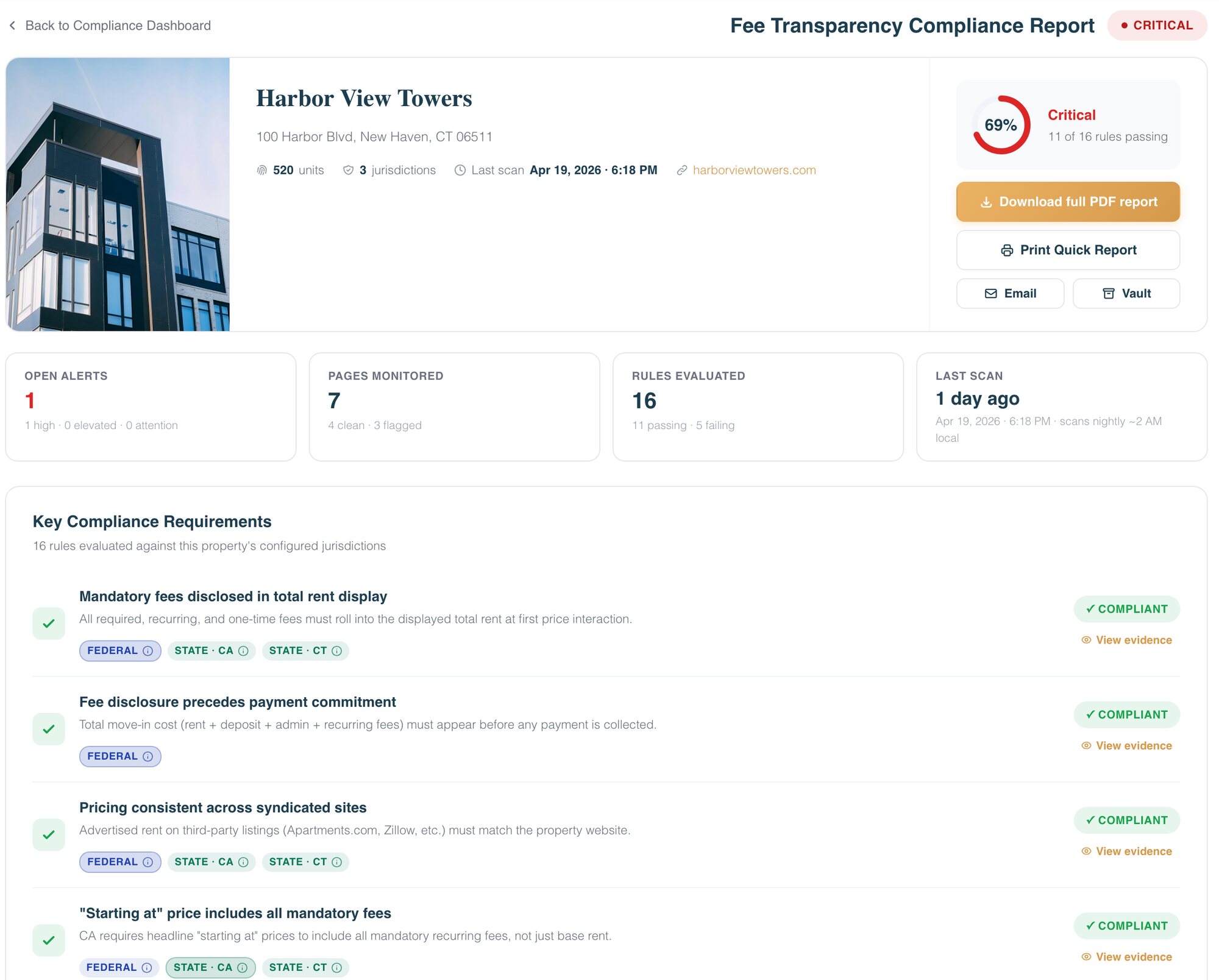
Compliance360 Fee Transparency resolves federal, state and city fee rules per property address and checks pricing, floor plans, unit listings and the application flow every night, keeping a timestamped capture of each finding. Listing Consistency compares each ILS listing with your PMS nightly, so a fee that drifts on Zillow or Apartments.com shows up in the same Resolution Center. Brynson works with Zillow and Apartments.com as partners.
Frequently asked questions
As of October 22, 2026, Colorado, Connecticut and Massachusetts require advertised rent to show a total including mandatory fees, and Minnesota requires nonoptional fees to be disclosed with rent in ads. Illinois requires non-optional fees in listings for leases from January 1, 2027. California's SB 478 bars prices that omit mandatory fees, but its reach to residential leases is unsettled.
No. The FTC published an advance notice of proposed rulemaking on rental housing fees on March 13, 2026; comments closed April 13, 2026 and no proposed rule had followed by October 22, 2026. The FTC still treats advertising rent without mandatory fees as deceptive, as the December 2025 Greystar settlement shows.
Connecticut's all-in rule covers periodic fees, so it does not require one-time fees in the monthly figure. Colorado and Massachusetts define total price as everything the renter must pay, so how a one-time fee sits beside a monthly headline is a question for counsel. Illinois requires every non-optional fee, one-time or recurring, in the listing or a linked page and on lease page 1.
The laws regulate advertising, displaying or offering a unit, not only your website, and Illinois, Ferndale and the NYC FARE Act name listings expressly. Treat every listing site that shows your rent as your advertisement and check it carries the same total. Brynson works with Zillow and Apartments.com as partners.
One prominent monthly total that includes every fee billed by default, shown with the lease term, utilities status and a link to all non-optional fees, plus itemized fees before any personal details and the total on lease page 1. Fee bans and caps still need per-jurisdiction settings.
The Illinois General Assembly record lists January 1, 2027 as the effective date of Public Act 104-0479, although Section 99 of the Act says July 1, 2026. It applies to residential leases entered into after the effective date, except owner-occupied buildings of six units or fewer. Confirm the date with counsel before changing Illinois templates.
How we checked this
Written by the Brynson Research Team and checked against the primary sources below. Each source shows the date we last read it. We update this page when the rules change; see the change log.
- House Bill 25-1090, signed act (adds C.R.S. 6-1-737), Colorado General Assembly, 2025-04-21. Accessed 2026-10-22.
- HB25-1090 Protections Against Deceptive Pricing, bill summary, Colorado General Assembly, 2025. Accessed 2026-10-22.
- Public Act No. 25-44 (Substitute Senate Bill No. 3), Sec. 9, Connecticut General Assembly, 2025. Accessed 2026-10-22.
- 940 CMR 38.00: Unfair and deceptive fees, Massachusetts Attorney General, 2025-03-14. Accessed 2026-10-22.
- Minnesota Statutes 504B.120, Prohibited fees, Minnesota Office of the Revisor of Statutes, 2023. Accessed 2026-10-22.
- Public Act 104-0479 (HB3564), Landlord and Tenant Act Sec. 35, Illinois General Assembly, 2025. Accessed 2026-10-22.
- Rental junk fee ban (FAQ), Illinois Legal Aid Online, 2026-09-11. Accessed 2026-10-22.
- California Civil Code 1770(a)(29) (Consumers Legal Remedies Act), California Legislative Information, 2024. Accessed 2026-10-22.
- Hidden fees (SB 478, Civil Code 1770(a)(29)), California Attorney General, 2024. Accessed 2026-10-22.
- FARE Act frequently asked questions, NYC Department of Consumer and Worker Protection, 2025. Accessed 2026-10-22.
- Notice of public hearing: proposed rules relating to junk fees (6 RCNY 5-16), NYC Department of Consumer and Worker Protection, 2026-07. Accessed 2026-10-22.
- Junk Fees (proposed rule status page), NYC Rules, Mayor's Office of Operations, 2026. Accessed 2026-10-22.
- Ferndale Municipal Code ch. 5.44, Consumer protections from unfair and excessive fees in housing tenancies, City of Ferndale, Washington, 2025-11. Accessed 2026-10-22.
- Greystar agrees to pay $24 million to stop deceptive advertising practices, Federal Trade Commission, 2025-12-02. Accessed 2026-10-22.
- FTC seeks public comment on proposed rulemaking regarding unfair or deceptive rental housing fees, Federal Trade Commission, 2026-03-12. Accessed 2026-10-22.
- Rule on Unfair or Deceptive Rental Housing Fee Practices (advance notice of proposed rulemaking), Federal Register (Federal Trade Commission), 2026-03-13. Accessed 2026-10-22.
Change log
- First published. State rows: CO, CT, MA, MN, IL, CA. City rows: New York City, Ferndale. Watch list: FTC ANPRM, NYC DCWP proposed rule.
This guide is general information, not legal advice. Laws and regulator guidance change; check the current rules for your properties with your counsel before acting.