
FTC Junk Fee Rules for Rental Housing: What the Greystar Order and 2026 Rulemaking Mean for Apartment Operators
For compliance, marketing and leasing leads at multifamily operators, and the counsel who advise them.
There is no final FTC rule on apartment fees yet. The FTC treats advertised rent that leaves out mandatory fees as deceptive under Section 5 of the FTC Act, settled with Greystar for $24 million in December 2025, and opened a rental housing fee rulemaking in March 2026. Comments closed April 13, 2026, and no proposed rule has been published.
- The Greystar order requires the total monthly leasing price to be shown more prominently than base rent, and every fee explained before payment.
- The existing FTC fees rule, 16 CFR part 464, covers live-event tickets and short-term lodging, not long-term apartment leases.
- The rental rulemaking is docket FTC-2026-0266, and its questions mirror the Greystar order terms.
- State attorneys general are following up, as Arizona did with Greystar settlements in May 2026.
- Build to the order spec now: it is what the FTC has already enforced, and the ANPRM's questions ask whether to make it the rule for everyone.
This guide is general information, not legal advice. Laws and regulator guidance change; check the current rules for your properties with your counsel before acting.
What federal law requires of apartment operators today
No federal rental fee regulation exists yet, but Section 5 of the FTC Act, which bans unfair or deceptive practices, already applies. The FTC's March 2026 notice says: "Unfair and deceptive rental housing fee practices violate Federal law" (ANPRM, Section II.B).
- The application fee is the hook. In Invitation Homes and Greystar the FTC also alleged Gramm-Leach-Bliley Act violations; in Greystar, a misleading low rent induced prospects to give card or bank details for a nonrefundable application fee. The ANPRM says those violations may carry civil penalties of up to $53,088 each (ANPRM).
- Software is in scope. On December 9, 2025 the FTC warned 13 property management software providers that limiting managers' ability to show accurate total prices may break the law, and told them to review "software or coding that controls the flow of information to internet listing sites" (FTC).
The ANPRM says a rule "would allow for civil penalties to be sought against violators". That is the practical change a final rule would bring.
The Greystar FTC settlement: what was alleged and what was ordered
| Item | Detail | Source |
|---|---|---|
| Court and case | U.S. District Court for the District of Colorado, No. 25-cv-00165. Stipulated final order entered December 12, 2025; Commission vote 2-0. | ANPRM II.B, FTC |
| Alleged conduct | A deceptively low advertised rent that excluded mandatory fixed monthly fees, used to induce nonrefundable application fee payments (FTC Act, Gramm-Leach-Bliley Act, Colorado Consumer Protection Act). | ANPRM II.B |
| Money | $23 million to the FTC for consumer redress, plus $1 million to Colorado for costs and fees. | FTC |
| Conduct required | Do not misrepresent "the total monthly leasing price" or fee pricing; when showing base rent or partial pricing, "more prominently disclose the total monthly leasing price"; before accepting payment, give the amount, purpose and mandatory status of every fee. | FTC |
Chairman Andrew Ferguson's concurring statement, quoted in the ANPRM, says the problem "is not limited to Greystar, and today's order will not fully resolve this problem."
The order as an operator spec for websites, ILS listings and application flows
The order does not bind you, but it shows the terms the FTC negotiated. Each one as a live-page test:
| Order term | Property website | ILS listing | Application flow | Pass test |
|---|---|---|---|---|
| Total monthly leasing price shown more prominently than base rent | Pricing cards, floor plan pages, unit availability | Rent field and any rent range | Unit selection step | The total is the larger or first number wherever any rent appears |
| No misrepresentation of the total or of fees | Fee guide, FAQ, specials banners | Fee fields and description text | Quote summary | Every fee amount matches the PMS fee schedule for that property |
| Amount, purpose and mandatory status of each fee before payment | Fee guide linked from every price | Fee section populated, mandatory flagged | Itemized screen before card or bank entry | A renter can see all three facts for every fee before the first payment field |
A floor plan card reads "From $1,650". Every resident pays $30 trash, $45 technology, $5 pest and $25 amenity fees monthly, so the total monthly leasing price is $1,755. A card on the order pattern leads with "$1,755 total monthly price", then "$1,650 base rent plus $105 required fees", linked to the itemized list.
Drift between surfaces is the usual failure: across 6,000 properties and 1.6 million units Brynson analysed, although 97% of listings had been updated within the previous 90 days, conflicting mandatory fees, missing amenities and contradictory terms persisted (the listing accuracy report). To run these tests property by property, use the fee transparency compliance checklist.
The FTC rental housing fee rule timeline and docket
| Date | Event | Source |
|---|---|---|
| Sept 24, 2024 | Invitation Homes settlement announced: $48 million in refunds; all mandatory monthly fees in advertised rent. | FTC |
| Jan 10, 2025 | 16 CFR part 464 fees rule published (tickets and short-term lodging only); effective May 12, 2025. | Federal Register, eCFR |
| Dec 2, 2025 | Greystar settlement announced ($24 million total). | FTC |
| Dec 9, 2025 | Warning letters to 13 property management software providers. | FTC |
| Jan 30, 2026 | Draft ANPRM sent to OMB for review (2-0 vote). | FTC |
| Mar 12, 2026 | ANPRM announced, Project No. R207011. | FTC |
| Mar 13, 2026 | Published in the Federal Register, document 2026-04907, RIN 3084-AB88; docket FTC-2026-0266. | Federal Register, Regulations.gov |
| Apr 13, 2026 | Comment period closed. | FTC business blog |
| May 13, 2026 | Arizona AG announces Greystar settlements: one adopting the federal order's terms, two over fees at specific communities. | Arizona AG |
| Oct 22, 2026 | No rental fee proposed rule in the Federal Register. | Federal Register |
The ANPRM is the first Section 18 step. If the Commission proceeds, the statute requires a notice of proposed rulemaking with the rule text, a written comment period and an opportunity for an informal hearing before any final rule (15 U.S.C. 57a(b)).
Seven fee practices the FTC rental ANPRM puts on the table
Each item names the practice, the ANPRM question that targets it, and the operator check that answers it.
- 01
Advertised rent that leaves out mandatory recurring fees
Question 58a asks whether total rent must include mandatory recurring fees such as administration, common area maintenance, estimated utilities and parking. Check: every fee charged to all residents sits inside the advertised number.
- 02
Base rent shown bigger than the total
Question 59 asks whether the total must be more prominent than any other price, the Greystar term. Check: on every pricing card and ILS rent field, the total is the first or largest figure.
- 03
Fees explained only after consent to pay
Question 60 asks whether the nature, purpose and amount of any fee left out of advertised rent must be disclosed before a renter consents to pay. Check: the itemized fee list appears before the first payment field.
- 04
One-time fees collected before the full picture
The ANPRM names application, screening, approval and holding fees, and Question 66 asks whether all mandatory fees must be disclosed before any of them is charged. Check: a prospect sees total monthly price and move-in costs without paying anything.
- 05
Utility charges and RUBS left out of the total
Questions 27 to 29 ask whether estimated utilities, including ratio utility billing (RUBS), can be included in total rent, and how common utility billing fees are. Check: you can state an estimate and its basis for each bill-back property.
- 06
Fees for things the landlord must provide anyway
The ANPRM lists billing for goods or services providers are legally obligated to provide as a practice under review, and commenters cited pest fees and fees to maintain the furnace. Check: counsel reviews each fee's stated purpose against that state's habitability duties.
- 07
Software that cannot show a total
Questions 22 and 23 ask how PMS, listing services and rental platforms limit total-rent advertising. Check: confirm in writing that your PMS, website platform and ILS feeds carry mandatory fees into the displayed price.
Does the FTC junk fee rule apply to apartments?
No. The FTC's existing Rule on Unfair or Deceptive Fees, 16 CFR part 464, covers only live-event tickets and short-term lodging, defined as "temporary sleeping accommodations at a hotel, motel, inn, short-term rental, vacation rental, or other place of lodging" (16 CFR 464.1). The rental ANPRM says the Commission chose "to proceed incrementally and not include rental housing", and Question 55 asks whether to write a new rental rule or amend part 464 to cover rental housing.
Two cautions. Ask counsel about furnished units marketed by the night, since the rule names short-term rentals. And no rule does not mean no standard: Greystar and Invitation Homes were brought without one.
State follow-on: the Arizona Greystar settlements
On May 13, 2026, Arizona Attorney General Kris Mayes announced settlements with Greystar. A general settlement adopts the injunctive terms negotiated in the FTC and Colorado case, with an anticipated $1.5 million of the federal $23 million in restitution going to Arizona consumers. Two more settlements, under the Arizona Consumer Fraud Act, resolve junk fees at The Julia Apartments in Mesa and Avana Gilbert in Gilbert, such as parking, valet trash and HOA dues, with a combined $100,000 for consumer restitution (Arizona AG).
State laws are tracked in rental junk fee laws by state; what penalties cost in practice is in the cost of multifamily non-compliance.
What could come next, and why waiting is the wrong plan
Two outcomes are open: a proposed rule, or no rule and continued case-by-case enforcement. The questions in the list above (Q58a, Q59, Q60, Q66) track the Greystar terms closely, so a proposed rule would likely extend them to everyone.
Either way, the order spec is the safest build target: it is what the FTC has enforced, and it is what the ANPRM asks about. The open questions are at the edges: one-time fees (Q58b asks whether to amortize them or show a total move-in cost), utilities and RUBS (Q27) and government charges (Q62).
How to align with the Greystar order spec before any rule
A one-property pilot, then roll out. Most of the time goes into reconciling the fee schedule.
Time needed: 4 hours
- 1
Export the fee schedule
Pull every fee for the property from the PMS and mark each one mandatory, optional or conditional. Mandatory means every resident pays it.
- 2
Calculate the total monthly leasing price
Add base rent and every mandatory recurring fee for each floor plan. Record the figure and the date.
- 3
Check prominence on every surface
On the website, each ILS listing and the application flow, confirm the total is the first or largest price shown. Note any surface that shows base rent alone.
- 4
Check pre-payment disclosure
Walk the application flow as a prospect and confirm the amount, purpose and mandatory status of each fee appear before any payment field.
- 5
Fix at the source
Correct fees in the PMS and feed settings rather than on one page, so the fix reaches every ILS on the next sync.
- 6
Keep dated evidence
Capture each surface before and after the fix with a date, so you can show what renters saw if a regulator or AG asks.
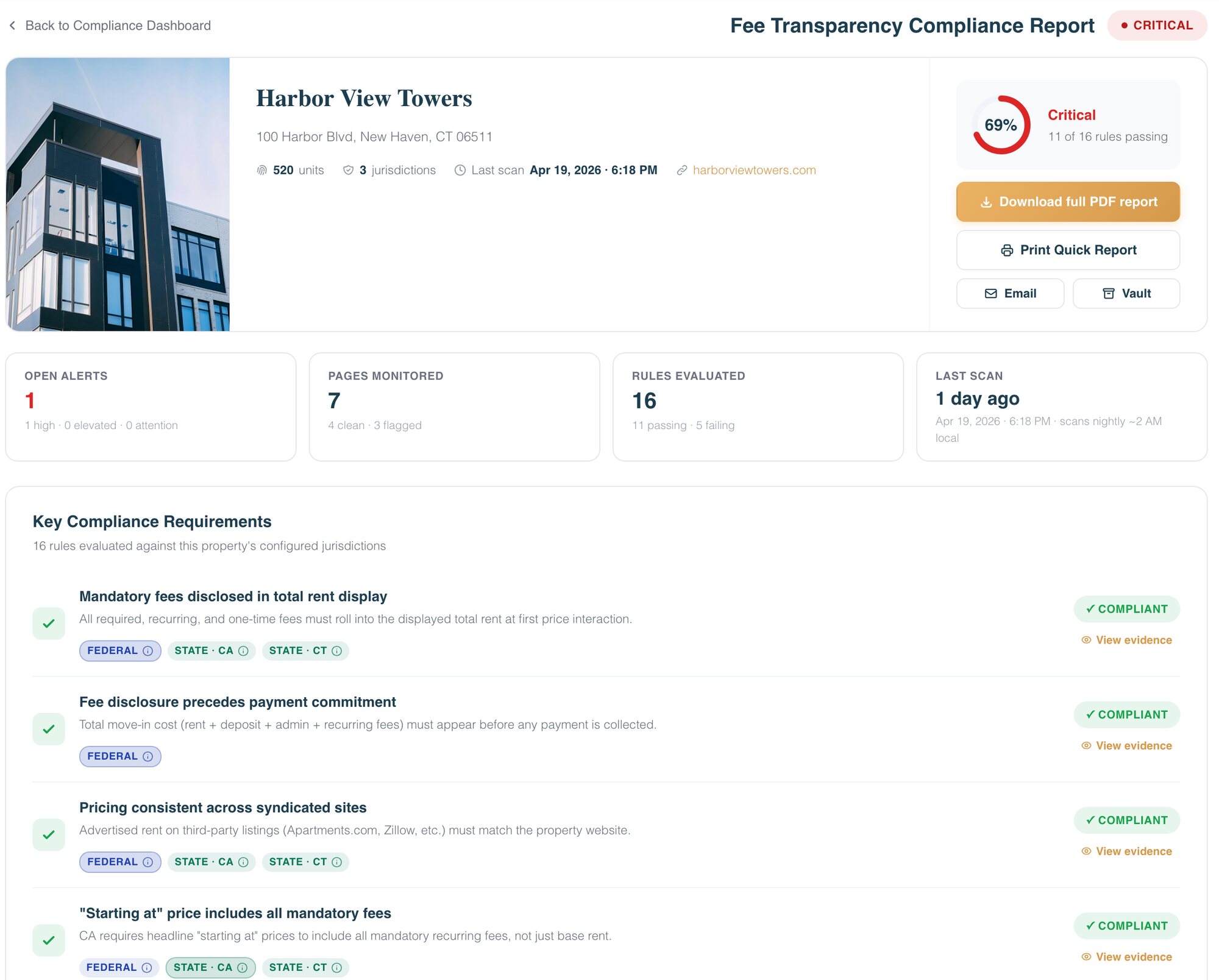
Fee Transparency in Compliance360 checks pricing, floor plan, unit listing and application pages every night against federal, state and city fee rules resolved for each property's address, and stores a timestamped capture with every finding. Listing Consistency catches the same fee drifting on ILS listings, and SiteArchiver keeps a dated record of what each pricing page said. It helps you find and fix gaps; it does not decide what the law requires for you.
Frequently asked questions
Not yet. The FTC published an advance notice of proposed rulemaking on rental housing fees on March 13, 2026, and comments closed April 13, 2026. Meanwhile it enforces fee disclosure under Section 5, as in Greystar and Invitation Homes.
Greystar agreed to pay $23 million to the FTC for consumer redress and $1 million to Colorado. The order requires the total monthly leasing price to be more prominent than base rent, and each fee's amount, purpose and mandatory status before payment.
It is the Greystar order's term for the full monthly price: base rent plus mandatory monthly fees. If every resident pays trash and technology fees, they belong in the total, shown more prominently than base rent.
No. The Rule on Unfair or Deceptive Fees, 16 CFR part 464, covers live-event tickets and short-term lodging such as hotels and vacation rentals. The FTC's rental notice asks whether to amend that rule or write a new one for rental housing.
The FTC has not said. As of October 22, 2026, no proposed rental fee rule appears in the Federal Register, and Section 18 requires a proposed rule, a comment period and a hearing opportunity before any final rule.
Yes, under their own consumer protection laws. In May 2026 Arizona's attorney general settled with Greystar under the Arizona Consumer Fraud Act over fees at two communities, and Colorado was co-plaintiff in the federal case.
How we checked this
Written by the Brynson Research Team and checked against the primary sources below. Each source shows the date we last read it. We update this page when the rules change; see the change log.
- Rule on Unfair or Deceptive Rental Housing Fee Practices (ANPRM, document 2026-04907), Federal Register, 2026-03-13. Accessed 2026-10-22.
- Unfair or Deceptive Rental Housing Fee Practices ANPRM, Project No. R207011 (full text), Federal Trade Commission, 2026-03. Accessed 2026-10-22.
- Docket FTC-2026-0266, Regulations.gov, 2026-03-13. Accessed 2026-10-22.
- Rule on Unfair or Deceptive Fees, 16 CFR part 464, eCFR, 2025-05-12. Accessed 2026-10-22.
- Trade Regulation Rule on Unfair or Deceptive Fees (final rule, document 2024-30293), Federal Register, 2025-01-10. Accessed 2026-10-22.
- 15 U.S.C. 57a, Unfair or deceptive acts or practices rulemaking proceedings, Legal Information Institute, Cornell Law School. Accessed 2026-10-22.
- Greystar Agrees to Pay $24 Million and Stop Deceptive Advertising Practices, Federal Trade Commission, 2025-12-02. Accessed 2026-10-22.
- FTC Sends Warning Letters to 13 Property Management Software Providers Nationwide, Federal Trade Commission, 2025-12-09. Accessed 2026-10-22.
- FTC Takes Action Against Invitation Homes for Deceiving Renters, Federal Trade Commission, 2024-09-24. Accessed 2026-10-22.
- Federal Trade Commission Announces Bipartisan Rule Banning Junk Ticket and Hotel Fees, Federal Trade Commission, 2024-12-17. Accessed 2026-10-22.
- FTC Submits Draft ANPRM Related to Rental Housing Fees for OMB Review, Federal Trade Commission, 2026-01-30. Accessed 2026-10-22.
- FTC Seeks Public Comment on Proposed Rulemaking Regarding Unfair or Deceptive Rental Housing Fee Practices, Federal Trade Commission, 2026-03-12. Accessed 2026-10-22.
- Do you have thoughts on rental fee-related regulations? Share them with the FTC, Federal Trade Commission, Business Blog, 2026-03-23. Accessed 2026-10-22.
- Attorney General Mayes Announces Settlements with Greystar over Hidden Rental Charges, Arizona Attorney General, 2026-05-13. Accessed 2026-10-22.
- Federal Register search: FTC proposed rules, Federal Register, 2026-10-22. Accessed 2026-10-22.
Change log
- First published.
This guide is general information, not legal advice. Laws and regulator guidance change; check the current rules for your properties with your counsel before acting.