
Multifamily Compliance Software RFP Template: Vendor Evaluation Checklist for Apartment Operators
For compliance, marketing and procurement leads at multifamily operators running a vendor process for website, listing and advertising compliance.
A multifamily compliance software RFP should test six things: which listing sites and pages a vendor monitors, including the application flow; whether it applies federal, state and city rules per property; how it limits false positives; how evidence is captured and verified; how fixes are confirmed; and what exports and reports cost.
- Attach a scope sheet of properties, surfaces, jurisdictions and owners so every vendor answers the same question.
- Ask 46 numbered questions in six sections and require a short answer to each.
- Score 0 to 3 per question, weight the sections, and drop any vendor that fails a must-have coverage or evidence question.
- Treat "our widget makes you compliant" and screenshot-only evidence as automatic zeros.
- Make every finalist demo on one of your own properties before you score it.
This guide is general information, not legal advice. Laws and regulator guidance change; check the current rules for your properties with your counsel before acting.
Before you send it: attach a scope sheet
If the RFP does not say which surfaces, jurisdictions and owners are in scope, every vendor describes the part it is good at. Attach these five items so answers are comparable.
| Attachment | What it contains |
|---|---|
| Property list | Name, street address, units, PMS code |
| Surface inventory | Website platform, ILSs per property, ad accounts, social pages, apply-flow vendor |
| Fee schedule sample | One property's full PMS fee list with mandatory and optional marked |
| Jurisdiction footprint | States and cities in the portfolio |
| Owners | Who fixes websites, ILS listings, ads and photos |
Keep ILS listings in scope even if your website is clean. In Brynson's analysis of 6,000 properties and 1.6M units, about 89% of communities described themselves differently across listing sites, so a website-only vendor misses most of the drift. Data: the apartment listing accuracy report. Settle surface owners first with the digital compliance program guide.
Section 1: coverage (7 questions)
Ask for names, page types and schedules; score anything vaguer as a zero.
| # | Question to ask | A good answer |
|---|---|---|
| C1 | Which listing sites do you pull our listings from, by name, and how often? | A named list and a schedule, such as nightly. "All major ILSs" is not an answer. |
| C2 | What do you compare each listing against: our PMS feed, our website or a manual entry? | The PMS feed as source of truth, field by field. |
| C3 | Which website pages do you scan: homepage, pricing, floor plan cards, unit pages, interactive map, fee guide? | Every page that carries a price or a fee, listed by page type. |
| C4 | Do you scan the application flow up to the first payment screen? | Yes, including embedded third-party flows, or where scanning stops. |
| C5 | Which ad and social channels do you read, and how do they connect? | Named channels, each marked connected or not per property. |
| C6 | Do you check listing photos against our originals? | Comparison with a registered original, not a standalone "looks edited" score. |
| C7 | How do you show us surfaces you are not watching? | Unmonitored surfaces reported per property, as visibly as violations. |
Test: ask each vendor to name the surfaces it would not watch at one of your properties.
Section 2: jurisdiction (6 questions)
Federal law sets the floor. HUD's rule at 24 CFR 100.75 makes it unlawful to publish any "notice, statement or advertisement" for the rental of a dwelling that "indicates any preference, limitation or discrimination because of race, color, religion, sex, handicap, familial status, or national origin," and it reaches "words, phrases, photographs, illustrations, symbols or forms." States and cities add classes on top: New York's Executive Law Section 296(5)(a)(3) bars ads that limit by "lawful source of income," which Section 292(36) defines to include Section 8 vouchers. See source of income laws by state.
| # | Question to ask | A good answer |
|---|---|---|
| J1 | How do you decide which rules apply to a property? | Resolved from the property address to federal, state and city layers, shown on each finding. |
| J2 | Show the rule set applied to one of our properties in each of our three busiest states. | A live screen, not a slide. |
| J3 | How do you handle a law's effective date? | The rule applies to affected properties from its effective date. |
| J4 | Who maintains the rule library, how often is it reviewed, and where is each rule's source cited? | A named owner, a cadence, and a primary-source link per rule. |
| J5 | Can we add our own disclosure language or internal policies as rules? | Yes, kept separate from legal rules and labelled as internal. |
| J6 | Give one example of a phrase you treat differently in two jurisdictions. | Source of income: flagged where protected, noted but not actionable elsewhere. |
Section 3: accuracy and human review (8 questions)
A tool that flags everything is as costly as one that flags nothing: reviewers stop reading.
| # | Question to ask | A good answer |
|---|---|---|
| A1 | How do you avoid false positives such as "master bedroom" or "wheelchair-accessible"? | Named guards and a phrase-in-context method, not a keyword list. |
| A2 | What does each flag carry? | Severity, rule basis, channel, page and a suggested fix or rewrite. |
| A3 | What is your false-positive rate on a sample of our listings, and how was it measured? | Measured on your data in the pilot, method stated. Not a sales-deck percentage. |
| A4 | Who makes the final call on a flag? | Your reviewer, with decision and name recorded. |
| A5 | Can we accept a known difference without it reappearing every night? | Ignore rules by item, period or date, kept in the audit trail. |
| A6 | How do you treat synonyms across ILS feeds, such as two names for the same amenity? | Mappings you control, so equivalents stop flagging. |
| A7 | Which checks are automated and which need a person? | A stated split, with a manual checklist for what automation cannot judge. |
| A8 | Does any output state that we are compliant? | No. Outputs are findings for review, never a statement that you are compliant. |
Section 4: evidence (8 questions)
Fee, accessibility and fair housing claims turn on what a page showed on a past date, often months ago.
The Federal Rules of Evidence give a useful target. Rule 902(13), added by the 2017 amendments, covers "a record generated by an electronic process or system that produces an accurate result," and Rule 902(14) covers "data copied from an electronic device, storage medium, or file, if authenticated by a process of digital identification." Both rest on a written statement from a qualified person. The 2017 Committee Note says copied data "are ordinarily authenticated by 'hash value'," hence E2, and hearsay and other objections remain open. Admissibility is for counsel; the RFP only tests whether the vendor's process could support such a statement.
| # | Question to ask | A good answer |
|---|---|---|
| E1 | How is a page captured: screenshot, PDF, HTML, or the rendered page with its resources? | The rendered page, replayable, not only an image. |
| E2 | How do you show a capture has not changed since it was made? | Hashing at capture, a chained ledger, and a verification step anyone can run. |
| E3 | Can we verify an exported evidence package without your software? | Yes, an offline check that fails if any file is edited. |
| E4 | As which visitors do you capture: desktop, mobile, a screen-reader user, a visitor who declined cookies? | Several named personas, captured at the same moment. |
| E5 | How often do you capture, and do you capture on change? | A fixed schedule plus capture on change for pricing and fee pages. |
| E6 | Can we prove a page never showed a phrase or fee over a period? | A prove-absence search that states coverage gaps rather than hiding them. |
| E7 | How do legal holds work, and who can release one? | Matter-based holds, chain of custody, and every export logged. |
| E8 | Who would supply a written statement about your capture process if counsel needs one? | A named role at the vendor and a sample of what they would provide. |
Retention periods and preservation duties are covered in apartment compliance evidence retention.
Section 5: remediation and reporting (7 questions)
The difference between a scanner and a compliance system is what happens after the flag.
| # | Question to ask | A good answer |
|---|---|---|
| R1 | When is an alert closed? | When the next scan agrees with the fix, not when someone clicks resolved. |
| R2 | What happens when a fixed issue returns? | The alert reopens and links to the earlier fix. |
| R3 | How are alerts ranked? | By exposure, with the formula shown, such as units, enforcement intensity, severity and age. |
| R4 | Can one fee drifting on an ILS and on our website be tracked as one issue? | Yes, one record across modules. |
| R5 | Who fixes listings on the ILS side, us or you? | A clear answer per channel and what is included in the fee. |
| R6 | What reports do leadership and owners receive, and can they be scheduled? | Scheduled property and portfolio reports that state what was not watched. |
| R7 | Can we export findings and history in open formats? | PDF, CSV and JSON or ZIP, without a services ticket. |
Section 6: integrations, security and pricing (10 questions)
Ask every vendor to answer the pricing block as one table so add-ons cannot hide in footnotes.
| # | Question to ask | A good answer |
|---|---|---|
| I1 | Which PMS platforms do you integrate with today, and how: API, feed or file? | Named platforms and the method, with a refresh schedule. |
| I2 | What happens when a feed goes stale? | Findings built on it are marked stale, and the owner is alerted. |
| I3 | Do you support SSO and role-based access by property? | Named identity providers and roles scoped to properties or regions. |
| I4 | Which independent security reports can you share under NDA? | Current reports, with dates, plus help with your security questionnaire. |
| I5 | Where is our data stored, and how is it returned or deleted at contract end? | Location stated, standard-format export, deletion window in writing. |
| I6 | Do you install anything on our websites? | No script or overlay is needed to find issues; fixes are made in the site itself. |
| # | Question to ask | A good answer |
|---|---|---|
| P1 | What is the pricing unit: per property, per unit, per service or per scan? | One stated unit you can multiply out for the whole portfolio. |
| P2 | Which of these cost extra: evidence exports, legal holds, extra ILS sources, report scheduling, API access, onboarding? | Each one priced or confirmed as included, in writing. |
| P3 | What does adding a property mid-term cost, and is it pro-rated? | A per-property rate and pro-rating rule. |
| P4 | If we leave, what does exporting our full evidence archive cost? | Nothing extra, or a fixed stated amount. |
8 red-flag vendor answers
Each of these answers should pull its question down to 0 or 1.
- 01
"Our widget makes your website compliant"
The FTC's April 2025 final order against accessiBe ($1 million) bars it from representing that its automated products can make any website WCAG-compliant unless it has evidence to support the claim. Score the same promise from anyone 0 on I6; see accessibility overlays.
- 02
"We confirm your listings are compliant"
No scan settles a legal question. Ask the vendor to put the promise in the contract's warranty section; if it will not, score the answer as marketing. You want findings with a rule basis and a recorded human decision (A8).
- 03
"Screenshots are available on request"
A screenshot cannot be replayed, carries no hash and rarely shows the right page on the right night. It fails E1 to E3 and offers none of the hash values the FRE 902(14) Committee Note describes.
- 04
"We cover your website" (and nothing else)
With about 89% of communities described differently across listing sites, website-only coverage scores 1 at best on C1 and C2.
- 05
"Our rules are nationwide"
The federal rule in 24 CFR 100.75 does not list source of income; New York's Executive Law 296(5)(a)(3) does. "No Section 8" means different things in Buffalo and under the federal rule alone. Ask for J2 live.
- 06
"Resolved means your team marked it fixed"
Without verification on re-scan (R1) and recurrence linking (R2), alert history shows activity, not results.
- 07
"Exports go through professional services"
Evidence that leaves only by ticket is not your evidence. Score P2 and P4 at 0 unless self-serve exports are included.
- 08
"Your states are on our roadmap"
A rule that is not live is not coverage. Score J4 at 0 for those states until it is live with a cited source, and put the date in the contract.
The weighted scoring sheet, with a worked example
Score every question 0 to 3: 0 no answer or a red flag, 1 partial, 2 meets the good answer, 3 meets it and was shown live on your property. Average each section, divide by 3 and multiply by its weight. Mark coverage questions C1 to C4 and evidence questions E2 and E3 as must-haves: a 0 on any of them removes the vendor whatever the total.
| Section | Weight |
|---|---|
| Coverage | 20 |
| Jurisdiction | 15 |
| Accuracy and review | 15 |
| Evidence | 20 |
| Remediation and reporting | 15 |
| Integrations and security | 10 |
| Pricing transparency | 5 |
| Section (weight) | Vendor A average | Vendor A weighted | Vendor B average | Vendor B weighted |
|---|---|---|---|---|
| Coverage (20) | 2.5 | 16.7 | 2.0 | 13.3 |
| Jurisdiction (15) | 1.0 | 5.0 | 2.5 | 12.5 |
| Accuracy and review (15) | 2.0 | 10.0 | 2.5 | 12.5 |
| Evidence (20) | 1.0 | 6.7 | 2.5 | 16.7 |
| Remediation and reporting (15) | 1.5 | 7.5 | 2.5 | 12.5 |
| Integrations and security (10) | 3.0 | 10.0 | 2.0 | 6.7 |
| Pricing transparency (5) | 2.0 | 3.3 | 1.5 | 2.5 |
| Total | 59.2 | 76.7 |
Vendor A gave the better demo and the smoother integration story, but scored 0 on E3 (no offline verification of exports), so it is out before totals are compared.
How to run the RFP in six steps
Use the question tables above as the body of the RFP. These steps keep the process comparable across vendors.
- 1
Build the scope sheet
List properties with addresses, every renter-facing surface per property, the jurisdictions in the portfolio and the owner of each surface. Attach it to the RFP.
- 2
Set weights and must-haves before reading answers
Agree section weights and the must-have questions with compliance, marketing and legal first, so no one adjusts weights to fit a favourite vendor.
- 3
Send the questions with a fixed answer format
Ask for a short answer per numbered question, C1 to P4, and the pricing block as one table. Free-form proposals are hard to score.
- 4
Require a live demo on your own property
Name one property in your busiest jurisdiction and ask each vendor to show coverage, a finding, its rule basis and an evidence export on it.
- 5
Score independently, then compare
Each scorer fills the sheet alone, then the group reconciles gaps of more than one point on any question.
- 6
Pilot the finalist on a small set of properties
Run it on a few properties for one cycle, count false positives with your reviewer, and test one export with counsel before signing.
How Compliance360 answers this RFP
Brynson's own product, described only from its published pages. Score it on the same sheet.
| Section | What Compliance360 does |
|---|---|
| Coverage | Listing Consistency compares five sources (Apartments.com, Apartment List, Zillow, Zumper and HelloData) with your PMS feed nightly. Fee Transparency checks every priced page, including the application flow, nightly. Fair Housing reads ILS, website, Google, Meta and social copy where connected. Web Accessibility scans key pages and the application flow against WCAG 2.1 AA by default. FrameCheck registers each photo against your original. |
| Jurisdiction | City, state and federal rules resolved per property, applied from each rule's effective date, plus your own disclosure rules. |
| Accuracy and review | Guards for phrases like "master bedroom"; a rule basis and a suggested compliant rewrite on every flag; a person decides. Every output is a flag for review, never a statement that you are compliant. |
| Evidence | SiteArchiver captures pages daily and on change, as six personas, on a hash-chained ledger, with replay, legal holds and offline-verifiable exports. |
| Remediation and reporting | The Resolution Center closes Fee Transparency and Listing Consistency alerts only when a re-scan agrees and links recurrences. Monthly compliance updates per property (reporting). |
| Integrations and security | Yardi, Entrata, RealPage and more feed the rules (integrations). Security: see the trust page and ask for current reports. |
| Pricing | Set by number of properties and services chosen (pricing). We will fill in the pricing block like any vendor. |
Brynson works with Apartments.com, Apartment List, Zillow and Zumper as partners. Brynson powers 1 in 20 U.S. apartment communities.
Compliance360 is built to answer every section of this RFP from one suite: Fair Housing, Fee Transparency, Listing Consistency, Web Accessibility, FrameCheck and SiteArchiver share one property list, one jurisdiction resolution and one audit trail. ILS spend and packages sit in a separate Brynson product, ILS Management™.
You are buying for one surface only
Use the matching section of this RFP plus the evidence and pricing blocks, and compare point tools in apartment marketing compliance tools.
You are still sizing the problem
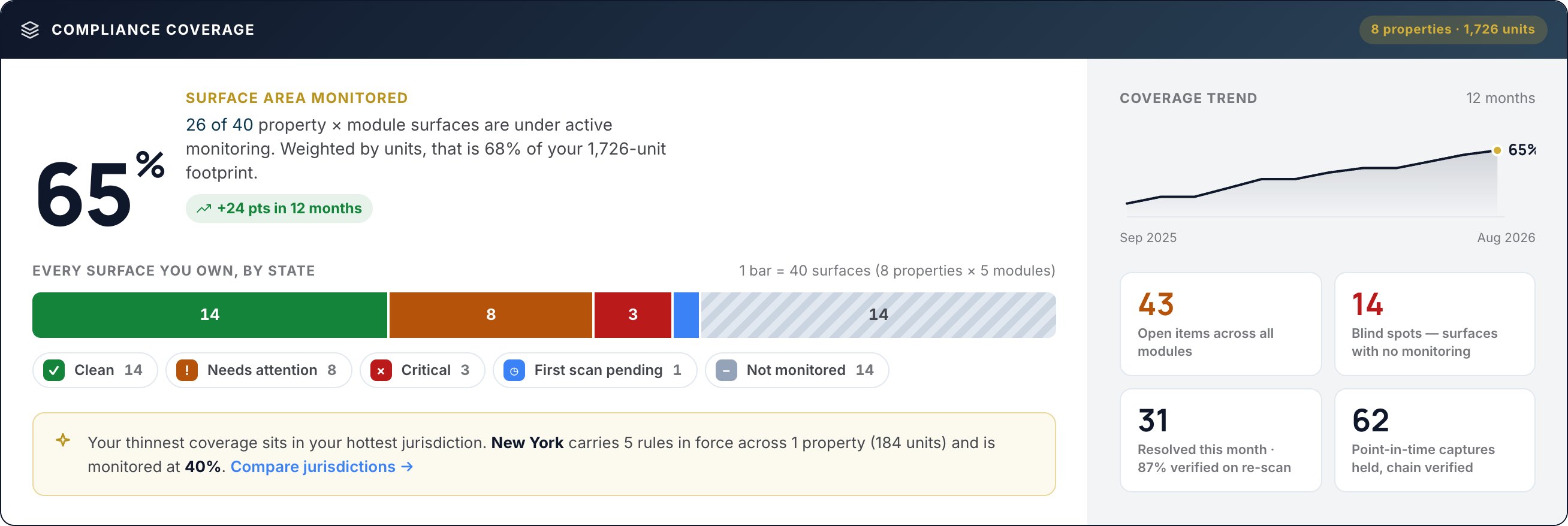
Score your own portfolio on the surface by rule grid in multifamily compliance software before writing the RFP.
Frequently asked questions
A scope sheet of properties, surfaces, jurisdictions and owners; numbered questions on coverage, jurisdiction, accuracy, evidence, remediation, integrations and pricing; a fixed answer format; and the scoring method. Publishing weights and must-haves tells vendors what matters.
Ask which pages it checks, including floor plan cards, the map and the application flow before payment; which state and city fee rules it applies per property; whether it compares fees across the website and each ILS; and what evidence it keeps. Test it on your own fee schedule.
Fix weights and must-haves before reading proposals, require one answer format, and have each scorer work alone first. A live demo on your own property closes the gap between deck and product.
Expect one stated unit, per property, per unit or per service, that you can multiply across the portfolio. Ask in writing whether exports, legal holds, extra listing sources, scheduled reports, API access and onboarding are included, and what leaving with your archive costs.
Yes, on a few properties for at least one scan cycle. Count false positives with your reviewer, follow one finding through re-scan verification, and have counsel review one evidence export.
How we checked this
Written by the Brynson Research Team and checked against the primary sources below. Each source shows the date we last read it. We update this page when the rules change; see the change log.
- 24 CFR 100.75, Discriminatory advertisements, statements and notices, U.S. Code of Federal Regulations (via Cornell LII). Accessed 2026-10-22.
- Federal Rules of Evidence, Rule 902: Evidence That Is Self-Authenticating, Cornell Legal Information Institute, 2017 amendments add (13) and (14). Accessed 2026-10-22.
- New York Executive Law Section 296: Unlawful discriminatory practices, New York State Senate. Accessed 2026-10-22.
- New York Executive Law Section 292: Definitions (subdivision 36, lawful source of income), New York State Senate. Accessed 2026-10-22.
- FTC Approves Final Order Requiring accessiBe to Pay $1 Million, Federal Trade Commission, 2025-04-22. Accessed 2026-10-22.
Change log
- First published.
This guide is general information, not legal advice. Laws and regulator guidance change; check the current rules for your properties with your counsel before acting.