Compliance Operations and Buying Guides

For operators treating renter-facing compliance as a system: software categories, suite vs point tools, evidence, exposure, RFPs and who owns what.

6 guides · Written for multifamily operators · Updated October 22, 2026

Start hereFramework Property Management Compliance Software for Multifamily: A Buyer's Map of the Five Categories for Apartment OperatorsProperty management compliance software for multifamily falls into five categories: affordable housing certification (LIHTC, HUD, USDA), building and safety violation tracking, vendor insurance (COI) tracking, leasing and fair housing process workflow, and digital advertising compliance. The fifth checks what renters see: advertised fees, fair housing language, website accessibility, listing accuracy and photos. Only that one reads the published page.
  • Ask a vendor which of the five categories it sells before you compare features; most demos only cover one.
  • Affordable housing tools verify tenant eligibility and report to agencies; they do not read your Zillow listing or your pricing page.
  • Digital advertising compliance is a grid of five surfaces against five rule sets, scored per property.
Read the guide
Comparison10 min readFair Housing and Fee Compliance Software for Property Managers: Compliance360 and Point Tools Compared for MultifamilyProperty managers can buy one compliance suite or stitch together point tools. Compliance360 checks fees, fair housing language, listing consistency, accessibility and property images per property and archives what renters saw on one audit trail. Point tools are strong in single areas, but most fee and fair housing products display or route content rather than audit it.Read the guide Reference table12 min readHow Long to Keep Apartment Advertising Records, and How to Prove What Renters Saw: A Multifamily Evidence GuideKeep apartment advertising evidence for at least three years after a page or ad changes, and longer under any dispute. Fair housing complaints can reach HUD within one year and court within two, with HUD proceeding time excluded; FTC Section 19 redress actions have a three-year limit. Keep pages as renters saw them, including the application flow, dated and hash-verified.Read the guide Reference table12 min readFair Housing, ADA and Fee Violation Fines for Apartment Operators: The 2026 Multifamily Penalty and Settlement TableFederal ceilings for 2026 are unchanged from 2025: a HUD administrative law judge can impose $26,262 for a first Fair Housing Act violation and $131,308 with two priors, and DOJ can seek $118,225 for a first ADA Title III violation. Refunds cost more: Invitation Homes paid $48 million and Greystar $24 million in FTC fee settlements.Read the guide Checklist12 min readMultifamily Compliance Software RFP Template: Vendor Evaluation Checklist for Apartment OperatorsA multifamily compliance software RFP should test six things: which listing sites and pages a vendor monitors, including the application flow; whether it applies federal, state and city rules per property; how it limits false positives; how evidence is captured and verified; how fixes are confirmed; and what exports and reports cost.Read the guide How-to9 min readMultifamily Compliance Program for Apartment Marketing: Owners, Cadence and a RACI TemplateA multifamily compliance program for marketing has four parts: an inventory of every surface renters see, a named owner for each rule on each surface, a review cadence, and a record of every fix. Marketing usually owns the content, compliance owns the rules, legal owns the evidence and operations owns the fee data in the PMS.Read the guide
Put it into practice

Compliance360

For operators treating renter-facing compliance as a system: software categories, suite vs point tools, evidence, exposure, RFPs and who owns what.

Explore Compliance360
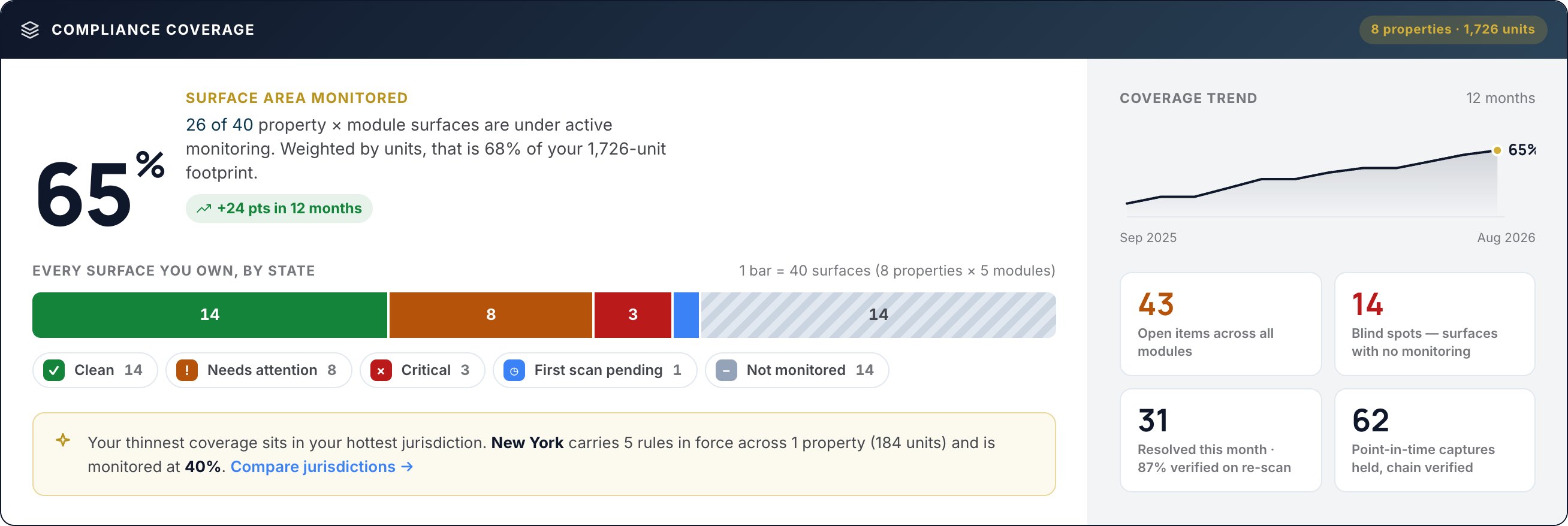
Compliance360 coverage view: surfaces under active monitoring by property and module