
ADA Website Compliance for Apartment and Multifamily Websites: What the Law Requires in 2026
For marketing, leasing, compliance and legal leads at multifamily operators.
Yes, in practice. The Justice Department treats a rental office as a public accommodation under ADA Title III, and courts apply Title III to websites that connect renters to that office. No federal rule sets a technical standard for private housing sites, so WCAG 2.1 Level AA is the working benchmark, and 2.2 AA is the safer build target.
- You answer for vendor-built sites and applications: Title III reaches discrimination "directly, or through contractual, licensing, or other arrangements."
- The 2024 Title II rule requires WCAG 2.1 AA of governments and their contractors, with deadlines moved in April 2026 to April 26, 2027 and April 26, 2028.
- The Fair Housing Act, Section 504 for HUD-assisted properties and California's Unruh Act, with its $4,000 damages floor, add separate exposure.
- No tool, overlay or audit can declare a site compliant; a dated record of testing, fixes and manual review is what you can show.
This guide is general information, not legal advice. Laws and regulator guidance change; check the current rules for your properties with your counsel before acting.
The short answer for operators
Yes. In 1992 the Justice Department wrote that "an office that is used for rental transactions with the public is a public accommodation under the ADA, regardless of the extent of actual use by the public" (DOJ technical assistance letter). Its web guidance says the ADA's requirements "apply to all the goods, services, privileges, or activities offered by public accommodations, including those offered on the web." The property website is that office's front door: renters check availability, book tours and apply there.
What is missing is a technical rule. The same guidance says the Department "does not have a regulation setting out detailed standards" for businesses, so the yardstick in practice is WCAG 2.1 Level AA: the level DOJ wrote into its 2024 rule for state and local governments (28 CFR 35.200), and the only web standard it has adopted under the ADA.
Why apartment websites fall under ADA Title III
| Link in the chain | What the text says | Source |
|---|---|---|
| The leasing office is a covered place | The regulation lists "other sales or rental establishment"; DOJ applied it to rental offices in 1992. | 28 CFR 36.104; DOJ letter |
| The operator is a covered person | Title III binds "any person who owns, leases (or leases to), or operates a place of public accommodation." | 42 U.S.C. 12182(a) |
| The website is part of the service | The Ninth Circuit held the ADA applies to a website and app that "connect customers to the goods and services" of a physical location, calling that nexus "critical to our analysis." | Robles v. Domino’s, 9th Cir. 2019 |
Courts split on the last link. Robles left open sites whose barriers do not block access to a physical place. Seyfarth Shaw reports that in California both federal and state appellate courts have held online-only businesses are not covered, while the Second Circuit (New York) has not decided (Seyfarth, via JD Supra, March 2026).
For operators the split rarely helps: a site that sells tours and leases for a building with a leasing office is the textbook nexus. Treat it as covered.
You answer for what your vendors build
Agencies, the PMS, screening companies and chat vendors build most of a property website. Title III makes it discriminatory to deny a person the opportunity to benefit from your services "directly, or through contractual, licensing, or other arrangements" (42 U.S.C. 12182(b)(1)(A)(i)). A vendor-built application flow is still your application flow.
| Surface | Usually built by | What to put in writing |
|---|---|---|
| Property marketing site | Website vendor or agency | Named WCAG target, pre-release testing, a fix window |
| Availability, pricing and floor plan widget | PMS or website vendor | Keyboard and screen reader support; plan details as text |
| Online application and payment | PMS or screening vendor | A current Accessibility Conformance Report and a barrier contact |
| Tour scheduler, chat or AI leasing assistant | Third-party widget | Keyboard operation, no focus traps, a non-chat route |
If you cannot see test results for a surface, you do not know its state.
Which standard: WCAG 2.1 AA, and where 2.2 fits
The DOJ guidance (March 18, 2022) says businesses "have flexibility in how they comply," and points to WCAG and the Section 508 Standards as "helpful guidance" (ada.gov).
WCAG 2.2 (a W3C Recommendation since October 5, 2023, updated December 12, 2024) adds nine success criteria, six of them at Level A or AA. W3C states that "content that conforms to WCAG 2.2 also conforms to WCAG 2.0 and WCAG 2.1" (WCAG 2.2). It removed 4.1.1 Parsing, which teams reporting against 2.1 "may need to continue to test and report." So 2.2 AA also covers 2.1 AA. Where the A and AA additions bite:
| Criterion | Level | Where it bites on an apartment site |
|---|---|---|
| 2.4.11 Focus Not Obscured (Minimum) | AA | A sticky "Schedule a tour" bar or cookie banner hides the field a keyboard user just moved to |
| 2.5.7 Dragging Movements | AA | Price-range sliders and draggable site maps with no tap or click alternative |
| 2.5.8 Target Size (Minimum) | AA | Tiny gallery arrows and floor plan filter chips on mobile |
| 3.3.8 Accessible Authentication (Minimum) | AA | Resident portal logins that block paste or password managers, or make residents solve a text puzzle to sign in |
| 3.2.6 Consistent Help | A | The leasing office phone, chat or contact link moves around from page to page |
| 3.3.7 Redundant Entry | A | Applications that ask for the same current address on step two and step five |
Source: W3C, What’s New in WCAG 2.2. Our recommendation: build and test to 2.2 AA, and report against 2.1 AA where a contract or rule names it. The full mapping is in WCAG 2.2 for apartment websites.
Eight places apartment websites fail WCAG, and the test for each
Each names the success criterion and a test your team can run without a tool.
- 01
Photo galleries with no text alternative
WCAG 1.1.1 Non-text Content (A). Test: swipe through the gallery with VoiceOver or NVDA. Each photo should say what it shows ("Kitchen in plan B2 with gas range"), not a file name. Floor plans need beds, baths and size in real text too; see accessible floor plans and photo galleries.
- 02
Availability filters built from divs
WCAG 2.1.1 Keyboard and 4.1.2 Name, Role, Value (A). Filters built as clickable boxes are skipped by keyboards and unnamed by screen readers. Test: Tab through the filters; each must take focus and announce its name and state.
- 03
The "Apply now" button and the application flow
WCAG 2.1.1, 3.3.1 Error Identification, 3.3.2 Labels or Instructions and 2.2.1 Timing Adjustable (A). This is where a barrier stops a lease. Test: complete the application keyboard-only, leave a required field empty and submit, then wait on a step to see whether a timeout warns you and lets you extend. The full test plan is in accessible rental applications.
- 04
Brand colors on text and buttons
WCAG 1.4.3 Contrast (Minimum) and 1.4.11 Non-text Contrast (AA). Body text needs 4.5:1 against its background, large text 3:1. Pale gold, gray-on-white and text over hero photos are the usual failures. Test: check every brand color pair once, then lock passing pairs into the theme.
- 05
Interactive site maps and dragging
WCAG 2.1.1 Keyboard (A) and, in 2.2, 2.5.7 Dragging Movements (AA). Drag-to-pan site maps exclude keyboard and switch users. Test: select every available unit without a mouse. A plain list of available units beside the map is the simplest fix.
- 06
Video and virtual tours
WCAG 1.2.2 Captions (Prerecorded) (A) and 1.2.5 Audio Description (Prerecorded) (AA). Walkthroughs need accurate captions and a description of what the narration leaves out. Test: watch with sound off, then listen with the screen off.
- 07
Tour schedulers, chat and AI leasing assistants
WCAG 2.1.2 No Keyboard Trap, 2.4.3 Focus Order (A) and 2.4.7 Focus Visible (AA). Third-party widgets often trap focus or lose it behind the page. Test: open, use and close the widget by keyboard; focus should return where you started, visibly.
- 08
PDF brochures, fee schedules and policies
PDFs count. The Title II rule treats PDFs a public entity posts as web content that must meet WCAG 2.1 AA, older files excepted (ada.gov), a fair guide for any site. A scanned fee schedule is an image to a screen reader. Test: try to select the text. If you cannot, publish it as an HTML page, which also helps fee disclosure (rental junk fee laws by state).
The Title II rule: who it reaches and the 2026 extension
The 2024 rule is the only ADA regulation that names a web standard, and it reaches operators who work for governments.
| Point | Detail | Source |
|---|---|---|
| Who it covers | State and local governments, their agencies and special districts | ada.gov rule summary |
| Contractors | "State and local governments that contract with other entities to provide public services for them ... also have to make sure that their contractors follow Title II." | ada.gov rule summary |
| Standard | WCAG 2.1 Level A and AA success criteria and conformance requirements | 28 CFR 35.200 |
| Exceptions | Five: archived web content, preexisting conventional electronic documents, third-party content posted without a contractual arrangement, individualized password-protected documents, preexisting social media posts | ada.gov rule summary |
| Deadline, population 50,000 or more | April 26, 2027 (was April 24, 2026) | Interim final rule, 91 FR 20902, April 20, 2026 |
| Deadline, under 50,000 and special districts | April 26, 2028 (was April 26, 2027) | Interim final rule |
If you manage property or run web services for a housing authority or city, expect Title II in the contract: tag those properties and hold their sites to 2.1 AA on the agency's schedule. As of October 22, 2026 the eCFR shows these dates, and no later Federal Register rule has changed them.
Fair Housing Act, Section 504 and California's Unruh Act
Fair Housing Act
The FHA makes it unlawful to refuse "reasonable accommodations in rules, policies, practices, or services, when such accommodations may be necessary to afford such person equal opportunity" (42 U.S.C. 3604(f)(3)(B)). The United African Asian Abilities Club filed "largely boilerplate" FHA suits, mainly in Los Angeles and Southern California, over "accessibility conditions at the apartment property and/or website." Stuart Tubis of JMBM, writing for defendants, noted that "the Fair Housing Act has not yet been interpreted as requiring website accessibility to our knowledge" (JMBM, February 2023). Either way, offer and log another way to apply.
Section 504 for HUD-assisted properties
Recipients of HUD financial assistance "shall take appropriate steps to ensure effective communication with applicants, beneficiaries, and members of the public" (24 CFR 8.6). HUD's 2023 advance notice said a coming proposed rule would clarify how recipients account for advances in "information and communication technology" (88 FR 24938, April 25, 2023). No proposed rule had followed by October 22, 2026; the existing duty applies now.
California Unruh Civil Rights Act
"A violation of the right of any individual under the federal Americans with Disabilities Act ... shall also constitute a violation of this section" (Civ. Code 51(f)), and damages are "in no case less than four thousand dollars ($4,000)" (Civ. Code 52(a)). Only 4 federal website suits were filed in California in 2025, but Seyfarth reports a significant number of state court suits and demand letters, which its federal count excludes.
Which law reaches which part of your site
"Likely" means courts or regulators point this way, not that the question is settled.
| Surface | ADA Title III | Title II rule | FHA and Section 504 | Unruh (CA) | Source |
|---|---|---|---|---|---|
| Property site, availability and floor plans | Likely, through the leasing office | Only for a public entity | FHA pleaded; 504 if HUD-assisted | Yes, via 51(f) | Robles; DOJ letter; Civ. 51 |
| Online application and payment | Likely, vendor-built included | Only for a public entity | Accommodation duty applies | Yes | 12182(b)(1)(A); 3604(f)(3)(B) |
| Resident portal | Unsettled: residents, not public | Only for a public entity | Accommodation duty applies | Unsettled | 3604(f) |
| ILS listing | Listing site operates it; you own content | No | Content matters for FHA ads | Listing site's exposure | Quezada v. CoStar; 3604(c) |
| Site run for a housing authority or city | Also applies | Yes, via contract, agency deadline | 504 likely if federally funded | Yes in CA | ada.gov; IFR |
| HUD-assisted property site | Likely covered | No, unless also public | 504 applies | Yes in CA | 24 CFR 8.6 |
The ILS copy of your property is a separate surface: Brynson's analysis of 6,000 properties and 1.6 million units found about 89% of communities described themselves differently across listing sites (listing accuracy report). Fix alt text and copy at the source.
Lawsuits, in two lines
Federal courts received 3,117 website accessibility suits in 2025, up 27% from 2,452, led by New York (1,021), Florida (961) and Illinois (585) (Seyfarth). Housing is not exempt: a blind New Yorker sued CoStar over Apartments.com in May 2021 (Bisnow).
What to do when a letter arrives is in the apartment website ADA demand letter guide.
What "compliant" can and cannot mean
No agency signs off on a private website. W3C says evaluation tools "can not determine accessibility, they can only assist in doing so" (W3C WAI). In April 2025 the FTC approved a final order requiring accessiBe to pay $1 million over claims its widget could "make any website compliant" with WCAG, and over undisclosed ties to reviewers (FTC). More in accessibility overlays on apartment websites.
What you can show is a record. W3C says an accessibility statement should at least state your commitment, the standard you target and a contact for reporting problems (W3C WAI). Behind it, keep dated evidence of testing and fixes.
| Item | Entry |
|---|---|
| Scope | Key pages, tour scheduler, application steps 1 to 6 |
| Target | WCAG 2.2 AA, reported against 2.1 AA |
| Automated findings | 38 open at start of quarter, 9 at end; 4 regressions after a theme update, all fixed within 10 days |
| Manual review | Keyboard-only application completed; screen reader pass on gallery; 12 alt texts rewritten |
| Alternative channel | Phone and in-person application offered on the accessibility statement; 2 requests logged and fulfilled |
Start with the apartment website accessibility checklist, then compare tools in website accessibility tools for property management.
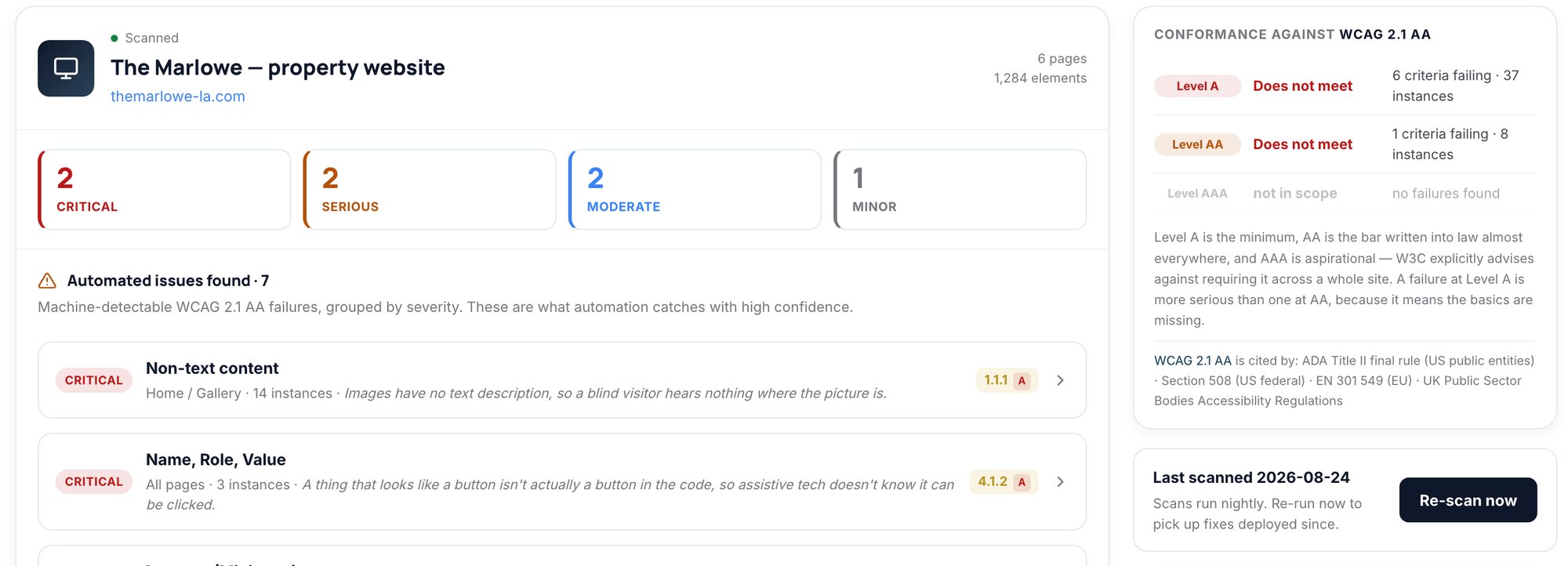
Compliance360 Web Accessibility reviews each property's key pages and application flow against WCAG 2.1 AA by default (or 2.2 AA, Level A only or AAA), explains every finding with where it is and how to fix it, and adds a manual review checklist for the criteria automation cannot judge. Nightly re-scans, scan history and a dated audit record build the ongoing-review record this guide describes, and SiteArchiver keeps point-in-time captures of how a page worked on a given date. It is a review aid, not a legal determination. See Web Accessibility or the full Compliance360 suite.
Frequently asked questions
In practice, yes. DOJ treats a rental office as a Title III public accommodation, and the Ninth Circuit in Robles v. Domino's applied Title III to a website tied to a physical location. A site selling tours and applications for a building with a leasing office fits that pattern.
No. DOJ says it "does not have a regulation setting out detailed standards" for businesses. WCAG 2.1 Level AA is the working benchmark because it is the level DOJ adopted for state and local government websites in 2024.
Not directly. It binds state and local governments, which must make sure their contractors follow Title II. If you manage property for a housing authority or city, expect WCAG 2.1 AA in the contract on the agency's 2027 or 2028 deadline.
You are, at least in part. Title III covers discrimination carried out directly or through contractual or other arrangements, so a vendor-built application is still your service. Write a WCAG target and fix window into each vendor contract.
Plaintiffs have filed such suits in Southern California, though defense-side counsel note the FHA has not been read to require website accessibility. The FHA's accommodation duty does cover your leasing process, so publish and log another way to apply.
No. W3C says evaluation tools can only assist in determining accessibility, and in 2025 the FTC ordered accessiBe to pay $1 million over claims its widget could make any website WCAG compliant. What you can show is a dated record of scans, manual review and fixes.
How we checked this
Written by the Brynson Research Team and checked against the primary sources below. Each source shows the date we last read it. We update this page when the rules change; see the change log.
- Technical assistance letter: rental office as a public accommodation, U.S. Department of Justice, Civil Rights Division, 1992-10-20. Accessed 2026-10-22.
- 42 U.S.C. 12182, Prohibition of discrimination by public accommodations, Legal Information Institute, Cornell Law School. Accessed 2026-10-22.
- 28 CFR 36.104, Definitions (place of public accommodation), Legal Information Institute, Cornell Law School. Accessed 2026-10-22.
- Guidance on Web Accessibility and the ADA, U.S. Department of Justice, ada.gov, 2022-03-18. Accessed 2026-10-22.
- Web accessibility rule for state and local governments, U.S. Department of Justice, ada.gov. Accessed 2026-10-22.
- Extension of Compliance Dates for Nondiscrimination on the Basis of Disability; Accessibility of Web Information and Services of State and Local Government Entities (interim final rule), 91 FR 20902, Federal Register, U.S. Department of Justice, 2026-04-20. Accessed 2026-10-22.
- 28 CFR 35.200, Requirements for web and mobile accessibility, Electronic Code of Federal Regulations. Accessed 2026-10-22.
- Robles v. Domino's Pizza, LLC, No. 17-55504, U.S. Court of Appeals for the Ninth Circuit, 2019-01-15. Accessed 2026-10-22.
- 42 U.S.C. 3604, Discrimination in the sale or rental of housing, Legal Information Institute, Cornell Law School. Accessed 2026-10-22.
- 24 CFR 8.6, Communications, Electronic Code of Federal Regulations. Accessed 2026-10-22.
- Nondiscrimination on the Basis of Disability: Updates to HUD's Section 504 Regulations (ANPRM), 88 FR 24938, Federal Register, U.S. Department of Housing and Urban Development, 2023-04-25. Accessed 2026-10-22.
- California Civil Code section 51, FindLaw (statute text). Accessed 2026-10-22.
- California Civil Code section 52, FindLaw (statute text). Accessed 2026-10-22.
- Web Content Accessibility Guidelines (WCAG) 2.1, W3C. Accessed 2026-10-22.
- Web Content Accessibility Guidelines (WCAG) 2.2, W3C, 2024-12-12. Accessed 2026-10-22.
- Understanding SC 3.3.8: Accessible Authentication (Minimum), W3C Web Accessibility Initiative. Accessed 2026-10-22.
- What's New in WCAG 2.2, W3C Web Accessibility Initiative. Accessed 2026-10-22.
- Selecting Web Accessibility Evaluation Tools, W3C Web Accessibility Initiative. Accessed 2026-10-22.
- Developing an Accessibility Statement, W3C Web Accessibility Initiative. Accessed 2026-10-22.
- FTC Approves Final Order Requiring accessiBe to Pay $1 Million, Federal Trade Commission, 2025-04-22. Accessed 2026-10-22.
- Federal Court Website Accessibility Lawsuits in 2025, Seyfarth Shaw LLP, via JD Supra, 2026-03-27. Accessed 2026-10-22.
- United African Asian Abilities Club Through David Wakefield Sue Apartment Buildings: How to Respond, Jeffer Mangels Butler & Mitchell LLP (Stuart Tubis), 2023-02-23. Accessed 2026-10-22.
- CoStar sued over lack of blind accessibility on Apartments.com, Bisnow, 2021-05-11. Accessed 2026-10-22.
Change log
- First published.
This guide is general information, not legal advice. Laws and regulator guidance change; check the current rules for your properties with your counsel before acting.