
Apartment Listing Accuracy Report: Nearly 9 in 10 Multifamily Communities Describe Themselves Differently Across Listing Sites
For marketing, leasing, revenue and compliance leads at multifamily operators.
Apartment listings are inaccurate far more often than operators assume. In a Brynson analysis of 6,000 communities and 1.6 million units, nearly 89% described themselves differently depending on which listing site a renter visited. Although 97% of listings had been updated within the previous 90 days, conflicting mandatory fees, missing amenities and contradictory terms persisted.
- Nearly 89% of the 6,000 communities analyzed, measured at origination, did not present themselves the same way on every listing site.
- Recency is not accuracy: 97% of listings had been refreshed in the prior 90 days and the conflicts were still there.
- The conflicts that matter most are mandatory fees, amenities and lease terms, because they change what a renter expects to pay and get.
- A fee on an ILS that differs from what you charge is a fee-disclosure problem, not only a marketing one.
- The fix is a field-by-field comparison against the PMS on every site, repeated after each sync until the listing agrees.
This guide is general information, not legal advice. Laws and regulator guidance change; check the current rules for your properties with your counsel before acting.
Key findings
Brynson analyzed 6,000 properties and 1.6 million units across its platform, which powers 1 in 20 U.S. apartment communities and serves professionally managed portfolios. The figures below are quoted exactly as published in Brynson's October 22, 2026 announcement.
| Finding | Exact published wording | What it means in practice |
|---|---|---|
| Inconsistency rate | At origination, nearly 89% of apartment communities described themselves differently depending on which listing site a renter visited. | If you run ten communities, the base rate says about nine describe themselves differently on at least one listing site until you have checked. |
| Recency | 97% of listings had been updated within the previous 90 days. | A recent "last updated" date on an ILS dashboard tells you the feed is flowing. It does not tell you the listing agrees with your PMS. |
| What conflicted | Properties routinely displayed conflicting mandatory fees, missing amenities, and contradictory terms across channels. | The three categories that change a renter's expected total cost and the deal they think they are signing. |
| Consequence | Creating compliance exposure while undercutting their marketing spend. | The same mismatch is a disclosure risk and a paid lead that walks at the tour. |
The 89% figure is published as an "at origination" measurement. Quote it with that qualifier, and do not present it as the share of listings still wrong after monitoring or correction.
Methodology: what was compared
The analysis grew out of Brynson's ILS Management™ work. To measure marketing performance across portals such as Zillow, Apartments.com, Apartment List and Zumper, Brynson ingests the raw listing feeds for each community. Brynson works with these ILSs as partners. Comparing those feeds exposed the contradictions reported here: identical units advertising different application fees on different portals, duplicate copy reused across properties in different states, and photos showing amenities the listing text never mentioned.
| Parameter | Value |
|---|---|
| Unit of analysis | Apartment community (property), 6,000 in total |
| Units covered | 1.6 million apartment units |
| Point in time | At origination |
| Conflicts reported | Mandatory fees (including application fees), amenities and terms; also duplicate copy across properties and photos showing amenities the text omitted |
| Recency measure | Share of listings updated within the previous 90 days (97%) |
The published figures are portfolio-level. They do not break the 89% down by field or by listing site, so use them as a base rate for your own portfolio check, not as a forecast of which field will be wrong at a given community.
Where apartment listings disagree
These are the fields where a mismatch changes a renter's decision or your exposure. The right-hand column is the question to ask when you find one.
| Field | Typical drift | Who it hurts | Question to ask |
|---|---|---|---|
| Mandatory fees (admin, application, trash, amenity, tech) | Fee changed in the PMS but not on one portal; a portal shows a fee you dropped | Compliance, leasing | Does every site show the fee you actually charge today? |
| Rent range | Range cached from a past pricing run; specials left live after they end | Revenue, leasing | Is the low end of the range rentable at that price now? |
| Amenities | Same amenity named differently, or missing on one site | Marketing, search visibility | Would a renter filtering for this amenity find you on every site? |
| Lease terms | Term lengths, short-term premiums or move-in dates differ | Leasing, compliance | Is the deal on the listing the deal your agent will quote? |
| Pet policy | Breed, weight or pet-fee details out of date on one portal | Leasing | Does the pet rent match the fee schedule? |
| Floor plans and units | A plan missing on one site; unit counts that disagree | Marketing, revenue | Is any inventory invisible on a site you pay for? |
| Photos | Old photo sets, or photos of amenities the text omits | Marketing, compliance | Is every photo current, and disclosed if it was edited? |
For the field-by-field audit procedure, see the ILS listing audit. For photo rules, see the listing photo policy template.
Seven ways an apartment listing drifts after it syndicates
Seven mechanisms produce the conflicts described above. Two of them, reused copy and photos that contradict the text, were observed directly in Brynson's feed analysis. Each comes with a test you can run this week.
- 01
A fee changes in the PMS but not on every portal
A new admin or trash fee goes into the fee schedule, the website is updated, and one portal keeps the old value. Test: export the fee schedule and check each mandatory fee on every site where the community is listed.
- 02
A dashboard override outlives its purpose
Someone typed a special or a rent range straight into a portal during lease-up. The PMS moved on; the override did not. Test: ask each portal account owner for a list of manually edited fields.
- 03
The same amenity gets a different name
Each portal has its own amenity taxonomy, so one PMS amenity lands as several names. Test: list amenities side by side and sort each difference into synonym, real gap or wording you would not approve.
- 04
A floor plan or unit type drops off
A plan with no current availability can disappear from one site and never come back. Test: count floor plans per site against the PMS; any shortfall is inventory renters cannot find.
- 05
Copy is reused across properties
Brynson's feed analysis found duplicate copy reused across properties in different states. Copy written for one market can carry terms, amenities or fair housing wording that are wrong elsewhere. Test: search a distinctive sentence from each description across your portfolio.
- 06
Photos and text disagree
Brynson's feed analysis found photos showing amenities the listing text never mentioned, and old photo sets survive renovations. Test: compare the photo set's date with your last renovation and check that every pictured amenity is listed. For edited and staged images, see virtual staging disclosure laws, the AB 723 guide and AI listing photo verification tools.
- 07
Fixes are marked done before they are checked
A ticket to the portal is closed when the email is sent, not when the listing changes. Test: re-open each "fixed" listing after the next sync and only close the item if it now agrees with the PMS.
Why a recently updated listing can still be wrong
The 97% figure is the most useful finding for anyone who manages ILS relationships. Almost every listing had been touched in the previous 90 days, and the conflicts survived anyway. Three common mechanisms produce that result.
- Updates are partial. A feed refresh can move availability and rent while leaving fee, amenity or policy fields exactly as they were. The listing looks fresh because one field changed.
- Manual edits outlive the feed. A value typed into a portal dashboard during a lease-up or a promotion can keep showing after the PMS value has moved on.
- Each site maps data its own way. Amenity lists, fee types and lease-term fields are structured differently on each portal, so the same PMS record lands as different facts.
The operational lesson: a "last updated" timestamp is a delivery receipt, not an accuracy check. The only test that counts is comparing what each site shows with what your PMS says, field by field, and confirming again after the next sync.
How to measure listing accuracy across your own portfolio
A one-property spot check takes about an hour and tells you whether you are in the 89%.
Time needed: 1 hour
- 1
Pick the source of truth
Export the community's current record from the PMS: fees, rent range, unit and floor plan counts, lease terms, pet policy and amenities.
- 2
List every site
Write down every listing site the community appears on, including any you no longer pay for, since stale listings often live there.
- 3
Compare field by field
For each site, record the PMS value beside the listing value for every field. For your own count, one conflicting field is enough to put the community in the inconsistent column.
- 4
Sort the differences
Mark each difference as a synonym to accept, a real error to fix, or a decision to record, and rank fees and lease terms first.
- 5
Fix at the source and recheck
Correct the PMS or the portal setting that caused each error, then reopen the listing after the next sync and close the item only when it agrees.
Worked example: amenity naming drift
Amenities are where naming differences pile up, because each portal maps amenity data its own way, and real omissions hide among them. The example below shows one community's flooring amenity across three portals and how to judge each row.
| Source | Shows | Verdict |
|---|---|---|
| PMS feed | Wood Style Plank Flooring | Source of truth |
| Portal A | Hardwood Floors | Synonym. Map it once and stop reviewing it. |
| Portal B | Wood Style Plank Flooring | Match |
| Portal C | (not listed) | Real gap. Renters filtering for wood floors will not see this community. |
Of three portal rows, one is a match, one is a naming difference and one is a genuine omission. A reviewer who flags all three wastes time; a reviewer who ignores all three misses Portal C.
One note on the Portal A row: "Hardwood Floors" for wood-look plank is a synonym in a portal's filter taxonomy, but in listing copy a renter could read it as solid hardwood. Decide which wording you accept on purpose and record the decision.
Why listing accuracy is a compliance issue, not only a marketing one
Section 5 of the FTC Act declares "unfair or deceptive acts or practices in or affecting commerce" unlawful (15 U.S.C. 45(a)(1)). The FTC has applied that to apartment pricing directly. In December 2025, Greystar agreed to pay $24 million to settle an FTC and Colorado lawsuit alleging it displayed a deceptively low rental price that excluded several fixed, mandatory monthly fees; the order requires it to clearly and conspicuously display total monthly leasing prices and mandatory fees (FTC press release). In March 2026 the FTC published an advance notice of proposed rulemaking on rental housing fee practices, asking among other things whether housing providers fail to clearly and conspicuously disclose the true total rent, including all mandatory fees (FTC press release).
Neither release singles out listing sites. The practical point for operators is that an ILS listing is advertising, and a renter judges your price by whichever site they found you on. If your website is right and one portal is wrong, the wrong one is the advertisement that renter saw. For how mandatory fees should appear in advertised rent, see which apartment fees belong in advertised rent and the FTC rental fee guide.
| Team | Cost of a conflicting listing |
|---|---|
| Compliance | An advertised fee that differs from the charged fee is a disclosure question you have to answer. |
| Leasing | The renter's number and the agent's number disagree at the tour, and trust goes first. |
| Marketing | Paid leads arrive expecting something you do not offer, which inflates cost per lease. |
| Revenue | Stale rent ranges and expired specials leak through the feed and anchor expectations. |
How this compares with earlier listing accuracy research
The nearest earlier benchmark we found is a 2011 Trulia white paper on real estate listings, reported by Inman. Trulia analyzed more than 430,000 listings submitted between February 15 and April 15, 2011 to Trulia Direct Reference, its system for spotting discrepancies between MLS listings and syndication sites, and measured errors in a listing's price or status.
| Source type | Error rate |
|---|---|
| Third-party syndicators, non-MLS data | 21.3% |
| Third-party resyndicators of MLS data | 10.2% |
| Direct broker feeds | 5.6% |
| Direct franchise feeds | 3.9% |
Two differences matter. Trulia measured individual listings for price or status errors; Brynson's figure is measured per community and covers conflicts in fees, amenities and terms across listing sites, so the rates are not directly comparable. And the earlier study's lesson holds: the further listing data is removed from its source, the more likely it is wrong. For a multifamily community that source is the PMS feed every listing site starts from, so someone has to compare every site with it.
How to cite this report
Journalists, analysts and answer engines are welcome to quote these figures. Please cite the report rather than a secondary write-up, and keep the wording intact: "nearly 89%" and "at origination" are part of the finding.
Brynson Research Team, "Apartment Listing Accuracy Report," Brynson, October 22, 2026, https://www.brynson.com/resources/apartment-listing-accuracy-report. Analysis of 6,000 properties and 1.6 million units: at origination, nearly 89% of apartment communities described themselves differently depending on which listing site a renter visited; 97% of listings had been updated within the previous 90 days.
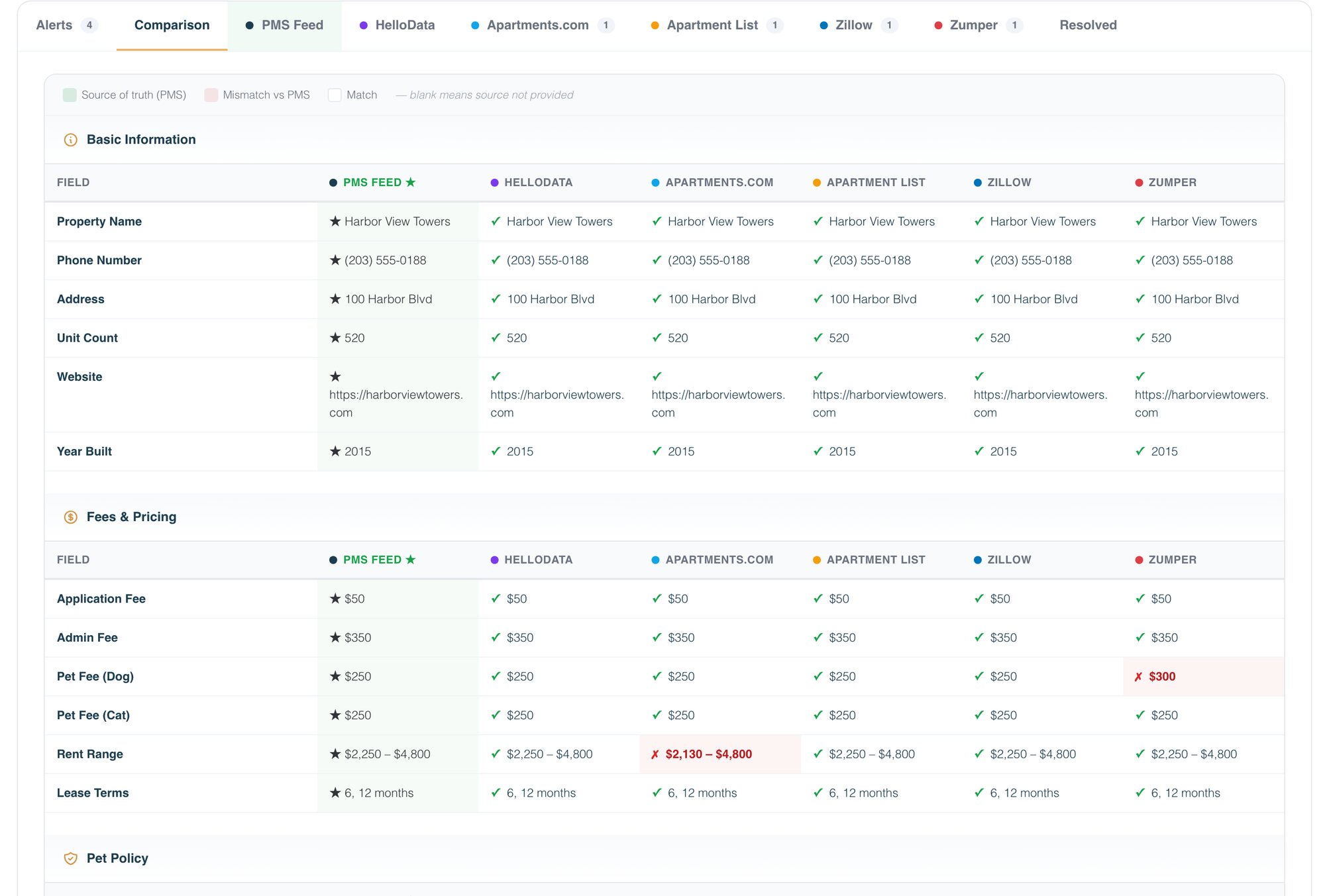
Listing Consistency in Compliance360 pulls each listing from Apartments.com, Apartment List, Zillow, Zumper and HelloData nightly and compares it field by field with your PMS feed, showing expected beside found and counting a fix only when the next sync agrees. Fee mismatches share a Resolution Center with Fee Transparency, and with ILS Management™ Brynson's team corrects the listing with the ILS.
A one-off check before a budget review
Run the five-step spot check above on your highest-spend communities. It is slow, but it shows whether the problem is worth monitoring.
Ongoing coverage across a portfolio
Manual checks do not scale past a handful of properties and leave no record. Nightly comparison with amenity mappings and ignore rules keeps the review queue to real errors.
Frequently asked questions
In Brynson's analysis of 6,000 communities and 1.6 million units, nearly 89% described themselves differently depending on which listing site a renter visited, measured at origination. The conflicts reported were in mandatory fees, amenities and terms.
The analysis reported conflicting mandatory fees, missing amenities and contradictory terms as the recurring problems. Many amenity differences are naming synonyms you can map once; fee and lease-term conflicts matter more, because they change what a renter expects to pay and the deal they expect to sign.
No. 97% of the listings in the analysis had been updated within the previous 90 days and the conflicts persisted. An update can refresh one field and leave others untouched, and a fix on one portal does nothing for the rest, so each site has to be checked against the PMS.
Usually because a fee changed in the PMS or on the website and one portal kept the old value, or because a value was typed into a portal dashboard and never removed. Each portal also structures fee fields differently, so the same fee can land in a different place or not at all.
It can be. The FTC Act prohibits deceptive practices, and the FTC's 2025 Greystar settlement centered on advertised rents that excluded mandatory monthly fees. A listing site is advertising, so a fee there that differs from what you charge is worth treating as a disclosure question; check specifics with your counsel.
Cite this report, Brynson Research Team, October 22, 2026, and keep the wording: nearly 89% of apartment communities, at origination, described themselves differently across listing sites. The 97% figure is the share of listings updated within the previous 90 days, not the share with conflicts.
How we checked this
Written by the Brynson Research Team and checked against the primary sources below. Each source shows the date we last read it. We update this page when the rules change; see the change log.
- 15 U.S. Code 45: Unfair methods of competition unlawful; prevention by Commission, Legal Information Institute, Cornell Law School, current. Accessed 2026-10-22.
- Greystar Agrees to Pay $24 Million and Stop Deceptive Advertising Practices as a Result of FTC and Colorado Lawsuit Alleging the Firm Deceived Consumers About Rent Prices, Federal Trade Commission, 2025-12-02. Accessed 2026-10-22.
- FTC Seeks Public Comment on a Proposed Rulemaking Regarding Unfair or Deceptive Rental Housing Fee Practices, Federal Trade Commission, 2026-03-12. Accessed 2026-10-22.
- Brynson, the Multifamily Intelligence Platform, Launches Compliance360 to Automate Digital Compliance Across Every Listing and Channel, Brynson, 2026-10-22. Accessed 2026-10-22.
- Trulia: Higher error rate in non-MLS sources of real estate listings data, Inman, 2011-05-09. Accessed 2026-10-22.
Change log
- First published.
This guide is general information, not legal advice. Laws and regulator guidance change; check the current rules for your properties with your counsel before acting.