
Fair Housing Advertising Rules for Apartments and Multifamily Communities: Federal, State and City (2026)
For marketing, leasing and compliance leads at multifamily operators and third-party managers.
42 U.S.C. 3604(c) and 24 CFR 100.75 bar any apartment ad, notice or statement indicating a preference based on race, color, religion, sex, disability, familial status or national origin. States and cities add classes such as source of income, age and marital status, so one phrase can be lawful in Texas and a violation in New York.
- The ban covers every channel: ILS listings, websites, paid and organic social, leasing texts, applications and signs.
- 24 CFR 100.75(c)(3) treats choosing media or locations that deny groups housing information because of a protected class as a violation.
- HUD withdrew its 2024 digital advertising guidance effective September 17, 2025, but the statute and regulation still bind.
- Review each property's copy against the classes protected at its own address, then find every copy of a fixed phrase.
This guide is general information, not legal advice. Laws and regulator guidance change; check the current rules for your properties with your counsel before acting.
The federal rule, in the statute's own words
The advertising ban sits in 42 U.S.C. 3604(c). It makes it unlawful "to make, print, or publish, or cause to be made, printed, or published any notice, statement, or advertisement, with respect to the sale or rental of a dwelling that indicates any preference, limitation, or discrimination based on race, color, religion, sex, handicap, familial status, or national origin, or an intention to make any such preference, limitation, or discrimination."
Three words do most of the work:
- "Indicates." The statute asks what the ad indicates, not what the writer intended. A phrase written as a friendly description can still indicate a preference.
- "Cause to be." The ban reaches whoever causes an ad to be published, not only the site that displays it. An operator that supplies the copy, approves the template or pays for the placement should assume it is within that language.
- "Statement." The ban is not limited to paid ads. It reaches any notice or statement about renting a dwelling.
A neighboring subsection, 3604(d), separately bars telling someone a unit is not available for inspection or rental when it is, because of a protected class.
The statute says "handicap". Current regulations and most operator policies say "disability". They mean the same protected class.
What counts as advertising for an apartment community
HUD's regulation, 24 CFR 100.75(b), says the ban applies "to all written or oral notices or statements by a person engaged in the sale or rental of a dwelling," and lists applications, flyers, brochures, deeds, signs, banners, posters and billboards as examples of written notices. For a portfolio, the map looks like this:
| Channel | Who usually writes it | Typical risk | Review owner |
|---|---|---|---|
| ILS listings (Apartments.com, Zillow, Apartment List and others) | Syndicated from the PMS or website, then edited on site | Old copy survives on one site after a fix elsewhere | Marketing |
| Property website | Agency or in-house marketing | Neighborhood and lifestyle copy that describes renters, not the property | Marketing |
| Paid search and paid social | Agency | Audience and location choices, plus short ad copy | Marketing and agency |
| Organic social and comment replies | Community managers | Off-script answers to "do you take vouchers?" or "is it kid friendly?" | Operations |
| Leasing emails, texts and call scripts | Leasing staff, CRM templates | Oral and written statements to prospects, covered by 100.75(b) | Operations and training |
| Applications and screening criteria | Compliance, PMS configuration | Criteria text that limits a protected group | Compliance |
| Signage, banners, brochures | Site teams | Local printing nobody centrally reviews | Regional managers |
The hard part is that one property says different things in different places: in Brynson's analysis of 6,000 properties and 1.6 million units, about 89% of communities described themselves differently across listing sites. An approved template is only as good as the last place it was copied to.
The four kinds of violation in 24 CFR 100.75(c)
24 CFR 100.75(c) lists four forms a discriminatory notice can take. Each has a common apartment version.
| Paragraph | What the regulation covers | Apartment example to review |
|---|---|---|
| (c)(1) Words and images | "Using words, phrases, photographs, illustrations, symbols or forms" that convey availability to, or exclusion of, a group (source) | "Perfect for young professionals" on a family-sized floor plan; a gallery where every person shown fits one narrow demographic |
| (c)(2) Statements to others | Expressing a preference or limitation to agents, brokers, employees or prospective renters (source) | A regional manager telling leasing staff to steer families to the ground-floor building |
| (c)(3) Media selection | "Selecting media or locations for advertising" that deny particular segments of the housing market information about housing opportunities because of a protected class (source) | Running lease-up ads only in channels or ZIP codes chosen so that a protected group never sees them |
| (c)(4) Unequal publishing terms | Refusing to publish ads, or charging different terms, because of a protected class (source) | Mostly a publisher's risk |
Paragraph (c)(3) is rarely quoted in operator guides, and it is the one that maps onto digital targeting: where an ad runs is part of the ad. Platform-specific rules for Meta and Google are covered in our Meta and Google housing ad guide.
Is HUD's advertising guidance still in effect? Where it stands in 2026
1996: Part 109 left the CFR
HUD's advertising guidelines used to sit in 24 CFR Part 109. A final rule published in the Federal Register on April 1, 1996, effective May 1, 1996, removed Part 109 entirely as nonbinding guidance. HUD said it would "more appropriately provide this nonbinding guidance and information through handbook guidance or other materials rather than maintain it in the CFR" (61 FR 14378, April 1, 1996). The regulation itself, 100.75, stayed. Its paragraph (d) still points readers to part 109 for guidance, a cross-reference to a part that no longer exists in the CFR (24 CFR 100.75(d)).
Whether apartment ads need the Equal Housing Opportunity logo or slogan is covered in the fair housing advertising checklist.
2024 to 2026: the digital platforms guidance was withdrawn
On April 29, 2024, HUD issued "Guidance on Application of the Fair Housing Act to the Advertising of Housing, Credit, and Other Real Estate-Related Transactions through Digital Platforms." A HUD notice published in the Federal Register on April 6, 2026 (FR Doc. 2026-06624) lists it among eight withdrawn guidance documents, with an effective date of withdrawal of September 17, 2025 (HUD notice, Docket FR-6571-N-01). The same notice also withdrew the February 12, 2024 FHEO memorandum on source of income testing under the Fair Housing Assistance Program.
The notice says the withdrawn documents "should not be relied upon as authoritative." It also says "any actions that do not comply with the text of the Fair Housing Act continue to be subject to enforcement by the Department," and that complainants may still file a civil action in federal or state court within two years of the alleged practice.
| Item | Status | Source |
|---|---|---|
| 42 U.S.C. 3604(c) | In force; statute | Cornell LII |
| 24 CFR 100.75 | In force; regulation | Cornell LII |
| 24 CFR Part 109 advertising guidelines | Removed from the CFR, effective May 1, 1996 | Federal Register, 1996 |
| HUD digital platforms advertising guidance (April 29, 2024) | Withdrawn, effective September 17, 2025 | HUD notice 2026-06624 |
| State and city fair housing laws | Unaffected by HUD's withdrawal; each has its own text | See the layering section below |
Losing the guidance removed explanations, not obligations. How to fold this into a broader program is covered in building a multifamily digital compliance program.
Federal, then state, then city: one listing checked in four places
Federal law is the floor. States and cities add protected classes, and many of them repeat the advertising ban in their own words. New York's ban, for example, covers any advertisement that "expresses, directly or indirectly, any limitation, specification or discrimination" as to classes including citizenship or immigration status, military status, age, marital status, status as a victim of domestic violence and lawful source of income (N.Y. Exec. Law 296(5)(a)(3)). Washington bars ads that indicate a preference based on any source of income (RCW 59.18.255) and lists marital status, citizenship or immigration status and veteran or military status in its real estate ad rule (RCW 49.60.222). Texas mirrors the seven federal classes (Tex. Prop. Code 301.022) and bars cities and counties from requiring landlords to accept federal housing assistance as source of income, with an exception for veterans (Tex. Loc. Gov. Code 250.007).
A national template contains five phrases. Here is how each reads at a property in Austin, Brooklyn, Seattle and Washington, DC, against the statutes and agency lists linked above. "Listed" means the class appears in that jurisdiction's housing law or agency list; it is a review flag, not a legal conclusion.
| Phrase | Austin, TX | Brooklyn, NY | Seattle, WA | Washington, DC |
|---|---|---|---|---|
| "No Section 8" | Source of income not in Tex. Prop. Code 301.022; local voucher mandates barred by LGC 250.007 (source) | Flag: lawful source of income, state (source) and city (source) | Flag: source of income ad ban (source) | Flag: source of income listed for housing (source) |
| "Perfect for young professionals" | Flag: familial status, federal (source) | Flag: familial status and age (source) | Flag: familial status (families with children) (source) | Flag: familial status and age (source) |
| "Ideal for married couples" | Marital status not in 301.022; familial status review still applies (source) | Flag: marital status (source) | Flag: marital status (source) | Flag: marital status (source) |
| "Applicants must be U.S. citizens" | Review: national origin, federal (source) | Flag: citizenship or immigration status (source) | Flag: citizenship or immigration status (source) | Review: national origin is listed (source) |
| "Great for grad students" | Not a listed class (source) | Not a listed class in Exec. Law 296(5)(a)(3) (source) | Not a listed class in RCW 49.60.222 (source) | Flag: matriculation is listed for housing (source) |
Austin raises one flag; Brooklyn, Seattle and DC raise four each, and DC's four are not Brooklyn's four. A single national review pass cannot catch that. Note that Seattle's column above uses Washington state law only; Seattle's own ordinance adds classes and should be checked from the city's code before you rely on the table. The full state-by-state picture lives in fair housing protected classes by state and source of income laws by state.
Eight fair housing advertising mistakes multifamily teams repeat
Drawn from the regulation's four categories and from how portfolio copy moves between the PMS, website, ILSs and social.
- 01
Copying a template across state lines
A phrase that raises no state-level flag in Austin can be a listed-class violation in Brooklyn or DC (see the table above). Review copy against the property's address, not against the brand's home state.
- 02
Refusing vouchers in a source of income jurisdiction
The New York AG investigation above started with online rental listings that said the owners did not accept Section 8. Where source of income is protected, the safer line is a neutral statement of income criteria applied to all applicants.
- 03
Describing the renter instead of the property
"Perfect for singles", "ideal for young professionals" and "great for empty nesters" describe people. "Studio with a home-office nook, two blocks from the light rail" describes the unit. Full lists are in fair housing words to avoid in apartment listings.
- 04
Adult-only language outside a qualifying exemption
"Adult community" or "no children" signals a familial status limitation unless the property actually qualifies as housing for older persons. If it does, the advertising still has to match the exemption. See 55+ apartment advertising and fair housing.
- 05
Ability requirements instead of feature descriptions
"Must be able to climb stairs" limits renters with a disability. "Third-floor walk-up, no elevator" gives the same information as a fact about the building.
- 06
Targeting choices nobody reviews
24 CFR 100.75(c)(3) covers the selection of media and locations. Audiences and ZIP codes an agency picks still run in the property's name. Approve targeting with the creative.
- 07
Leasing replies on social and text
Regulation 100.75(b) covers written and oral statements by anyone engaged in renting. A community manager answering "do you take vouchers?" in an Instagram comment is making a statement for the property.
- 08
No dated record of what ran
When a complaint arrives months later, the question is what the listing said on a given date. With most communities describing themselves differently from site to site, a screenshot of today's website is not that answer. Keep dated captures; see compliance evidence retention.
Photos, models and AI-generated lifestyle imagery
Images are covered by the same regulation as words: 100.75(c)(1) names "photographs, illustrations, symbols or forms." With Part 109 gone, the operative question is the regulatory one: does the set of images, taken together, convey that the community is for one kind of renter?
Tests for a gallery or ad set:
- Count, then look. Across a property's full image set, do the people shown cover a range of ages, family types and backgrounds, or does every shot repeat one profile?
- Check the generated images. A generated set can repeat one profile across every shot. Review generated people with the same eye as stock; the regulation names photographs and illustrations without regard to how they were made.
AI-written listing copy raises the same issues in text; see AI listing copy and fair housing.
Recent enforcement involving apartment advertising and statements
Two state actions, each from the agency's own release. Both concern source of income, which federal law does not protect.
| Agency and date | What happened | Terms | Source |
|---|---|---|---|
| New York Attorney General, April 15, 2025 | Online rental listings for 24 units in three Capital Region buildings said the owners did not accept Section 8 | $3,000 in penalties ($6,000 more if they fail to comply); rent at least three units to subsidy users within a year; anti-discrimination policy; training for customer-facing staff; Equal Housing Opportunity signs at each property; "Equal Housing Opportunity Provider" on every advertisement, listing and social media post | NY AG release |
| California Civil Rights Department, April 2, 2024 | Testers from Fair Housing Advocates of Northern California documented a Novato apartment complex saying it would not rent to people using Section 8 | $35,000 to Fair Housing Advocates of Northern California; end the ban; written equal-treatment policy; staff training; post vacancies where assistance recipients look, including the Marin Housing Authority site | CRD release |
The remedies (training, written policy, signage, a change to every listing) are controls an operator can adopt before any complaint.
How to run fair housing ad review across a portfolio
A workable review loop for a marketing or compliance lead with dozens or hundreds of properties.
- 1
Map every channel per property
List each surface where a property's copy or images appear: website, each ILS, paid search, paid social, organic social, CRM templates, applications and signage. Name one owner per surface.
- 2
Attach jurisdiction to each property
Record the state and city for every property and the protected classes in force there. Federal classes apply everywhere; add state and city classes from each law's own text.
- 3
Review copy and images against that address
Check every phrase and the image set against the property's classes, using the four 100.75(c) categories as the checklist. Record the rule basis for every flag.
- 4
Review targeting with the creative
For paid campaigns, approve the audience, location and placement settings together with the ad text, since media selection is part of the regulation.
- 5
Fix once, then find every copy
When a phrase is changed, search every other listing, ad and template for the same phrase and fix those too, starting with the ILS listings that tend to lag.
- 6
Keep a dated audit record
Save what each surface said before and after the fix, who approved it and when. Re-check on a schedule, because syndicated copy drifts back.
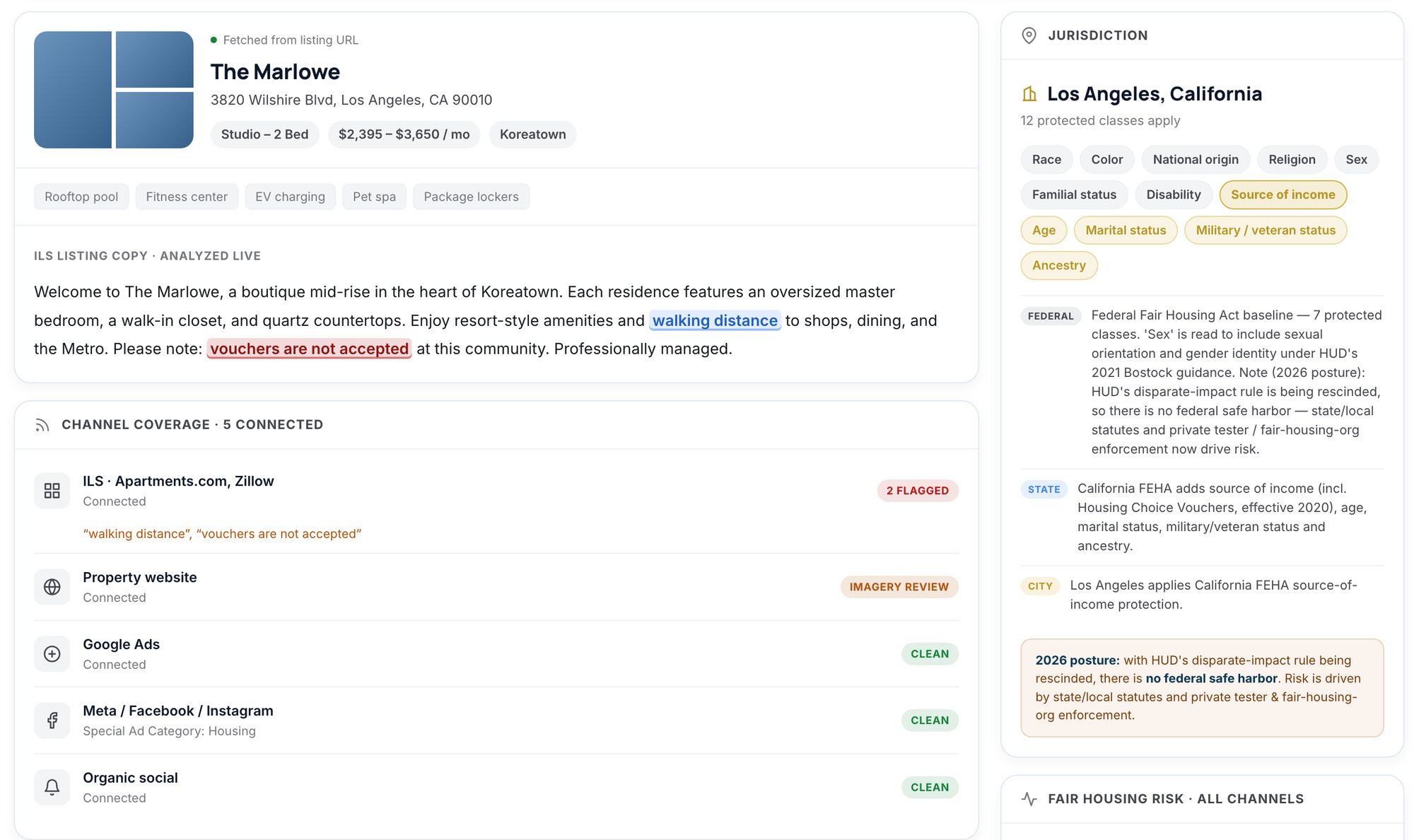
Compliance360 Fair Housing reads listing, website, ad and social copy span by span, wherever those channels are connected for the property. It resolves each phrase against the federal, state and city classes for that property's address and shows the protected class, rule basis and a suggested rewrite, plus every other place the same phrase runs. Every output is a flag for a person to review, with a dated audit record. SiteArchiver, part of Compliance360, captures property websites daily and on change, so you can replay what a page said on a given date.
Frequently asked questions
Yes. 42 U.S.C. 3604(c) covers any notice, statement or advertisement about renting a dwelling, and it reaches anyone who causes the ad to be published. An operator that supplies the listing copy should assume it is within that language, not only the site that displays it.
Yes. 24 CFR 100.75(b) applies the ban to all written or oral notices or statements by a person engaged in renting a dwelling, and a property website is a written statement about renting.
No. HUD's April 29, 2024 guidance on advertising through digital platforms was withdrawn effective September 17, 2025, in a HUD notice published in the Federal Register on April 6, 2026. The same notice says conduct that does not comply with the text of the Fair Housing Act remains subject to enforcement, so the statute and 24 CFR 100.75 still apply.
Yes. The regulation covers written and oral statements by anyone engaged in renting a dwelling, so a comment reply, direct message or text from a community manager is a statement for the property. Approved answers for common questions, such as vouchers and children, reduce the risk.
The statute covers anyone who makes, prints or publishes a discriminatory ad, or causes one to be published. An operator that writes, approves or pays for the copy is within that language even when a vendor places it. How liability is shared with a specific platform or agency is a question for counsel and your contracts.
No. State and city laws add to the federal floor; they do not replace it. A property in New York must meet both 42 U.S.C. 3604(c) and New York Executive Law 296(5)(a)(3), which covers more classes, including lawful source of income and marital status.
How we checked this
Written by the Brynson Research Team and checked against the primary sources below. Each source shows the date we last read it. We update this page when the rules change; see the change log.
- 42 U.S. Code 3604: Discrimination in the sale or rental of housing, Cornell Law School Legal Information Institute (U.S. Code), current. Accessed 2026-10-22.
- 24 CFR 100.75: Discriminatory advertisements, statements and notices, Cornell Law School Legal Information Institute (eCFR), current. Accessed 2026-10-22.
- HUD final rule removing 24 CFR Parts 106 and 109, 61 FR 14378 (FR Doc. 96-7786), Federal Register via GovInfo, 1996-04-01. Accessed 2026-10-22.
- Notification of Withdrawal of Fair Housing and Equal Opportunity Guidance Documents (FR-6571-N-01, FR Doc. 2026-06624), U.S. Department of Housing and Urban Development, Federal Register public inspection, 2026-04-06. Accessed 2026-10-22.
- New York Executive Law 296, New York State Senate, current. Accessed 2026-10-22.
- Protected Classes fact sheet, NYC Commission on Human Rights, 2025-01-23. Accessed 2026-10-22.
- 23 Protected Traits Under the DC Human Rights Act, DC Office of Human Rights, 2026-07-01. Accessed 2026-10-22.
- RCW 49.60.222: Unfair practices with respect to real estate transactions, Washington State Legislature, current. Accessed 2026-10-22.
- RCW 59.18.255: Source of income, Washington State Legislature, current. Accessed 2026-10-22.
- Texas Property Code Chapter 301 (Sec. 301.022, Publication), Texas Legislature, Texas Constitution and Statutes, current. Accessed 2026-10-22.
- Texas Local Government Code Chapter 250 (Sec. 250.007), Texas Legislature, Texas Constitution and Statutes, current. Accessed 2026-10-22.
- Attorney General James Stops Illegal Housing Discrimination in the Capital Region, New York State Office of the Attorney General, 2025-04-15. Accessed 2026-10-22.
- Civil Rights Department Reaches Settlement Ending Novato Apartment Complex Ban on Section 8 Vouchers, California Civil Rights Department, 2024-04-02. Accessed 2026-10-22.
Change log
- First published.
This guide is general information, not legal advice. Laws and regulator guidance change; check the current rules for your properties with your counsel before acting.