
Accessibility Overlays and Widgets on Apartment Websites: Do They Make a Multifamily Site ADA Compliant?
For marketing, digital and compliance leads at multifamily operators deciding whether to buy, keep or renew an accessibility widget.
No. A widget or overlay script does not by itself make an apartment website conform to WCAG. In April 2025 the FTC finalised an order requiring accessiBe to pay $1 million and barring it from claiming, without competent evidence, that its automated tool can make any website WCAG compliant. Conformance comes from fixing the site's own code and re-testing it.
- The order also requires accessiBe to disclose that its product does not fix third-party domains, where many apartment applications and tour schedulers live.
- Automated tools find only part of the problem: in a GOV.UK test, ten tools together found 71% of 143 known barriers.
- WCAG accepts a separate accessible version only if it has the same information and functions and is kept as up to date as the main site.
- At renewal, ask your website vendor for a current Accessibility Conformance Report, its manual test method and a written fix window.
This guide is general information, not legal advice. Laws and regulator guidance change; check the current rules for your properties with your counsel before acting.
The short answer, with the FTC order
An overlay is a vendor script that adds a toolbar (text size, contrast, "screen reader mode") and tries to patch the page as it loads. It runs on top of your site's code and does not change it.
On April 22, 2025 the FTC announced a 3-0 vote finalising an order requiring accessiBe to pay $1,000,000 (FTC press release). The FTC alleged that accessiBe falsely claimed its accessWidget plug-in could make websites WCAG compliant, and that it formatted third-party reviews and articles to look independent while hiding its material connections to them. The order bars accessiBe, unless it has competent and reliable evidence, from claiming that its automated technology "can make any website compliant with WCAG" or "can ensure continued automatic compliance with WCAG over time as website content changes" (Decision and Order, Section I). accessiBe neither admitted nor denied the allegations. The order runs for 20 years and binds accessiBe only: it is not a rule about overlays in general, and it does not say any operator broke a law by installing one.
DOJ's web guidance says automated checkers and overlays "can be helpful tools, but like other automated tools such as spelling or grammar checkers, they need to be used carefully," and that "a 'clean' report does not necessarily mean everything is accessible" (ada.gov, March 18, 2022). Background: the ADA website compliance guide for apartments.
What an overlay can and cannot reach on a property website
| Finding | What it says | Source |
|---|---|---|
| W3C on evaluation tools | "Tools cannot check all accessibility aspects automatically. Human judgement is required." | W3C WAI |
| GOV.UK tool test | A test page with 143 failures in 19 categories; the best single tool found 37% from errors and warnings (41% counting manual inspection prompts); all ten combined found 71%. | GOV.UK, February 24, 2017 |
| WebAIM Million 2026 | 95.9% of one million home pages had detected WCAG 2 failures. Pages with ARIA present averaged 59.1 errors; pages without averaged 42. | WebAIM, February 2026 |
Coverage percentages differ by method (criteria, barrier types or issue volume), but every method leaves a large share for a person. The WebAIM ARIA result is a caution for any fix that works by adding attributes, by hand or by script: more ARIA is not the same as fewer barriers. WebAIM does not report overlay pages separately.
The FTC order adds a limit specific to how apartment sites are built. Section V requires accessiBe to disclose, whenever it claims the product can correct barriers and before a customer takes on any financial obligation, that its product "will not correct barriers on third-party web domains or subdomains that may be part of the overall user experience, unless those domains also use the product." On many property sites the application, payment step, resident portal and often the tour scheduler are served by another vendor on its own domain or in an iframe. A widget on the marketing site does not reach them, and the application is where a barrier stops a lease. See accessible rental applications.
Six barriers an overlay leaves on a typical apartment website
Each is common on property sites, maps to a WCAG criterion, and needs a change to the code or the content that a script cannot make reliably.
- 01
Gallery photos with no meaningful description
WCAG 1.1.1 Non-text Content (A). A script can guess "kitchen"; it cannot know the photo shows the B2 plan's gas range. WebAIM found missing alternative text on 53.1% of home pages in 2026.
- 02
Availability filters built from clickable boxes
WCAG 2.1.1 Keyboard and 4.1.2 Name, Role, Value (A). Bedroom, price and move-in filters made from styled divs need real buttons or form controls.
- 03
The application on the PMS domain
WCAG 3.3.1 Error Identification and 3.3.2 Labels or Instructions (A). Under Section V of the FTC order, accessiBe must disclose that its product does not correct barriers on third-party domains that do not run it. Unlabelled fields and timeouts in a vendor-hosted application stay as they are unless that vendor fixes them.
- 04
Floor plans as images only
WCAG 1.1.1 (A). Beds, baths, square footage and rent need to be real text next to the plan image. See accessible floor plans and photo galleries.
- 05
Low-contrast brand colours
WCAG 1.4.3 Contrast (Minimum) (AA). The most common failure in the WebAIM Million at 83.9% of home pages. A toolbar contrast switch helps only users who turn it on; the default theme still fails.
- 06
Tour schedulers and chat widgets in iframes
WCAG 2.1.2 No Keyboard Trap (A) and 2.4.3 Focus Order (A). A calendar that traps focus, or a chat bubble that steals it, is third-party code the overlay often cannot touch.
How multifamily vendors have described their tools
Multifamily search results still surface these vendor statements. They are quoted as published, with dates. Brynson has not tested these products.
| Vendor and date | What the vendor says | Source |
|---|---|---|
| ResMan, October 26, 2020 | Announces ResMan Accessibility Pro, describing it as "proven to ensure complete compliance with domestic and international regulations," naming WCAG 2.1, the ADA and Section 508. | ResMan blog |
| Apartments247 (page undated, read October 22, 2026) | Calls RAMP "The Accessibility Portal" and says "providing a separate, screen reader-specific marketing site is ideal when ensuring equal access to vision impaired users," and states "Full compliance can never be achieved with an overlay." | Apartments247 |
| WebAIM on Apartments247, sample to January 7, 2026 | WebAIM reports it evaluated seven Apartments247 Accessible Themes for WCAG 2.2 Level A and AA, and "cannot verify the conformance or accessibility of content beyond the scope of the sample, nor content changed after January 7, 2026." | WebAIM |
A credible conformance statement names a sample, a standard and a date. Ask for all three from any vendor, Brynson included.
Three approaches compared: overlay, separate accessible version, fixing the site
| Question | Overlay or toolbar script | Separate accessible version | Fix the site's code, then monitor |
|---|---|---|---|
| Changes the underlying code? | No. Patches the page in the browser. | Builds a second site; the main site stays as is. | Yes. Barriers are removed at source. |
| WCAG position | Not a method WCAG describes; the FTC order limits accessiBe's claims that its script makes sites WCAG compliant. | Allowed as a "conforming alternate version" only if it conforms, has the same information and functionality, is "as up to date as the non-conforming content," and can be reached by an accessible link. W3C calls it "a fallback option" (W3C). | W3C's "preferred method of conformance is to make all content directly accessible." |
| Reaches the PMS application on another domain? | Only if that domain runs it too (FTC order, Section V). | Only if the alternate version includes an accessible application path. | Only if the application vendor fixes its flow; put it in the contract. |
| Main risk for operators | Barriers stay in the code; claims of automatic compliance are what the FTC order limited for accessiBe. | Drift: specials, availability and fees fall out of date on the second site. | Regressions after theme or plugin updates unless re-tested. |
Parity is the hard part of option two: availability, pricing and concessions change daily. Brynson's analysis of 6,000 properties and 1.6 million units found about 89% of communities described themselves differently across listing sites; a second website is one more copy that can drift. See the apartment listing accuracy report.
If your site already runs a widget
Keeping or removing the script changes nothing in your code. Test with the widget switched off: that is the code you own and the code a tester reads.
| Surface | Finding | Owner |
|---|---|---|
| Photo gallery | 32 of 40 images with no alt text | Website vendor and marketing |
| Floor plan filters | Bedroom and price filters not reachable by keyboard | Website vendor |
| Apply now | Opens a PMS-hosted application on a separate domain where the toolbar does not load; 6 unlabelled fields on step 2 | PMS vendor |
| Tour scheduler | Iframe with a focus trap on the calendar | Scheduling vendor |
Fix in the order a renter meets the barrier on the way to a lease: application, tour booking, availability, then galleries. Keep a dated record of each fix; it is what you can show if a demand letter arrives (see responding to an apartment website ADA demand letter).
How to move from a widget to fixes you can show
A sequence for one property site; repeat by template across a portfolio.
- 1
Test with the widget off
Disable the overlay script on a staging copy or with a browser blocker and run an automated scan of the key pages and the application flow. This is the baseline of the code you own.
- 2
Run the manual checks
Complete a tour booking and an application using only the keyboard, then with a screen reader. Record where focus is lost, what is unlabelled and where you get stuck.
- 3
Assign each finding to its owner
Split findings by who controls the code: website vendor, PMS or application vendor, scheduler or chat vendor, and your own content team for alt text and fee copy.
- 4
Fix in renter order
Fix the application and tour booking first, then availability and pricing, then galleries and content pages. Log each fix with a date.
- 5
Publish an accessibility statement
State the WCAG level you target and a phone and email contact for anyone who meets a barrier, and route those requests to a named person.
- 6
Decide on the widget, then monitor
Once fixes are in, decide whether the toolbar adds anything users want; it is optional either way. Re-scan after every site release so regressions are caught and fixed.
Renewal checklist for your website vendor
| Ask | A good answer | A warning sign |
|---|---|---|
| Which standard and level do you build to? | WCAG 2.1 AA or 2.2 AA, named in the contract | "ADA compliant" with no standard named |
| Can we see a current Accessibility Conformance Report? | A dated report naming the pages tested and the method, including keyboard and screen reader testing by a person | A badge or toolbar dashboard only |
| Does it cover the application, scheduler and portal? | Names each third-party domain and who tests it | Marketing pages only, unstated |
| Who fixes regressions, and how fast? | A written fix window after each release | Fixes billed as change requests |
| Does your marketing claim automatic or ongoing compliance? | No; it describes testing and fixes | The two claims the FTC order limited for accessiBe |
Compare tools in website accessibility tools for property management; test pages with the apartment website accessibility checklist.
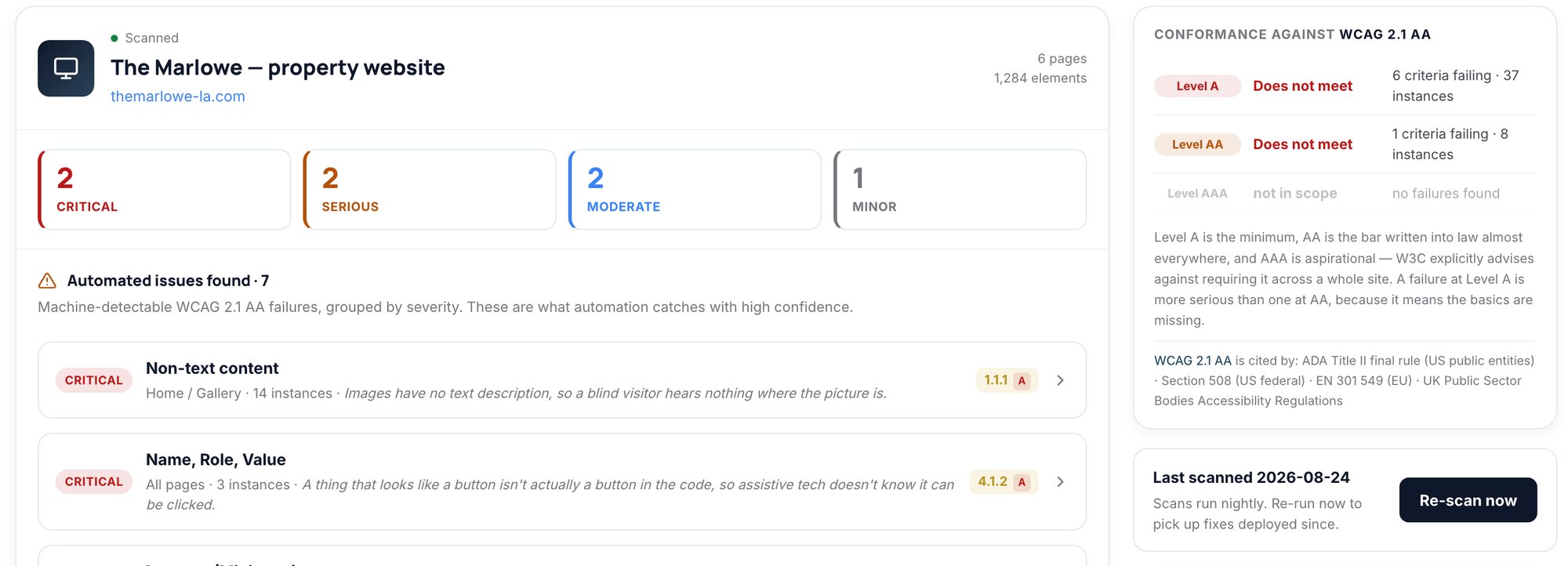
Compliance360 Web Accessibility installs no overlay or widget. It reviews each property's key pages and application flow against WCAG 2.1 AA by default (or 2.2 AA, Level A only or AAA), explains every finding with where it is and how to fix it, adds a manual review checklist for the criteria automation cannot judge, and re-scans nightly so each fix is confirmed and each regression is caught. SiteArchiver keeps point-in-time captures of how a page looked and worked on a given date. It is a review aid that supports fixes in your own code, not a legal determination. See Web Accessibility or the full Compliance360 suite.
Frequently asked questions
No. A widget runs on top of the site's code and does not remove barriers in it. The FTC's 2025 order bars accessiBe from claiming, without competent evidence, that its tool can make any website WCAG compliant.
Pay $1 million, under a final order announced April 22, 2025. It also bars unsupported claims that its automated product can make or keep any website WCAG compliant, bans misleading endorsements and requires disclosure that the product does not fix third-party domains that do not run it.
Yes. Installing a widget does not prevent a claim, and it does not change whether barriers exist in the site's code, which is what a tester checks. DOJ guidance warns that a clean automated report does not mean everything is accessible. What helps is a dated record of testing and fixes, and an accessible way to apply.
Only as a fallback. WCAG allows a conforming alternate version if it meets the target level, has the same information and functions, is as up to date as the main site and is reachable by an accessible link. For apartments, keeping availability, fees and specials in step is the hard part.
Usually not. Applications are often hosted by the PMS or screening vendor on another domain, and the FTC order requires accessiBe to disclose that its product does not fix third-party domains unless they run it too.
Fixing the site's own code and content, then re-testing after each release: automated scans, keyboard and screen reader checks by a person, an accessibility statement with a contact, and contracts that make each vendor fix its part.
How we checked this
Written by the Brynson Research Team and checked against the primary sources below. Each source shows the date we last read it. We update this page when the rules change; see the change log.
- FTC Approves Final Order Requiring accessiBe to Pay $1 Million, Federal Trade Commission, 2025-04-22. Accessed 2026-10-22.
- In the Matter of accessiBe Inc. and accessiBe Ltd., Decision and Order, Docket No. C-4817, Federal Trade Commission, 2025-04-21. Accessed 2026-10-22.
- accessiBe Inc., case file 222-3156, Federal Trade Commission. Accessed 2026-10-22.
- Guidance on Web Accessibility and the ADA, U.S. Department of Justice, ada.gov, 2022-03-18. Accessed 2026-10-22.
- Understanding Conformance (WCAG 2.2): conforming alternate version, W3C Web Accessibility Initiative. Accessed 2026-10-22.
- Web Content Accessibility Guidelines (WCAG) 2.2, W3C, 2024-12-12. Accessed 2026-10-22.
- Selecting Web Accessibility Evaluation Tools, W3C Web Accessibility Initiative. Accessed 2026-10-22.
- What we found when we tested tools on the world's least-accessible webpage, GOV.UK Accessibility blog, Government Digital Service, 2017-02-24. Accessed 2026-10-22.
- The WebAIM Million 2026, WebAIM, Utah State University, 2026-02. Accessed 2026-10-22.
- Apartments247 Accessible Themes evaluation summary, WebAIM. Accessed 2026-10-22.
- RAMP accessibility portal, Apartments247. Accessed 2026-10-22.
- ResMan Accessibility Pro announcement (blog post), ResMan, 2020-10-26. Accessed 2026-10-22.
Change log
- First published.
This guide is general information, not legal advice. Laws and regulator guidance change; check the current rules for your properties with your counsel before acting.