
Source of Income Discrimination Laws by State: Can Apartment Ads Say 'No Section 8'?
For regional compliance, marketing and leasing leads at multifamily operators with properties in more than one state.
Federal fair housing law does not protect source of income, but PRRAC's March 2026 compilation lists 21 states and territories, including DC and Guam, with statewide laws, plus many cities and counties. Where those laws cover vouchers and advertising, as in California, New York, Washington and Michigan, writing "no Section 8" in an apartment ad is itself a violation.
- Where a statute bans ads that indicate a source of income preference, the ad itself is the violation.
- A 3x-the-full-rent rule is the most common hidden violation: Washington, Rhode Island and California test only the tenant's share, and Michigan bars leaving voucher income out.
- Size thresholds vary: Michigan covers landlords with 5 or more units, Colorado more than 3, Virginia more than 4.
- Seven states, including Texas, Missouri and (in part) Florida, bar or limit local source of income laws.
- A March 2026 New York appellate ruling struck the refusal-to-rent clause for Section 8 vouchers, not the ad clause; PRRAC reports an appeal.
This guide is general information, not legal advice. Laws and regulator guidance change; check the current rules for your properties with your counsel before acting.
Federal law versus state law: why the ad itself is the violation
The federal Fair Housing Act does not list source of income. Its advertising ban, 42 U.S.C. 3604(c), covers race, color, religion, sex, handicap, familial status and national origin.
Strong state laws add a separate ban on ads indicating a source of income preference, which makes the ad itself the violation. In Washington, RCW 59.18.255(2) bars any "communication, notice, advertisement, or sign of any kind" indicating "a preference, limitation, or requirement based on any source of income."
New York's Executive Law 296(5)(a)(3) goes further: it covers ads and also "any form of application" and any "record or inquiry" that expresses a source of income limitation. Illinois (775 ILCS 5/3-102(F)) has the same reach. Application forms and screening questions are in scope in both. For other classes that vary by state, see fair housing protected classes by state.
Source of income discrimination laws by state: the table
This table follows the March 2026 update of PRRAC's Appendix B, checked against official text for Washington, New York, Michigan and Delaware. "Ad clause" means the statute names source of income in its advertising ban. "Confirm" means we have not read the clause; those states still ban refusing to rent, so a "no vouchers" line is hard to defend.
| Jurisdiction | Statute | Vouchers covered | Ad clause | Size threshold or exemption | Income-requirement rule | Enforcement and penalty | Source |
|---|---|---|---|---|---|---|---|
| California | Gov. Code 12955; 12927(i) | Yes (since 2020) | Yes, 12955(c) | All but one room rented in the landlord's home | Tenant's share only (2 CCR 12143) | CRD or civil suit | PRRAC |
| Colorado | C.R.S. 24-34-502 | Yes | Yes, (1)(n) | Over 3 units; small single-family owners may decline HCVs | 200% of tenant's share (38-12-904); credit score limits | Commission, court, AG | PRRAC |
| Connecticut | C.G.S. 46a-64c | Yes | Confirm | Confirm | Tenant's share only (case law) | CHRO or court | PRRAC |
| Delaware | 25 Del. C. 5116; 6 Del. C. ch. 46 | Yes, from Jan. 1, 2026 per PRRAC (SB 293) | Confirm | May deny if a PHA misses the standard approval sequence, 5116(e) | Commercially reasonable, source-neutral, 5116(g) | Up to $10,000; $25,000 and $50,000 for repeats (4612) | Del. Code; PRRAC |
| District of Columbia | D.C. Code 2-1402.21 | Yes (since 2005) | Confirm | Confirm | No income-level or credit score test for subsidized applicants (2022) | OHR or court; extra fees presumed discriminatory | PRRAC |
| Guam | 21 G.C.A. 48602 | Yes, from Oct. 1, 2026 | Yes, (a)(4) | Not stated in PRRAC | Silent | $2,000; $2,500 repeat; no fees | PRRAC |
| Hawaii | H.R.S. 368F-2 | Limited: HCV and supportive housing | Yes, 368F-2(1) | 4 or fewer units exempt | Not addressed | $2,000; $2,500 repeat; no fees | PRRAC |
| Illinois | 775 ILCS 5/3-102 | Yes | Yes, (F), incl. applications | See 3-106 | Tenant's share only (IDHR FAQ) | IDHR, court, AG | PRRAC |
| Maryland | State Gov't 20-701 to 20-705 | Yes (since 2020) | Confirm | Owner-occupied, 5 or fewer units | 2.5x rule open to disparate-impact challenge (Hare, 2025) | Commission or court | PRRAC |
| Massachusetts | M.G.L. c. 151B, 4(10) | Yes, incl. program requirements | Confirm | Confirm | No 3x full rent (state guide) | MCAD; fees awarded | PRRAC |
| Michigan | MCL 554.601c | Yes (since Apr. 2, 2025) | Yes, (1)(h) | 5 or more units, counting related entities | May not exclude voucher income from the test, (1)(f) | Civil suit: injunctive relief, damages, fees (per PRRAC) | MCL; PA 178 of 2024 |
| New Jersey | N.J.S.A. 10:5-12(g) | Yes | Confirm | Confirm | Landlord must justify (Moran, 2018) | DCR or court | PRRAC |
| New York | Exec. Law 296(5)(a) | Yes, 292(36); see 2026 ruling | Yes, (a)(3), incl. applications | Owner-occupied two-family exempt | No full-rent ratio (Pelican, 2d Cir. 2025, per PRRAC) | DHR or court | NY Senate; PRRAC |
| North Dakota | N.D.C.C. 14-02.5-07 | Limited: public assistance status | Confirm | Confirm | Not addressed | Human Rights Division or court | PRRAC |
| Oklahoma | 25 O.S. 1452(A)(8) | Limited: tied to other classes | Confirm | Confirm | Not addressed | Commission or court | PRRAC |
| Oregon | ORS 659A.421 | Yes | Yes, (2)(e) | Confirm | Count the assistance in ability to pay | BOLI or court; $200 minimum damages | PRRAC |
| Rhode Island | R.I.G.L. 34-37-4 | Yes | Yes, (a) | Owner-occupied, 3 or fewer units | Tenant's share only, (c) | Commission or court | PRRAC |
| Utah | Utah Code 57-21-5 | Limited or unclear | Confirm | Confirm | Not addressed | Division or court | PRRAC |
| Vermont | 9 V.S.A. 4503 | Yes, by rule | Confirm | Confirm | Not addressed | Commission or court | PRRAC |
| Virginia | Va. Code 36-96.3 | Yes (since 2020) | Yes, (A)(3) | Over 4 units; may deny if not approved in 15 days | Tenant's share (2021 board guidance) | Fair Housing Office, AG, court | PRRAC |
| Washington | RCW 59.18.255 | Yes (since 2018) | Yes, (2) | Exception if inspection repairs exceed $1,500, (1)(a) | Subtract voucher from rent, (3) | Up to 4.5x monthly rent plus fees | RCW; PRRAC |
"Limited" rows: Hawaii covers only voucher and supportive housing participants, and the North Dakota, Oklahoma and Utah texts do not clearly reach Housing Choice Vouchers.
8 ad and screening practices that break source of income laws
Each of these turns up in real apartment marketing, and each one fails at least one statute in the table above.
- 01
"No Section 8", "no vouchers", "vouchers not accepted"
It violates the ad clause in California (Gov. Code 12955(c)), Colorado, Illinois, Michigan (MCL 554.601c(1)(h)), New York, Oregon, Rhode Island, Virginia, Washington and Hawaii, Guam from October 1, 2026, and many city laws. Delete it; do not soften it to "vouchers considered case by case."
- 02
"Income must be 3x the rent" with no voucher rule
Neutral on its face, unlawful in effect in the tenant-share states above. Add one sentence to published criteria: "For applicants with rental assistance, the income requirement applies to the applicant's share of the rent." In Michigan, also confirm with counsel how voucher income is counted.
- 03
"Employment income only" or "must show pay stubs"
Definitions are broad: New York names child support, alimony, Social Security and public assistance; Rhode Island adds SSI and veterans assistance. Say "verifiable income from any lawful source."
- 04
A "Do you have Section 8?" screening question
New York 296(5)(a)(3) and Illinois 3-102(F) cover application forms and inquiries, not only ads. Ask every applicant the same income questions.
- 05
Different deposits, fees or terms for voucher holders
Washington (59.18.255(1)(c)) and Michigan (554.601c(1)(b)) name "fees" directly, and DC treats extra fees or deposits for subsidized tenants as presumptive discrimination.
- 06
Credit score cutoffs applied to subsidized applicants
Colorado (C.R.S. 38-12-904) and DC limit the use of credit scores for applicants with housing subsidies. A national minimum score needs a property-level override there.
- 07
"We're not taking vouchers right now" on the phone or in chat
Colorado (24-34-502(1)(o)), Washington (59.18.255(1)(g)) and New York also bar telling someone a unit is unavailable when it is. Scripts and chatbot answers need the same rewrite.
- 08
One national template copied everywhere
In Brynson's analysis of 6,000 properties and 1.6M units, about 89% of communities described themselves differently across listing sites, so a line removed from the website can survive on an ILS. Fix the template, then check every channel.
States that weaken or preempt source of income protections
PRRAC lists four states whose laws do not, in practice, protect voucher holders from most landlords, and seven that stop or limit local protections.
Weakened statewide laws
- Maine (5 M.R.S. 4581-A): Dussault (2014): refusing voucher lease terms is not status discrimination.
- Minnesota (Minn. Stat. 363A.09): Edwards (2010) allows a business decision to stay out of Section 8. Minneapolis has its own ordinance.
- Texas: Property Code 202.024 bars only HOA covenants against renting to voucher holders.
- Wisconsin (Wis. Stat. 106.50): Knapp (1995) held Section 8 is not "lawful source of income". Madison and Dane and Milwaukee Counties have local laws.
States that preempt local protections
| State | Preemption law | Local laws affected | Source |
|---|---|---|---|
| Florida | Fla. Stat. 83.425 (CS/HB 1417, 2023) | Preempts local screening, fee and lease rules; PRRAC calls the effect on ten local laws, including Miami-Dade and Tampa, partial | Fla. Stat.; PRRAC |
| Idaho | HB 545 (2024), Idaho Code 55-307(2) | Boise | PRRAC |
| Indiana | Ind. Code 36-1-3-8.5 (2015) | Proposed Indianapolis ordinance | PRRAC |
| Iowa | Iowa Code 331.304(13) and 364.3(16) (2021) | Des Moines, Iowa City, Marion (void from Jan. 1, 2023) | Iowa Code; PRRAC |
| Kentucky | KRS 65.874 (2024) | Louisville and Lexington | PRRAC |
| Missouri | RSMo 441.043 (2025); also bars local limits on income and credit screening | Kansas City, St. Louis and three others | RSMo; PRRAC |
| Texas | Local Gov't Code 250.007 (SB 267, 2015); local protection for veterans' income survives | Austin and Dallas, preempted in 2015 | Tex. Local Gov't Code; PRRAC |
Preemption removes a local rule, not the federal Fair Housing Act. Whether a tax credit or other assisted property carries separate voucher duties is a question for counsel.
New York's March 2026 ruling: what changed and what did not
On March 5, 2026, New York's Appellate Division, Third Department, decided Matter of People of the State of N.Y. v. Commons West, LLC, 2026 NY Slip Op 01253, an Attorney General case against Ithaca landlords who refused Section 8 applicants. Because the voucher contract requires "full and free access" to units and records, the court held the law forces landlords to consent to warrantless searches.
The holding is narrow: Executive Law 296(5)(a)(1) is facially unconstitutional "to the extent" it bars refusing to rent because a person's income includes Section 8 vouchers. For operators:
- The advertising and application clause, 296(5)(a)(3), was not part of the holding, and New York City's law (Admin. Code 8-107) is separate.
- PRRAC's March 2026 update says the case is on appeal and the law still stands.
- Reintroducing refusal language on the strength of a decision under appeal is a call for counsel, not marketing.
Decision read October 22, 2026. Appeal status not yet confirmed; we will update this section when it is decided.
The city and county layer in large multifamily markets
Local laws matter most where state law is weak or absent, or where the city adds penalties. These are the largest multifamily markets on PRRAC's local list.
| Market | Law | Exemptions that matter | Enforcement and penalty | Source |
|---|---|---|---|---|
| New York City | Admin. Code 8-107 | Owner-occupied two-family exemption lost once publicly advertised | CCHR; up to $125,000, or $250,000 if willful | CCHR fact sheet; PRRAC |
| Chicago | Municipal Code 5-8-040 | Religious organizations | Up to $500 per violation | PRRAC |
| Cook County, IL | Human Rights Ordinance Sec. 42-38 | Owner-occupied rooms; 2022 minimum income guidance | $100 to $500 per offense; each day counts | PRRAC |
| Los Angeles | LAMC Art. 5.6.1 (effective January 1, 2020) | None listed | Private suit; injunction, damages and fees | PRRAC |
| San Francisco | Police Code Art. 33, Sec. 3304 | Owner-occupied with a shared kitchen or bath, or under 3 units | Commission or court | PRRAC |
| Denver | D.R.M.C. 28-95 | Owner-occupied duplexes | Up to $5,000 | PRRAC |
| Seattle | S.M.C. 14.08 | Owner-occupied single-family, in part | Up to $11,000; $27,500 and $55,000 for repeats | Seattle guidance; PRRAC |
| Philadelphia | Phila. Code 9-1108 | Rooms in a personal residence | Commission; up to $2,000 per violation | PRRAC |
PRRAC also lists Boston, Minneapolis, and Montgomery and Prince George's Counties. Seattle's guidance marks "Does not accept housing vouchers" and "No Section Eight" not allowed, and "Section 8 welcome" allowed.
Income requirements with a voucher: the 3x rent math
A standard "income of 3x the rent" rule, applied to the full rent, screens out most voucher holders without the word "voucher" appearing anywhere. Statutes and agencies handle it four ways:
- Test only the tenant's share: Washington (RCW 59.18.255(3), subtract the voucher from rent first), Rhode Island (34-37-4(c)), California (2 CCR 12143), Connecticut case law, and agency guidance in IL, MA, VA and NY.
- Count the voucher as income: Michigan, MCL 554.601c(1)(f), bars a landlord from excluding a rent voucher or subsidy when checking an income threshold. Agree the arithmetic with counsel.
- A fixed lower ratio: Colorado (C.R.S. 38-12-904) caps the check at 200% of the tenant's share of annual rent.
- No income-level test at all: DC bars income-level tests beyond legal thresholds, and credit scores, for subsidized applicants.
A two-bedroom rents for $2,000 a month. The applicant's voucher pays $1,500 and the applicant pays $500.
| Approach | Calculation | Income needed |
|---|---|---|
| Standard 3x full rent | 3 x $2,000 | $6,000 a month |
| Washington, Rhode Island, California (tenant share) | 3 x $500 | $1,500 a month |
| Colorado (200% of tenant share) | 2 x ($500 x 12) / 12 | $1,000 a month |
| DC | No income-level test beyond legal thresholds | None |
Same unit, same applicant: a $4,500 gap between the template rule and the Washington rule.
Fix the screening configuration, not only the ad: the Washington and Michigan ad clauses reach "any communication, notice, advertisement, or sign of any kind", which can include published qualifying criteria.
Enforcement examples from ad copy and screening
- New York, April 15, 2025. The Attorney General settled with Capital Region landlords of 24 units who had advertised that they did not accept Section 8. Terms: a $3,000 penalty, at least three units rented to voucher holders within a year, and staff training.
- California, April 2, 2024. The Civil Rights Department settled with a Novato apartment complex over a blanket ban on Section 8 voucher holders, found by Fair Housing Advocates of Northern California testers: $35,000 to that group, a written policy and staff training. CRD reported nearly 150 source of income settlements in three years.
- Second Circuit, January 21, 2025. FHJC v. Pelican Management (per PRRAC) held that a rent-to-income ratio based on full rent for voucher holders violates New York's law.
The Novato case shows the method: a tester mentions a voucher to a leasing office and records the answer. See also fair housing words to avoid.
How to clear source of income risk from a multi-state portfolio
A seven-step pass a compliance lead can run with marketing and leasing, property by property.
- 1
Map each property to its jurisdictions
List the state, county and city for every property address and mark which have a source of income law, using the tables above and PRRAC's local list.
- 2
Choose a portfolio default
Decide whether to remove voucher refusal language everywhere, including preemption states, or only where required. A single standard is simpler to enforce across templates and staff.
- 3
Pull every live surface
Export current copy from ILS listings, the property website, paid ads, social posts, published qualifying criteria and the rental application.
- 4
Search for the risk phrases
Search for "section 8", "voucher", "assistance", "subsidy", "employment income", "pay stubs" and "3x", and review every hit in context.
- 5
Fix the screening rules
Set the income test to the tenant's share of rent in tenant-share states, apply Colorado's 200% rule and DC's limits, and remove credit score cutoffs where restricted.
- 6
Rewrite scripts and replies
Give leasing, call center and social teams an approved answer to "Do you take vouchers?" for each jurisdiction.
- 7
Record and recheck
Keep dated captures of the corrected copy and recheck against PRRAC's next update and this page's changelog each quarter.
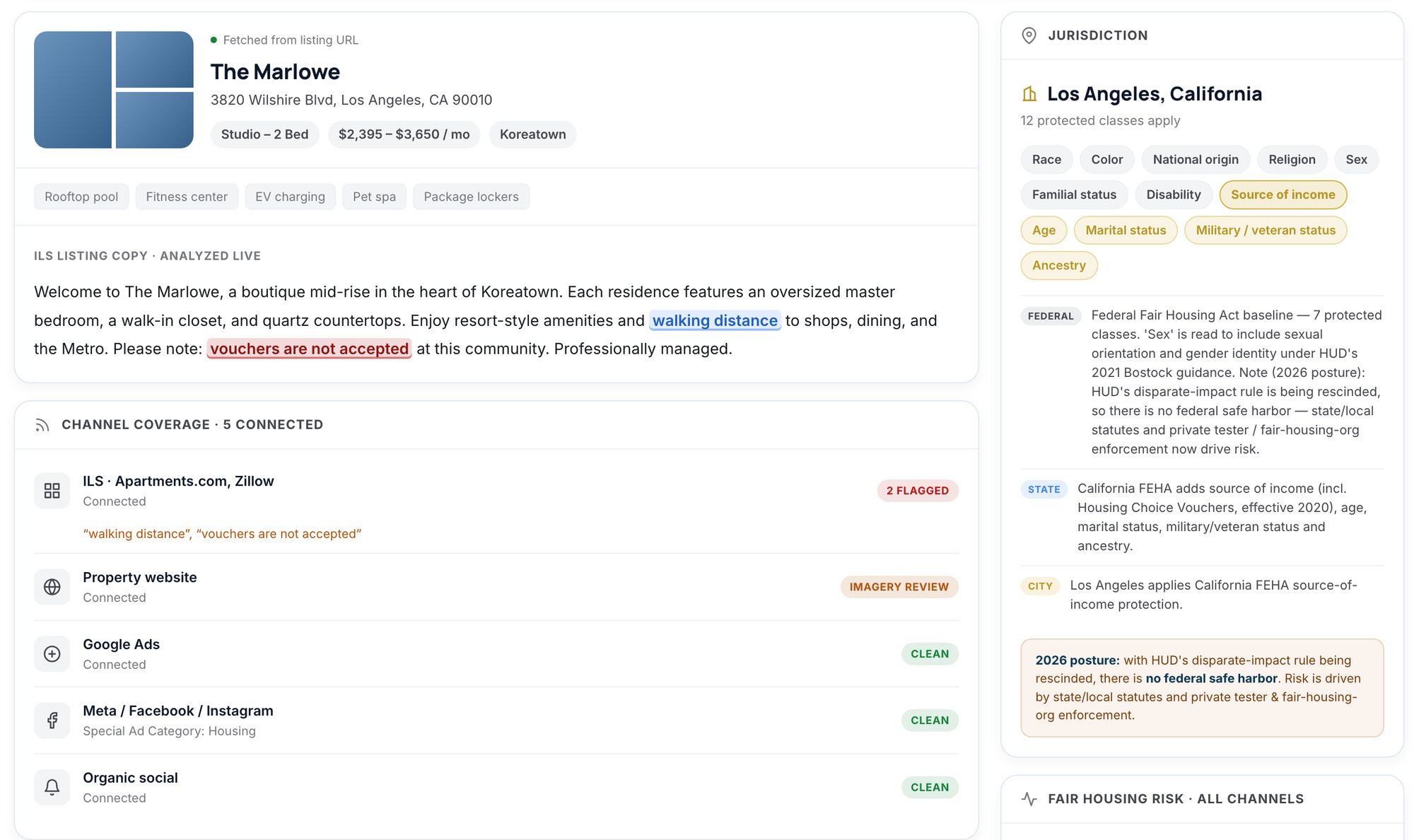
Compliance360 Fair Housing resolves the protected classes in force at each property's address, so "no vouchers" is flagged where source of income is protected and marked as recognized but not actionable where it is not. The portfolio blast radius shows every listing and ad carrying the same phrase, with the rule basis and a suggested rewrite on each flag for a person to review. Listing Consistency, also part of Compliance360, compares listing details on each ILS against your PMS feed nightly, so listings that drift from the source are caught.
Frequently asked questions
It depends on the address. Federal law does not cover source of income, but California, New York, Washington, Michigan, Colorado, Oregon and others ban ads indicating a source of income preference, so the ad alone is a violation there, and many cities add their own bans.
No state uses those words, but PRRAC's March 2026 compilation lists 21 jurisdictions that bar refusing tenants because of source of income. Most cover Housing Choice Vouchers, including California, Colorado, Connecticut, Illinois, Maryland, Massachusetts, Michigan, New Jersey, New York, Oregon, Virginia and Washington; Hawaii, North Dakota, Oklahoma and Utah are narrower.
Not on the full rent in many voucher states. Washington subtracts the voucher from the rent first, Rhode Island and California look only at the tenant's share, Colorado caps the test at 200% of that share, and Michigan bars leaving voucher income out of the count.
Often not. Michigan applies only to landlords with 5 or more units, counting related entities, Colorado excludes three or fewer, and Virginia and Hawaii exempt four or fewer. Multifamily operators clear every statewide threshold.
Not for federal housing assistance. Texas Local Government Code 250.007, in force since September 1, 2015, bars cities and counties from requiring landlords to accept it, which ended Austin's and Dallas's ordinances. Florida (in part), Idaho, Indiana, Iowa, Kentucky and Missouri have similar bans.
Largely. On March 5, 2026 the Third Department, in People v. Commons West, held the refusal-to-rent clause unconstitutional as applied to Section 8 vouchers; the advertising clause was not part of the holding, and PRRAC reports an appeal. Keep refusal language out of New York ads; New York City's own law also applies.
How we checked this
Written by the Brynson Research Team and checked against the primary sources below. Each source shows the date we last read it. We update this page when the rules change; see the change log.
- RCW 59.18.255: Source of income, discrimination prohibited, Washington State Legislature. Accessed 2026-10-22.
- New York Executive Law Section 296, New York State Senate. Accessed 2026-10-22.
- MCL 554.601c: Prohibition based on source of income of tenant, Michigan Legislature, 2025-04-02. Accessed 2026-10-22.
- 42 U.S.C. 3604: Discrimination in the sale or rental of housing, Legal Information Institute, Cornell Law School. Accessed 2026-10-22.
- Matter of People of the State of N.Y. v Commons West, LLC, 2026 NY Slip Op 01253 (3d Dept, Mar. 5, 2026), New York State Law Reporting Bureau, 2026-03-05. Accessed 2026-10-22.
- New York Executive Law Section 292 (definition of lawful source of income, subd. 36), New York State Senate. Accessed 2026-10-22.
- Public Act 178 of 2024 (Enrolled Senate Bill 205), adding MCL 554.601c, Michigan Legislature, 2024-12-30. Accessed 2026-10-22.
- 25 Del. C. 5116: Fair housing provisions, Delaware Code Online. Accessed 2026-10-22.
- Texas Local Government Code Chapter 250 (Sec. 250.007), Texas Legislature, Texas Constitution and Statutes. Accessed 2026-10-22.
- Florida Statutes 83.425: Preemption, Florida Legislature. Accessed 2026-10-22.
- Iowa Code 364.3 (city powers, subsection 16), Iowa Legislature. Accessed 2026-10-22.
- RSMo 441.043: Prohibited ordinances and resolutions, Missouri Revisor of Statutes. Accessed 2026-10-22.
- Appendix B: State, Local, and Federal Laws Barring Source of Income Discrimination (updated March 2026), Poverty & Race Research Action Council, 2026-03. Accessed 2026-10-22.
- Marketing your unit, City of Seattle, Renting in Seattle. Accessed 2026-10-22.
- Protected classes fact sheet, NYC Commission on Human Rights. Accessed 2026-10-22.
- Attorney General James stops illegal housing discrimination in the Capital Region, New York State Attorney General, 2025-04-15. Accessed 2026-10-22.
- Civil Rights Department reaches settlement ending Novato apartment complex ban on Section 8 vouchers, California Civil Rights Department, 2024-04-02. Accessed 2026-10-22.
Change log
- First published.
This guide is general information, not legal advice. Laws and regulator guidance change; check the current rules for your properties with your counsel before acting.