
Multifamily Compliance Program for Apartment Marketing: Owners, Cadence and a RACI Template
For compliance directors, VPs of marketing and operations leads at multifamily operators who have been told to own renter-facing compliance.
A multifamily compliance program for marketing has four parts: an inventory of every surface renters see, a named owner for each rule on each surface, a review cadence, and a record of every fix. Marketing usually owns the content, compliance owns the rules, legal owns the evidence and operations owns the fee data in the PMS.
- Ownership is a portfolio question because fair housing law reaches anyone who publishes or causes an ad to be published, including through agents and vendors.
- Inventory surfaces per property before assigning anyone: the application flow and each ILS listing are the cells most often left unwatched.
- Run checks nightly, triage weekly and report monthly, and count a fix only when the next check agrees.
- Report four numbers: coverage, time to verified fix, recurrence rate and unmonitored cells.
- The RACI on this page is a recommended operating model, not a legal requirement; have counsel confirm the rule list for your states.
This guide is general information, not legal advice. Laws and regulator guidance change; check the current rules for your properties with your counsel before acting.
The four parts, and the default ownership split
Most operators review some marketing. What they lack is a system with four parts:
- Inventory. Every place a renter sees price, policy, copy or photos, per property.
- Owners. One accountable person per rule per surface (the RACI below).
- Cadence. How often each cell is checked, triaged and reported.
- Record. A dated trail from finding to verified fix.
The default split that works for most portfolios: marketing owns content and channel setup, leasing and operations own the fee and unit data in the PMS, compliance owns the rulebook and triage, legal owns evidence and holds, and revenue management owns how prices and fees are packaged before they publish. Vendors are consulted, never accountable: the liability does not move to them.
Why it cannot sit with one team: across 6,000 properties and 1.6M units, Brynson found nearly 89% of communities described themselves differently across listing sites, and although 97% of listings had been updated within the previous 90 days, conflicting mandatory fees, missing amenities and contradictory terms persisted (see the listing accuracy report). Those errors start in the PMS, the syndication feed and the ILS dashboards, which no single team controls.
Why the law makes ownership a portfolio problem
| Rule | What it says | What it means for the program |
|---|---|---|
| Fair Housing Act, 42 U.S.C. 3604(c) | Unlawful "to make, print, or publish, or cause to be made, printed, or published" a discriminatory notice, statement or ad. | An ad your ILS or agency publishes from your data is one you caused. |
| 24 CFR 100.7(a)(1) | Direct liability for "failing to take prompt action to correct and end" a discriminatory practice by an employee or agent the person "knew or should have known" about, and by a third party where the person also "had the power to correct it". | Once a fair housing finding is logged, the duty to act promptly has started: time to verified fix is a legal number too. |
| 24 CFR 100.7(b) | Vicarious liability for an agent's or employee's practice "regardless of whether the person knew or should have known". | Agents and agencies need the same rulebook as marketing. |
| 24 CFR 100.75(b), (c)(2), (c)(3) | Covers oral statements, preferences expressed "to agents, brokers, employees", and "selecting media or locations for advertising". | Scripts, agency briefs and the media plan need owners too. |
| FTC and Colorado v. Greystar, proposed stipulated order (D. Colo., announced December 2, 2025; binds only Greystar) | Section VII.B: deliver the order for 10 years to managers and "all agents and representatives who participate in leasing, advertising, and marketing". Section IX.E: for dynamically generated ads, Greystar may instead keep the ad components and "create a weekly representative example" on each marketing channel. | A public picture of what a regulator expects a fee program to contain. |
One regulatory change matters for program documents. HUD's April 29, 2024 guidance on advertising through digital platforms was withdrawn effective September 17, 2025, and "should not be relied upon as authoritative" (HUD notice FR-6571-N-01). Cite the statute and regulation instead; details are in fair housing advertising for apartments.
How to build the program in seven steps
Run these in order. Steps 1 to 3 are one-time setup per property; steps 4 to 7 are the operating loop.
- 1
Inventory every surface
List each website page with price or policy, the application flow, each ILS listing, paid and organic social, listing photos and leasing scripts, per property. Mark any surface nobody checks today as unwatched.
- 2
Map rules to properties
For each property, record the federal, state and city rules that apply to fees, fair housing, accessibility and image disclosure. Have counsel confirm the map for each state.
- 3
Assign owners with the RACI
Give every rule-on-surface row one accountable owner and a named backup for each responsible role. No vendor can be the accountable owner.
- 4
Set the cadence
Run checks nightly, triage findings weekly, report monthly and review the rulebook quarterly. Put each meeting on a recurring calendar with its owner.
- 5
Close the loop
Count a finding as resolved only when the next check agrees. Link any recurrence to the earlier fix and fix it at the source, usually the PMS.
- 6
Keep the evidence
Capture what renters saw on pricing pages and the application flow on a schedule and on change, and keep it under a written retention schedule with legal holds.
- 7
Report the KPIs
Send leadership coverage, time to verified fix, recurrence rate and unmonitored cells every month, including surfaces you do not watch and why.
8 surfaces programs most often leave unwatched
Use this list to finish step 1.
- 01
The application flow
Often hosted by a PMS or leasing vendor on another domain, so marketing does not treat it as theirs. It is where fee disclosure is tested hardest: the proposed Greystar order's Section II.C bars charging "an initial payment or deposit" without clearly and conspicuously disclosing the Total Monthly Leasing Price and "the existence and amount of any fees or costs" (order text). Owner: leasing and ops, with compliance accountable.
- 02
Each ILS listing, separately
Brynson found that although 97% of listings had been updated within the previous 90 days, conflicts persisted. Treat each ILS as its own cell per property. Brynson works with Apartments.com, Apartment List, Zillow and Zumper as partners. How to audit them is in the ILS listing audit.
- 03
Fee data in the PMS
The source for most surfaces. A mandatory fee flagged optional in the PMS publishes wrong everywhere at once. Owner: leasing and ops.
- 04
Leasing scripts and follow-up templates
Oral statements are in scope under 24 CFR 100.75(b), and email and text templates are copied across properties for years. Review them quarterly and whenever a new script ships.
- 05
Agency briefs and the media plan
Preferences expressed to agents and the choice of media are both covered by 100.75(c)(2) and (c)(3). Keep briefs on file with the campaign.
- 06
Listing photos after syndication
Edited and virtually staged photos get re-syndicated until the original is lost. Track where each runs and whether it needs a disclosure, see virtual staging disclosure laws.
- 07
Organic social and community pages
Posted by site teams with no review step. A post is a written statement under 24 CFR 100.75(b), so "perfect for young professionals" can read as a familial status preference exactly as it would in an ad. Add a weekly sample review using fair housing words to avoid.
- 08
Fee guides, PDFs and interactive maps
Fee guides and site maps carry their own fee numbers, often updated on a different schedule from pricing pages. Compare each fee across all three monthly.
RACI template: who does what, by rule and surface
A recommended model, not a legal requirement. R = responsible (does the work), A = accountable (one per row, signs off), C = consulted, I = informed.
| Rule on surface | Marketing | Leasing and ops | Compliance | Legal | Revenue mgmt | Vendors |
|---|---|---|---|---|---|---|
| Fair housing copy on website, ILS and ads | R | I | A | C | C (agency, ILS) | |
| Paid ad targeting and media mix | A, R | C | I | R (agency) | ||
| Leasing scripts, email and text templates | C | R | A | C | ||
| Fee amounts and mandatory flags in the PMS | I | A, R | C | C | ||
| Fee display on website pricing and floor plans | R | C | A | C | C | R (website provider) |
| Fees shown before payment in the application flow | C | R | A | C | R (PMS or apply vendor) | |
| ILS listing parity with the PMS | A, R | R | I | I | C (ILS) | |
| Website accessibility (WCAG level you target) | A | I | C | C | R (website provider) | |
| Photo edits and virtual staging disclosure | A, R | I | C | C | R (photographer) | |
| Evidence capture, retention and legal holds | I | I | R | A | ||
| New state or city rule intake | I | I | R | A | C |
Two tests: every row has exactly one A and none sits with a vendor; every R has a named backup. A row with no nameable R goes on the unwatched list.
Cadence: what happens nightly, weekly, monthly and quarterly
| Rhythm | What happens | Owner | Output |
|---|---|---|---|
| Nightly | Automated checks of pricing pages, the application flow and ILS listings against the PMS. | System, read by compliance | New and reopened findings, ranked by exposure |
| Weekly | 30-minute triage: assign new findings, chase overdue ones, confirm last week's fixes held. | Compliance (A), marketing and ops (R) | Owners and due dates; a weekly per-channel ad example if you mirror the Greystar pattern |
| Monthly | Portfolio report: coverage, KPIs, top five exposures, and every surface not monitored, with the reason. | Compliance, reviewed by legal | Board or ownership report, dated and kept |
| Quarterly | New state and city laws, script review, RACI names after turnover. | Legal (A), compliance (R) | Updated rule map and RACI with a change log |
End each triage with what reopened: a recurrence usually means the fix went into an ILS dashboard instead of the PMS.
KPIs that tell leadership whether the program works
| KPI | Formula | What a bad number tells you |
|---|---|---|
| Coverage | Property-by-surface cells monitored divided by cells that exist, weighted by units | You are reporting on the part of the portfolio you happen to watch |
| Time to verified fix | Median days from finding to the first re-check that agrees | Fixes are slow or are being marked done without proof |
| Recurrence rate | Findings reopened within 90 days divided by findings closed | Fixes are made downstream (an ILS, a page) instead of at the source |
| Unmonitored cells | Count of surfaces with no check and no named R, by property | Where the next demand letter is most likely to land |
A 40-property portfolio with 9,600 units tracks seven surfaces per property, so 280 cells. In month one, 168 cells are monitored, covering 5,400 units: 60% coverage by cell but 56% by units, because the unwatched cells sit at larger properties. Of 212 findings closed, 38 reopen within 90 days, an 18% recurrence rate; 31 of the 38 are ILS fee mismatches fixed in the ILS dashboard instead of the PMS.
A 30/60/90-day rollout
| Window | Deliverables | Done when |
|---|---|---|
| Days 1 to 30 | Surface inventory; rule map by jurisdiction; draft RACI; evidence capture on for pricing pages and the application flow. | Every cell is monitored or listed as unwatched, with a reason |
| Days 31 to 60 | Named owners and backups; weekly triage running; fee data cleaned in the PMS first. | Four weekly triages held; baseline KPIs recorded |
| Days 61 to 90 | First monthly report; RACI signed off by compliance and legal; retention schedule adopted. | Leadership has seen coverage and unmonitored cells |
Start the evidence capture on day one, not day 90. The schedule and what to keep are in the evidence retention guide.
How one large operator split ownership
Multifamily Executive reported in April 2026 how Mill Creek Residential, with 153 communities operating or under construction in 16 states, spreads the work: a Director of Innovation and Integrations vets technology, a Vice President of Community Support keeps the fee list accurate and sends it to the company's proptech partners, and a Director of Compliance maintains jurisdiction-specific lease documents and works with "14 attorneys nationwide who advise us on their jurisdiction-specific requirements" (Multifamily Executive, April 15, 2026).
Copy the separation, not the headcount: tools, fee execution, rules and local law each have an owner. A 20-property operator can hold all four with three people.
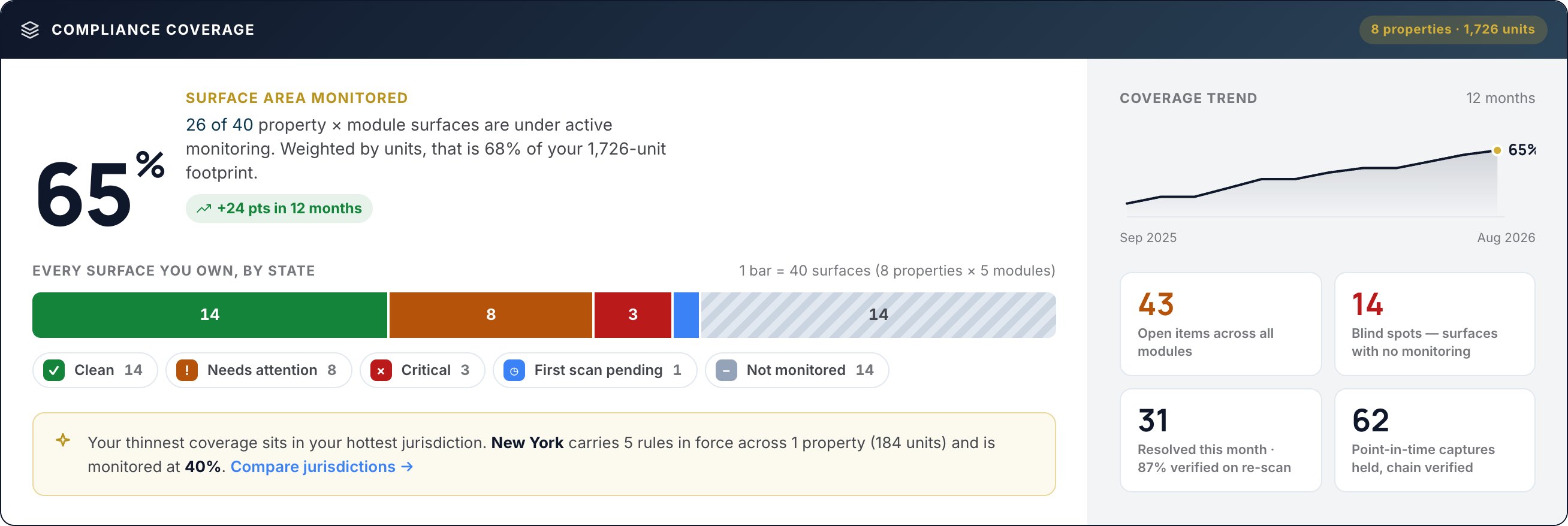
Compliance360 is built around this operating model. Its surface-area matrix scores every property by service cell as clean, attention, critical, first scan pending or not monitored, which is the inventory and the unmonitored-cells KPI; the coverage trend tracks your monitored footprint month over month. The Resolution Center tracks Fee Transparency and Listing Consistency alerts from open to verified, where "resolved" means the next scans agreed, and closed items roll into the monthly compliance report, which Reporting can schedule to ownership. SiteArchiver keeps the evidence, and your PMS, connected through integrations, is the source of truth listings are compared against.
You are still sizing the program
Build the inventory and RACI by hand for five properties first. If most cells are already watched, a manual monthly review may carry you for now.
Fees carry most of your exposure
Start with Fee Transparency for pricing pages and the application flow, and Listing Consistency for ILS parity with the PMS.
You are comparing vendors
See apartment marketing compliance tools and multifamily compliance software, and check security terms on the trust page and costs on pricing.
Frequently asked questions
Legally, the owner and manager can be liable for ads they publish or cause to be published, including through vendors. Internally, marketing is usually responsible for copy, compliance accountable for review and legal consulted. Name one accountable person per surface.
Neither alone. Fee amounts live in the PMS, so operations owns the data, marketing owns the display and compliance is accountable for the rule check. Legal owns the state rule map and the evidence.
Coverage of property-by-surface cells weighted by units, median time to verified fix, recurrence rate within 90 days, and the count of unmonitored cells.
We found no general federal requirement for one. Fair housing rules do make owners liable for failing to promptly correct practices they know about, and FTC orders such as Greystar's impose program-like duties on the company bound. Ask counsel about state and city rules where you operate.
Coverage and its trend, the five largest open exposures, verified fixes, recurrences with root cause, and every surface not monitored with the reason.
How we checked this
Written by the Brynson Research Team and checked against the primary sources below. Each source shows the date we last read it.
- 42 U.S. Code 3604: Discrimination in the sale or rental of housing, Cornell Law School Legal Information Institute (U.S. Code), current. Accessed 2026-10-22.
- 24 CFR 100.7: Liability for discriminatory housing practices, Cornell Law School Legal Information Institute (eCFR), current. Accessed 2026-10-22.
- 24 CFR 100.75: Discriminatory advertisements, statements and notices, Cornell Law School Legal Information Institute (eCFR), current. Accessed 2026-10-22.
- Notification of Withdrawal of Fair Housing and Equal Opportunity Guidance Documents (FR-6571-N-01, FR Doc. 2026-06624), U.S. Department of Housing and Urban Development, Federal Register public inspection, 2026-04-06. Accessed 2026-10-22.
- FTC and State of Colorado v. Greystar Real Estate Partners, LLC, et al., [Proposed] Stipulated Order for Permanent Injunction, Monetary Judgment, and Other Relief (D. Colo. No. 1:25-cv-00165), Federal Trade Commission, 2025-12-02. Accessed 2026-10-22.
- Greystar Agrees to Pay $24 Million to Stop Deceptive Advertising Practices as Result of FTC, Colorado Lawsuit, Federal Trade Commission, 2025-12-02. Accessed 2026-10-22.
- How One Operator Is Leveraging Tech to Navigate a Complex Regulatory Landscape, Multifamily Executive, 2026-04-15. Accessed 2026-10-22.
This guide is general information, not legal advice. Laws and regulator guidance change; check the current rules for your properties with your counsel before acting.