
Apartment Website ADA Lawsuits and Demand Letters: What Multifamily Operators Should Do
For owners, regional managers, in-house counsel and compliance leads at multifamily operators.
Do not ignore it, and do not edit the site first. Send the letter to counsel the day it arrives, preserve how the cited pages looked and worked, reproduce each barrier, then check every property on the same template. Federal website accessibility suits rose 27% to 3,117 in 2025, led by New York, Florida and Illinois.
- Private ADA Title III suits seek injunctions and attorney's fees; California's Unruh Act adds damages of at least $4,000 for each offense.
- Preserve first: once you fix a page, the version the letter describes is gone unless you captured it.
- One letter usually describes a template problem, so test every site built on the same theme and application vendor.
- An overlay widget installed in response is not a fix; the FTC ordered accessiBe to pay $1 million over its WCAG compliance claims.
- The best defense file is built before a letter: a dated record of scans, manual review and fixes.
This guide is general information, not legal advice. Laws and regulator guidance change; check the current rules for your properties with your counsel before acting.
The first hour: three things to do and three to avoid
A demand letter usually names one property, a URL, a list of barriers a screen-reader or keyboard user hit, and a deadline to respond or settle. The first hour decides whether you keep your options open.
| Do | Avoid |
|---|---|
| Log the date received, the property, every URL cited and any deadline, then send it to counsel. | Replying to the sender or the plaintiff's firm yourself. |
| Tell marketing and the website vendor to hold changes to the cited pages until they are captured. | Quietly fixing the cited pages before preserving them. |
| Ask counsel whether any insurance policy requires notice of the claim. | Installing an overlay widget and calling the site fixed. |
The overlay point matters. The FTC's final order against accessiBe, approved in April 2025, required it to pay $1 million over claims that its widget could make any website WCAG compliant (FTC). Why widgets do not answer a claim is covered in accessibility overlays on apartment websites.
Website accessibility lawsuit statistics for 2025
Seyfarth Shaw counted 3,117 federal website accessibility suits in 2025, a 27% increase from 2,452 in 2024, and found website cases were 36% of all ADA Title III federal filings (Seyfarth, March 2026). Filing is concentrated in a few federal courts:
| State | Suits | Share of 3,117 |
|---|---|---|
| New York | 1,021 | 33% |
| Florida | 961 | 31% |
| Illinois | 585 | 19% |
| Minnesota | 162 | 5% |
| Pennsylvania | 137 | 4% |
| Missouri | 86 | 3% |
| Massachusetts | 57 | 2% |
| California | 4 | 0.1% |
Why California looks quiet. Seyfarth's explanation is that New York federal judges have been more favorable to plaintiffs suing online-only businesses, while "in California, both federal and state courts of appeals have reached the conclusion that online only businesses are not covered by the ADA." An apartment community has a physical leasing office, so counsel should not assume the online-only argument helps. And a federal count does not include state court cases, where California Unruh Act claims can be brought. Unruh makes an ADA violation a violation of state law (Civ. Code 51(f)) and sets damages "for each and every offense" at up to three times actual damages "but in no case less than four thousand dollars ($4,000)," plus attorney's fees (Civ. Code 52(a)). Read a low federal number as "filed elsewhere", not "low risk".
UsableNet's mid-year report counted 2,019 digital accessibility lawsuits in the first half of 2025, with eCommerce at 69% (UsableNet, August 2025). Neither UsableNet's release nor Seyfarth's count breaks out housing, so no published figure tells you how often apartment sites are targeted. Plan on the basis that a letter can arrive, not on an industry share.
Housing cases: Apartments.com and the Southern California suits
Apartments.com (S.D.N.Y., filed May 5, 2021). A legally blind Bronx resident sued CoStar alleging 13 WCAG failures on Apartments.com, including links and entry fields not properly titled in the code and images without alternative text. The complaint asked for an injunction requiring a mutually agreed accessibility consultant, compensatory damages and class status for blind and visually impaired New York City users (Bisnow, May 2021). Any property site can carry the same kinds of barrier: unnamed buttons, unlabeled filters, undescribed photos.
Southern California apartment suits. The United African Asian Abilities Club has filed suits against apartment buildings, mainly in Los Angeles and Southern California, alleging Fair Housing Act violations based on both physical barriers at the property and website accessibility; a defense firm describes "dozens or hundreds" of buildings sued on similar grounds. That firm wrote that "the Fair Housing Act has not yet been interpreted as requiring website accessibility to our knowledge," and advised recipients to use defense counsel experienced in both ADA and Fair Housing Act claims rather than treat the suits casually (JMBM, February 2023). The practical lesson for operators: a website letter can arrive alongside a physical-site claim, so loop in the property team as well as marketing.
What a plaintiff can actually ask for
Knowing the remedy explains the letter. A private Title III plaintiff gets "the remedies and procedures set forth in section 2000a-3(a)" (42 U.S.C. 12188(a)(1)), which means "preventive relief, including an application for a permanent or temporary injunction" (42 U.S.C. 2000a-3(a)). Separately, the court "may allow the prevailing party, other than the United States, a reasonable attorney's fee, including litigation expenses, and costs" (42 U.S.C. 12205).
| Claim | What it can produce | Source |
|---|---|---|
| ADA Title III (private suit) | An injunction to make the site usable, plus attorney's fees to a prevailing party at the court's discretion | 42 U.S.C. 12188, 12205 |
| California Unruh Act | For each offense, actual damages up to three times, in no case less than $4,000, plus attorney's fees | Civ. Code 52(a) |
| Fair Housing Act | Pleaded in some apartment website suits; a defense firm says that, to its knowledge, it has not been interpreted to require website accessibility | JMBM, 2023 |
Because the federal remedy is an order to fix the site, a remediated site with a dated record is the core of most responses. What that is worth in a particular case is counsel's call.
Day 1 to day 30: the operator's response plan
Counsel sets the legal strategy and deadlines. This is the operational work that runs alongside it, so counsel has facts to work with.
Time needed: P30D
- 1
Day 1: log it and route it to counsel
Record when and how the letter arrived, the property, every URL and barrier cited, and any deadline. Send it to counsel the same day and do not respond to the sender directly.
- 2
Day 1 to 2: preserve before you change anything
Capture each cited page as it looks and works now, on desktop and mobile, and keep CMS change history and vendor release notes for the dates cited. Counsel decides whether a formal legal hold is needed; see the evidence retention guide for what to keep.
- 3
Day 2 to 5: reproduce every cited barrier
Test each barrier with a keyboard and a screen reader and map it to a WCAG 2.1 AA success criterion. Mark each one confirmed, not reproduced, or already fixed, with the date and the tester's name.
- 4
Day 3 to 7: test the template across the portfolio
List every property site that shares the theme, application vendor and widgets of the cited site, and run the same tests there. Record which barriers come from shared components and which from per-property content.
- 5
Day 5 to 10: brief vendors in writing
Send each responsible vendor the confirmed barriers, the WCAG criteria and a fix date, and check what your contract says about accessibility. A vendor-built application is still part of your leasing service.
- 6
Day 7 to 21: fix in order of who is blocked
Fix the application flow and keyboard blockers first, then missing names and alt text, then contrast and lower-impact items. Log every fix with the date, the page and the change made.
- 7
Day 14 to 25: re-test, including the manual checks
Re-run automated scans and have a person check what tools cannot judge, such as meaningful alt text and focus order. Record the result for each cited barrier and for the portfolio sweep.
- 8
Day 21 to 30: hand counsel the record
Give counsel the preserved captures, the reproduction notes, the fix log, re-test results and an updated accessibility statement. Counsel decides what to share and how to respond.
The portfolio blast radius: one letter, one template, many sites
Property websites are rarely built one at a time. A management company usually runs dozens of sites on one theme from one website vendor, with one application vendor and one chat or tour widget embedded in all of them. A barrier in the theme exists on every site that uses it, so the next letter can name a different property for the same defect.
A letter cites three barriers on one property's site: unlabeled bedroom filters, gallery photos with no alt text, and an "Apply now" control that a keyboard cannot reach. The operator runs 42 sites.
| Cited barrier | Where it comes from | Sites affected | Who fixes it |
|---|---|---|---|
| Unlabeled bedroom filters | Shared theme component | 38 of 42 | Website vendor, once |
| Photos without alt text | Content entered per property | 42 of 42, to different degrees | Marketing, per property |
| "Apply now" not reachable by keyboard | Embedded application vendor button | 42 of 42 | Application vendor, once |
Two of the three fixes are single vendor changes that clear every site. Fixing only the cited property would have left 41 sites with the same two defects.
Per-property content is the part that drifts. In listing data, Brynson's analysis of 6,000 properties and 1.6 million units found about 89% of communities described themselves differently across listing sites. Fix the shared template once, then sample the content property by property: alt text entered property by property is only as good as whoever entered it.
Eight records to build before a letter arrives
Most of the response plan is faster when these already exist. Each is something you can produce on request, with a date on it.
- 01
An accessibility statement on every property site
W3C says a statement should at least give a commitment to accessibility, "the accessibility standard applied, such as WCAG 2.2" and "contact information in case users encounter problems," and calls it advisable to list known limitations (W3C WAI). Test: can a renter find a phone number and email on the statement page in two clicks from the home page?
- 02
A dated scan history per property
A one-off audit PDF shows one day. A history shows that you scan on a schedule and that issues close. DOJ notes that a "clean" automated report "does not necessarily mean everything is accessible" (DOJ web guidance), so pair scans with the next record.
- 03
A manual review log
Who checked keyboard access, focus order, alt text meaning and the application flow by hand, on which date, and what they found. The test plan is in the apartment website accessibility checklist.
- 04
A fix log with ticket dates
Each finding, the ticket, who fixed it and when it shipped. This is the record that shows a cited barrier was already known and closed, or closed within days of the letter.
- 05
Vendor contracts with a WCAG target and fix window
Website, application, chat and tour vendors each own part of the experience. A contract clause naming WCAG 2.1 AA and a fix window turns a template defect into the vendor's ticket. Applications get their own section in accessible rental applications.
- 06
Point-in-time captures of key pages
Letters cite a page as it was, sometimes months earlier. Captures of pricing, floor plans and application pages let you show what the page did on that date. What counts as good evidence, and why screenshots and the Wayback Machine fall short, is in compliance evidence retention.
- 07
A log of requests for help applying
When a renter calls or emails because a site step did not work, log the request and how you helped. It shows the leasing team responds, and it surfaces barriers before a plaintiff's tester does.
- 08
A written decision on overlays
If a widget is installed, record why and what it does not do. If you removed one, record the date. After the FTC's accessiBe order, "we installed a widget" is not a defense file.
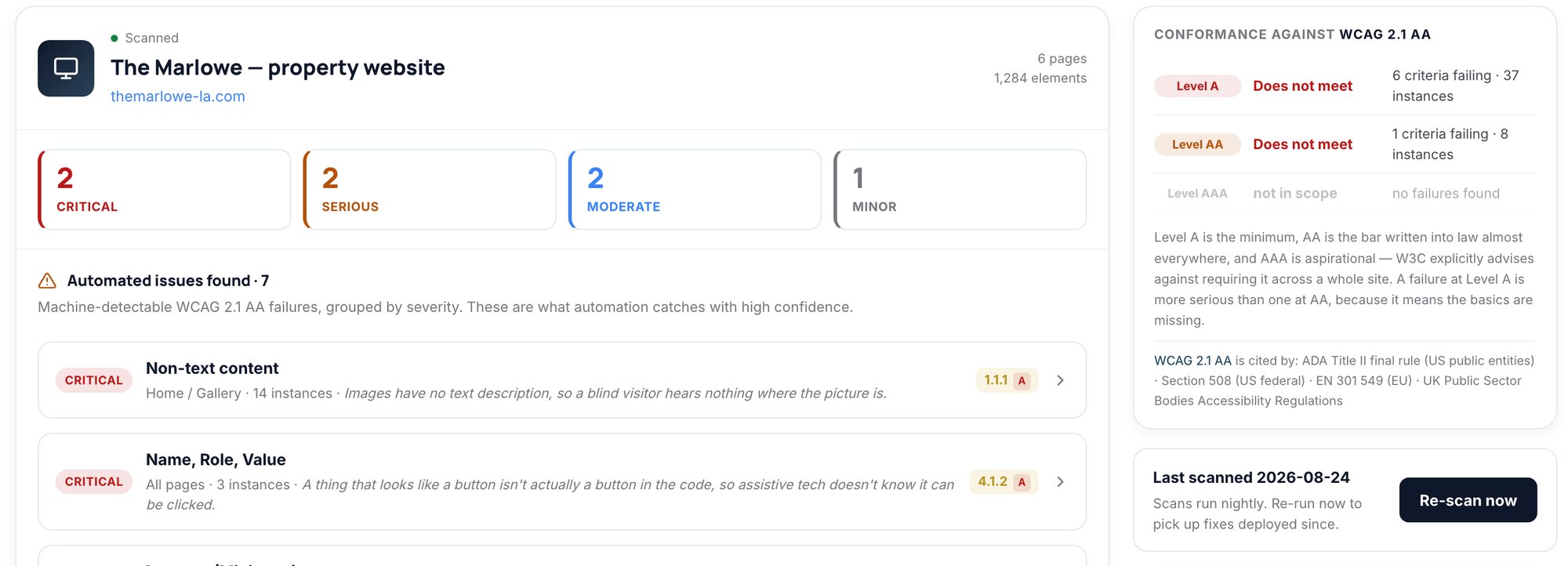
Two Compliance360 services build the records above. Web Accessibility reviews each property's key pages and application flow against WCAG 2.1 AA by default, explains every finding with where it is and how to fix it, adds a manual review checklist, and keeps a dated history of findings, fixes and nightly re-scans. SiteArchiver keeps hash-chained, point-in-time captures of property pages so you can show how a page looked and worked on a given date, and place a matter on legal hold. Neither prevents a claim or decides whether a site meets the law; they give counsel the record. See the full Compliance360 suite.
Frequently asked questions
Send it to counsel the same day, preserve the cited pages before anyone edits them, and reproduce each barrier with a keyboard and screen reader. Then test every property on the same template and fix in order of who is blocked, logging each fix with a date.
Seyfarth Shaw counted 3,117 federal website accessibility suits in 2025, up 27% from 2,452 in 2024, and 36% of all ADA Title III filings in federal court. That count covers federal court only, so state court cases such as California Unruh Act claims are not in it.
In federal court, New York (1,021), Florida (961) and Illinois (585) accounted for about 82% of 2025 filings, per Seyfarth's counts. California shows only 4 federal cases, but Unruh Act claims, with a $4,000 minimum for each offense, can be brought in state court, which the federal count does not include.
Under federal ADA Title III, a private plaintiff can seek an injunction, and the court may award attorney's fees to the prevailing party; the statute does not provide money damages to private plaintiffs. State laws can add damages: California's Unruh Act sets at least $4,000 for each offense. Counsel can tell you which laws apply to your properties.
Not automatically, and the answer depends on the case. Because the federal remedy is an order to fix the site, a documented fix is central to most responses, but whether it resolves a case is for counsel and the court. Fix anyway, and keep the dated record.
It can. Settling one claim does not fix the site, and if the barriers remain or come back, the next letter can come from someone else about the same template. What a particular settlement covers is a question for counsel, which is why the fix log, scheduled re-scans and portfolio-wide testing matter after a settlement.
How we checked this
Written by the Brynson Research Team and checked against the primary sources below. Each source shows the date we last read it.
- 42 U.S.C. 12188, Enforcement, Legal Information Institute, Cornell Law School. Accessed 2026-10-22.
- 42 U.S.C. 2000a-3, Civil actions for injunctive relief, Legal Information Institute, Cornell Law School. Accessed 2026-10-22.
- 42 U.S.C. 12205, Attorney's fees, Legal Information Institute, Cornell Law School. Accessed 2026-10-22.
- California Civil Code section 51, FindLaw (statute text). Accessed 2026-10-22.
- California Civil Code section 52, FindLaw (statute text). Accessed 2026-10-22.
- Guidance on Web Accessibility and the ADA, U.S. Department of Justice, ada.gov, 2022-03-18. Accessed 2026-10-22.
- FTC Approves Final Order Requiring accessiBe to Pay $1 Million, Federal Trade Commission, 2025-04-22. Accessed 2026-10-22.
- Developing an Accessibility Statement, W3C Web Accessibility Initiative. Accessed 2026-10-22.
- Federal Court Website Accessibility Lawsuits in 2025, Seyfarth Shaw LLP (Kristina Launey, Minh Vu), via JD Supra, 2026-03-27. Accessed 2026-10-22.
- Digital Accessibility Lawsuits Surge in 2025 (UsableNet mid-year report), UsableNet, via Newswire, 2025-08-04. Accessed 2026-10-22.
- United African Asian Abilities Club Through David Wakefield Sue Apartment Buildings: How to Respond, Jeffer Mangels Butler & Mitchell LLP (Stuart Tubis), 2023-02-23. Accessed 2026-10-22.
- CoStar sued over lack of blind accessibility on Apartments.com, Bisnow, 2021-05-11. Accessed 2026-10-22.
This guide is general information, not legal advice. Laws and regulator guidance change; check the current rules for your properties with your counsel before acting.