
Apartment Admin Fees: What They Cover, Where They Are Restricted and How Multifamily Operators Disclose Them
For revenue, marketing, leasing and compliance leads at multifamily operators deciding whether to keep, restructure or re-disclose an admin fee.
An apartment admin fee is a one-time charge for processing a new lease, separate from the application fee and the security deposit. No federal law bans it, but the FTC's Greystar order sets the benchmark: disclose it before taking any payment. California treats it as security, Massachusetts bars it at move-in, and Illinois restricts related lease fees.
- The FTC's Greystar order, binding on Greystar only, requires each fee's amount, purpose and timing before any initial payment.
- California counts a fee for processing a new tenant as security, so a lease cannot call it nonrefundable.
- Massachusetts limits move-in payments to first and last month's rent, a security deposit and a new lock and key.
- Illinois bans renewal and modification fees and puts every non-optional fee on the lease's first page, for leases from January 1, 2027.
- Nearly 89% of communities in Brynson's analysis described themselves differently across listing sites, so fee changes rarely land everywhere.
This guide is general information, not legal advice. Laws and regulator guidance change; check the current rules for your properties with your counsel before acting.
What an admin fee is, and what it is not
The admin fee (also called administrative or lease processing fee) is a flat, one-time charge collected on approval or at signing. Fee schedules often blur it with charges the law treats differently.
| Charge | When it is taken | What it pays for | Where the law gets specific |
|---|---|---|---|
| Application or screening fee | With the application, per applicant | Credit and background checks | California caps it at actual out-of-pocket cost with a CPI-indexed ceiling (Civ. Code 1950.6); Illinois caps it at $50 with a narrow background-check pass-through (765 ILCS 705/35(c)(1)) |
| Admin fee | On approval or at lease signing | Lease preparation and onboarding | Security in California; barred at move-in in Massachusetts (below) |
| Security deposit | Before move-in | Unpaid rent, damage | Refundable; California caps it at one month's rent for most (Civ. Code 1950.5(c)) |
| Recurring "admin" or service fee | Monthly | Whatever the addendum says | Not an admin fee: under the Greystar order and Connecticut's rule, it belongs in the advertised rent (fee-by-fee guide) |
Zumper estimates typical admin fees at $100 to $500 (December 2023); that range is theirs, not Brynson's. Zumper also says the fee can cover credit and background checks, the exact description that creates exposure in Illinois and California.
Is an apartment admin fee legal? The states that change the answer
No federal statute bans admin fees. The federal exposure is deception: the stipulated order the FTC and Colorado announced against Greystar in December 2025 bars misrepresenting "the existence or amount of any fees or costs" (Section I.B). It binds Greystar only but sets the federal benchmark. The FTC's March 2026 advance notice on rental fees asked for comment; it is not a rule.
| State | What the text says | What it means for an admin fee | Source |
|---|---|---|---|
| California | "Security" includes any fee imposed at the start of the tenancy "to reimburse the landlord for costs associated with processing a new tenant," and no lease may call security "nonrefundable." | Security: refundable, and counted toward the one-month cap. | Civ. Code 1950.5(b), (c), (n) |
| Massachusetts | At or before the start of a tenancy, no lessor may require "any amount in excess of" first and last month's rent, a security deposit and the cost of a new lock and key. | Not on the list, so it cannot be required. | M.G.L. c. 186, s. 15B(1)(b) |
| Illinois | Bans fees "ancillary to the application fee" that duplicate screening, and fees "for modification or renewal of a lease agreement." Every non-optional fee, one-time or recurring, goes on the lease's first page and in the listing. Owner-occupied buildings of 6 units or fewer are exempt. | At application: high risk. At signing: allowed if disclosed. At renewal: banned. | Public Act 104-0479, 765 ILCS 705/35 |
| Minnesota | Ads must disclose "the nonoptional fees included with the total amount for rent"; the lease must disclose all nonoptional fees. | A mandatory admin fee must appear in the ad and the lease. | Minn. Stat. 504B.120 |
| Colorado | "Total price" includes amounts that "are not reasonably avoidable," shown as a single number. Anything outside it needs its nature and purpose, including refundability, disclosed before the renter "consents to pay." | Disclose it with the price and say if it is refundable. How a one-time fee fits a monthly figure is not spelled out. | HB25-1090, C.R.S. 6-1-737 |
| Connecticut | Fees the tenant pays "on a periodic basis" must be "prorated and included" in the advertised rent. | A one-time fee sits outside the advertised rent; a monthly one does not. | Public Act 25-44, Sec. 9(a) |
Illinois date: the enrolled Act's Section 99 reads July 1, 2026, but the ILGA bill status lists January 1, 2027, as does Illinois Legal Aid Online. Confirm with counsel. Other states: the rental junk fee laws by state tracker.
8 admin fee mistakes that create disclosure risk
Patterns on operator fee schedules, with the rule each runs into.
- 01
Taking the admin fee with the application
Illinois bans fees "ancillary to the application fee" that duplicate screening or cover costs unrelated to it (705/35(c)(2)). Collect it at lease signing.
- 02
Describing it as covering credit or background checks
That reads as a screening fee, which is capped in California (Civ. Code 1950.6) and at $50 in Illinois (705/35(c)(1)). Make the stated purpose match what it pays for.
- 03
Calling it nonrefundable in California
A fee for "processing a new tenant" is security, which no lease may call "nonrefundable" (1950.5(b), (n)), and it counts toward the one-month cap.
- 04
Requiring it at move-in in Massachusetts
The move-in list is closed and has no admin fee (c. 186, s. 15B(1)(b)).
- 05
Charging an admin fee for renewals or lease changes in Illinois
Fees "for modification or renewal of a lease agreement" are banned for covered leases (705/35(c)(3)). Review renewal, transfer and lease-change fees now.
- 06
Renaming it
"Lease processing" or "onboarding" is the same fee. Illinois says a landlord "may not rename a fee or charge to avoid application" of the section (705/35(e)).
- 07
Revealing it after money changes hands
A fee first shown after the application fee is paid is the pattern Section II.C of the Greystar order prohibits. Show it before the first payment screen.
- 08
Changing it in one place
A fee updated in the PMS but not on a hand-keyed ILS listing gives renters two prices, and in Illinois breaks the listing rule in 705/35(b)(1). Verify every fee change on each site.
Does the admin fee belong in the advertised rent?
Usually beside the headline number, not in it. The Greystar order's Total Monthly Leasing Price covers "all mandatory monthly costs or fees," so a one-time fee sits outside it (Definition K), and Connecticut reaches only periodic fees. Massachusetts defines Total Price as "inclusive of all fees, charges, or other expenses" (940 CMR 38.03) but lets rentals show it monthly (38.04); its move-in ban usually decides the question first. In Colorado, have counsel approve the display.
The safe pattern: monthly all-in price first, one-time charges in one labelled line under it, everywhere.
Before: "2 Bed from $1,895/mo. Apply now." The $250 admin fee first appears after the $50 application fee is paid.
After: "2 Bed from $1,960/mo (includes $1,895 rent, $65 technology). One-time: $50 application per applicant, $250 admin fee, due at lease signing and not charged if you do not sign." Shown above Apply and on every ILS.
When it must be disclosed: before the application fee
The Greystar order bars "Charging or causing any Charge for an initial payment or deposit" without first disclosing, clearly and conspicuously, the existence and amount of each fee, whether it is optional or required, its nature and purpose, and "the timing and frequency" of the charge (Section II.C). The FTC's release says "before taking any payment, such as a nonrefundable application fee"; Colorado's line is before the renter "consents to pay."
Test every apply path, including ILS apply buttons:
- Visible: is the amount shown without opening a PDF or tooltip?
- Before payment: does it appear before the first card-details screen?
- Complete: does it say when it is due and whether it is refundable?
One fail is a finding; the fee transparency audit checklist extends this page by page.
Why your ILS shows a different admin fee than your PMS
A lease-up promo waives the admin fee, a regional VP raises it, a state law zeroes it, and each change must reach the website, every ILS and the lease template. In Brynson's analysis of 6,000 properties and 1.6 million units, nearly 89% of communities, at origination, described themselves differently across listing sites. Although 97% of listings had been updated within the previous 90 days, conflicting mandatory fees, missing amenities and contradictory terms persisted (the listing accuracy report).
| Surface | Admin fee shown | Why |
|---|---|---|
| PMS fee schedule | $250 | Source of truth, raised from $150 |
| Property website | $250 | Pulls from the PMS |
| ILS listing A | $400 | Hand-keyed, never synced |
| ILS listing B | $150 | Fee field unmapped; old value stuck |
| Lease first page | Not listed | Filed under "other charges" |
For a covered Illinois lease, the missing first-page line alone means the tenant is not liable for the fee (705/35(b)).
Fix the PMS and feed mapping, not the ILS dashboard, then recheck every surface (method: the ILS listing audit).
How to audit an admin fee across your portfolio
Run it per property, starting with California, Massachusetts and Illinois.
- 1
Export the fee schedule
Pull every one-time charge from the PMS for each property, with its amount, when it is collected and its refund terms.
- 2
Map each property to its rules
Tag each address with its state and city fee rules, using the state table above and the junk fee tracker.
- 3
Classify the fee honestly
Decide whether it pays for screening, lease processing or something recurring, and rename nothing to change the answer.
- 4
Walk the apply path
On the website and each ILS, confirm the amount, timing and refundability appear before the first payment screen.
- 5
Compare every listing with the PMS
Check the admin fee field on each listing source against the PMS value and record every mismatch.
- 6
Check the lease template
Make sure the fee is on the first page in Illinois, disclosed in the lease in Minnesota, and never labelled nonrefundable in California.
- 7
Fix at the source and verify
Correct the PMS and feed mapping, resync, recheck every surface and keep dated captures.
Keep, restructure or re-disclose: the revenue decision
Once the fee must sit beside rent on every listing, it is a revenue decision.
| Option | Fits when | Watch for |
|---|---|---|
| Keep and re-disclose | Outside California and Massachusetts, charged once at lease signing | Disclose before the application fee, on every ILS and, in Illinois, on the lease's first page |
| Fold into rent | It hurts ILS comparison, or a state treats it as security | Fold it into rent, not a new monthly fee, which must be in the advertised rent anyway |
| Drop or waive | Massachusetts; Illinois renewals; any fee that really pays for screening (fold that cost into the capped application fee) | Remove it from the PMS, feeds and lease template the same day |
$250 over a 12-month lease is about $20.83 a month: a $1,895 listing becomes $1,916, with no separate line to keep in sync.
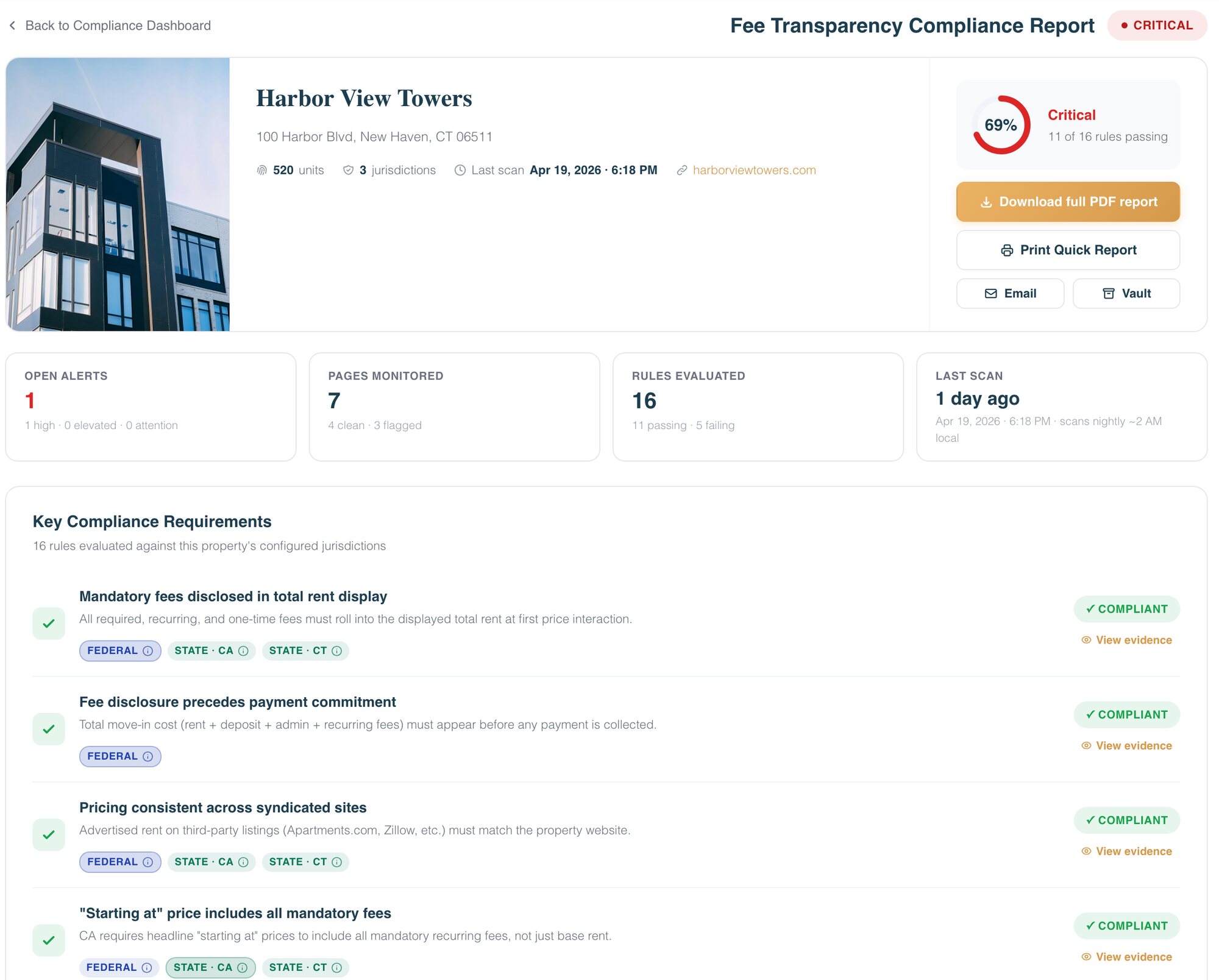
Listing Consistency in Compliance360 compares application, admin and pet fees, rent range and lease terms on Apartments.com, Apartment List, Zillow, Zumper and HelloData with your PMS every night, and counts a fix only when the next sync agrees. Brynson works with Apartments.com, Apartment List, Zillow and Zumper as partners. Fee Transparency checks your pricing pages and application flow each night against each property's fee rules, and SiteArchiver keeps dated captures of what renters saw, so you can show when an admin fee changed and what was displayed before.
Frequently asked questions
Usually lease preparation, move-in coordination and onboarding. If it actually pays for credit or background checks, it works as a screening fee, which California and Illinois cap.
It depends on the state. California counts a fee to process a new tenant as security under Civil Code 1950.5, which a lease cannot call nonrefundable. Elsewhere, state the refund terms before the renter pays.
No. The application fee pays for screening, per applicant; the admin fee is a one-time lease processing charge. Taking it with the application fee can breach Illinois's ban on fees ancillary to the application fee.
No. Massachusetts limits move-in payments to first and last month's rent, a security deposit and a new lock and key, which leaves no room for one. California treats it as refundable security.
Not in Illinois for leases covered by Public Act 104-0479 (January 1, 2027 on the ILGA record), which bans renewal and modification fees. Elsewhere, disclose it like any mandatory fee and check local rules.
Usually the fee changed in the PMS but the listing was hand-keyed or the fee field is unmapped in the feed. Fix the source and mapping, resync, then verify each listing.
How we checked this
Written by the Brynson Research Team and checked against the primary sources below. Each source shows the date we last read it.
- Stipulated Order for Permanent Injunction, Monetary Judgment, and Other Relief, FTC and State of Colorado v. Greystar Real Estate Partners, LLC et al., Federal Trade Commission, 2025-12. Accessed 2026-10-22.
- Greystar Agrees to Pay $24 Million and Stop Deceptive Advertising Practices as a Result of FTC and Colorado Lawsuit, Federal Trade Commission, 2025-12-02. Accessed 2026-10-22.
- FTC Seeks Public Comment on a Proposed Rulemaking Regarding Unfair or Deceptive Rental Housing Fee Practices, Federal Trade Commission, 2026-03-12. Accessed 2026-10-22.
- California Civil Code 1950.5 (security), FindLaw (California Codes), current as of 2026-01-01. Accessed 2026-10-22.
- California Civil Code 1950.6 (application screening fee), FindLaw (California Codes), current as of 2026-01-01. Accessed 2026-10-22.
- Massachusetts General Laws, Chapter 186, Section 15B, Massachusetts Legislature, current. Accessed 2026-10-22.
- 940 CMR 38.04, Total Price disclosure (incl. dwelling-unit periodic pricing), Legal Information Institute, Cornell Law School (Massachusetts Regulations), 2025-03-14. Accessed 2026-10-22.
- 940 CMR 38.03, Definitions (Total Price), Legal Information Institute, Cornell Law School (Massachusetts Regulations), 2025-03-14. Accessed 2026-10-22.
- Public Act 104-0479 (HB3564), 765 ILCS 705/35, Rental fee transparency and limitations (enrolled text), Illinois General Assembly, 2026. Accessed 2026-10-22.
- Public Act 104-0479 (ILGA page; shows Effective Date 1/1/2027), Illinois General Assembly, 2026. Accessed 2026-10-22.
- HB3564 bill status (Governor approved 6/26/2026; Effective Date January 1, 2027; Public Act 104-0479), Illinois General Assembly, 2026-06-26. Accessed 2026-10-22.
- Rental junk fee ban, Illinois Legal Aid Online. Accessed 2026-10-22.
- Minnesota Statutes 504B.120, Prohibited Fees, Minnesota Office of the Revisor of Statutes, 2023. Accessed 2026-10-22.
- HB25-1090, Protections Against Deceptive Pricing Practices, Session Laws 2025, Chapter 94 (C.R.S. 6-1-737), Colorado General Assembly, 2025-04-21. Accessed 2026-10-22.
- Public Act No. 25-44 (Substitute Senate Bill No. 3), Sec. 9, Connecticut General Assembly, 2025-06-10. Accessed 2026-10-22.
- What Is an Apartment Administrative Fee and What Does It Cover?, Zumper, 2023-12-07. Accessed 2026-10-22.
- Apartment Listing Accuracy Report, Brynson, 2026-10-22. Accessed 2026-10-22.
- Brynson Launches Compliance360 for Multifamily Operators (press release), Brynson, 2026-10-22. Accessed 2026-10-22.
This guide is general information, not legal advice. Laws and regulator guidance change; check the current rules for your properties with your counsel before acting.