
Does California SB 478 Apply to Apartments? The Honest Pricing Law and Multifamily Advertised Rent
For marketing, leasing and compliance leads at operators with California communities, and the counsel who advise them.
SB 478 does not name apartments. It added Civil Code 1770(a)(29) to the Consumers Legal Remedies Act, in force since July 1, 2024, banning advertised prices that leave out mandatory fees other than government taxes and shipping. Whether the CLRA reaches residential leases is unsettled, so the conservative course is to price advertised rent as if it does.
- The Attorney General's SB 478 FAQ names short-term rentals as covered but says nothing about long-term residential leases.
- The CLRA covers goods and services, and a lease of real property fits neither definition cleanly.
- California's False Advertising Law covers real property in its own words, so misleading rent carries risk either way.
- Fees contingent on later conduct, such as late fees, are not mandatory under the AG's guidance.
- SB 611 and AB 2493 changed other fees; neither requires all-in rent ads.
This guide is general information, not legal advice. Laws and regulator guidance change; check the current rules for your properties with your counsel before acting.
What SB 478 actually says
SB 478 (Chapter 400, Statutes of 2023, chaptered October 7, 2023) took effect on July 1, 2024 (CalMatters Digital Democracy). It added paragraph (29) to the list of unlawful practices in Civil Code 1770, the core of the Consumers Legal Remedies Act (CLRA). The operative words are short (Civ. Code 1770(a)(29)(A)):
Advertising, displaying, or offering a price for a good or service that does not include all mandatory fees or charges other than either of the following: (i) Taxes or fees imposed by a government on the transaction. (ii) Postage or carriage charges that will be reasonably and actually incurred to ship the physical good to the consumer.
Subparagraphs (B) to (D) carve out broadband providers that use the FCC broadband label, financial entities making required federal or state disclosures, and certain restaurant, bar and grocery fees. None mentions housing. The statute also does not define "mandatory". Four answers in the Attorney General's FAQ fill part of that gap:
| AG guidance (quoted) | What it would mean for advertised rent, if the law applies | Source |
|---|---|---|
| "The advertised or listed price must be the full price that the consumer is required to pay." | A fee every resident pays, such as a mandatory trash, pest or technology package, belongs inside the rent number, not in a footnote. | CA AG FAQ |
| Disclosing fees before the transaction is finalized: "No." | Showing the fees on the application page or in the lease does not fix an advertised rent that left them out. | CA AG FAQ |
| Fees "contingent on certain later conduct by a consumer" are "not mandatory". | Late fees, NSF charges and damage charges would sit outside the number. | CA AG FAQ |
| "Fees for optional services or features do not need to be included in the advertised price." | Parking, storage or pet rent that a resident can decline stays outside the number. | CA AG FAQ |
The AG also says the law "applies to the sale or lease of most goods and services that are for a consumer's personal use" (CA AG FAQ). Its examples are "event tickets, short-term rentals, hotels, and food delivery platforms". Long-term residential leases, landlords and tenants are not mentioned anywhere in the FAQ.
Does it apply to residential leases? What is settled and what is not
The CLRA covers practices "in a transaction intended to result or that results in the sale or lease of goods or services to any consumer" (Civ. Code 1770(a)). Everything turns on two definitions in Civ. Code 1761:
- Goods are "tangible chattels bought or leased for use primarily for personal, family, or household purposes". An apartment is real property, not a chattel.
- Services are "work, labor, and services for other than a commercial or business use". An apartment lease is a lease of real property, but a modern rent bill often bundles services: valet trash, internet, pest control, amenity access.
One reading says a lease of real property is neither; the other says the bundled fees are services sold to a consumer. This page does not cite a court ruling settling the question for apartments, because none was confirmed for it. Ask counsel for current case law before relying on either reading.
Three things make the open question less comforting:
- The False Advertising Law covers real property in its own words. Bus. and Prof. Code 17500 reaches untrue or misleading statements made to dispose of "real or personal property" or services. A violation is a misdemeanor punishable by up to six months in county jail, a fine of up to $2,500, or both. A rent figure that leaves out a fee every resident pays can be attacked as misleading without the CLRA at all.
- CLRA remedies attract plaintiffs. Civ. Code 1780 allows actual damages with a $1,000 floor on total damages in a class action, injunctions, restitution and punitive damages, and "the court shall award court costs and attorney's fees to a prevailing plaintiff".
- The federal layer points the same way. See the FTC rental fee explainer.
Building advertised rent as if SB 478 applies is the conservative course, because the same display also answers the False Advertising Law and the federal standard. That is a business decision, not a legal conclusion; counsel makes the call.
Six rental price displays, read the conservative way
Each item reads a common display as if SB 478 applies, the conservative posture described above. Figures are illustrative.
- 01
The "starting at" pricing card
Illustrative example Card reads "1 Bed from $2,150". Every resident pays a $35 trash fee and a $60 tech package.
Read conservatively, the starting price is $2,245, because the cheapest unit still carries $95 of mandatory monthly charges. Itemize the fees directly under the card, not behind a link.
- 02
A rent range on a floor plan
"$2,150 to $2,480" has the same problem at both ends. Add mandatory recurring fees to each end of the range. A fee that varies by unit goes on the units it applies to.
- 03
A unit page with revenue-managed pricing
Daily price changes are not the issue; the AG says charging less than the advertised price does not violate the law. The issue is a unit page showing base rent alone. Make the total the first figure, and let the lease-term selector change the total, not just base rent.
- 04
Specials and concessions
Illustrative example "6 weeks free, net effective $1,902 over 12 months" on a $2,150 unit with $95 of mandatory fees.
Net effective rent built from base rent alone misses the fees, which usually are not waived during free weeks. Compute it from rent plus mandatory fees and say what the concession covers.
- 05
An ILS listing fed from your PMS
The ILS shows what your feed sends, in its own layout. Check that every mandatory recurring fee arrives coded as required and shows beside the rent. If a site can only show base rent, put the mandatory monthly total in the description.
- 06
Utilities billed by RUBS
The AG says a business that does not know a charge in advance "should wait to display a price until they know how much they will charge", which does not fit a monthly utility allocation. The common conservative pattern: state that the charge is mandatory, give a recent average or range for the floor plan with its date, and explain the allocation method.
Recurring, one-time and contingent fees: a display pattern for each
The question that decides each row: does every resident on this floor plan pay it? Optional add-ons such as parking or pet rent stay outside the number, which matches the AG's line on optional features, unless a unit cannot be leased without them.
| Fee | Every resident pays? | Common display pattern |
|---|---|---|
| Trash, pest, technology or amenity package | Yes, monthly | Inside the advertised monthly rent. Itemize below it. |
| Application, admin, move-in fee | Yes, once | Disclosed beside the monthly figure as a one-time cost, before any payment is taken. |
| Water, sewer, RUBS allocation | Yes, but the amount varies | Disclosed as a mandatory charge with a stated estimate or range and the method. |
| Late, NSF, damage, lockout | No, contingent on later conduct | Outside the advertised price under the AG's contingent-fee guidance; keep in the lease and fee guide. |
For a field-by-field definition of mandatory, see which fees count in advertised rent, and for admin fees specifically, the apartment admin fee guide.
What else changed in California: SB 611 and AB 2493
Two 2024 bills are routinely bundled with SB 478 in vendor posts. Neither is an advertised-rent law.
| Law | What it does | What it does not do | Source |
|---|---|---|---|
| SB 611 (Ch. 287, Stats. 2024, chaptered Sept. 19, 2024) | Bans fees for serving, posting or delivering the termination notices described in Civ. Code 1946.1 (1946.1(i)) and fees for paying rent or deposit by check (Civ. Code 1947.3(b)). | The bill summary describes no requirement to advertise all-in rent. | CalMatters, 1946.1, 1947.3 |
| AB 2493 (Ch. 966, Stats. 2024, chaptered Sept. 29, 2024) | Current Civ. Code 1950.6(c)(2) allows a screening fee only if one of two processes is offered when the fee is collected: applications considered in the order received, or a full refund to every applicant not selected. The landlord must also send the applicant a copy of any consumer credit report within seven days (1950.6(f)). | It does not touch advertised rent. The cap in 1950.6(b) is $30 per applicant, adjustable annually for CPI beginning January 1, 1998. | CalMatters, 1950.6 |
Practical effect: no fee schedule line for notice service or check processing; no screening fee when you know or should know no unit is or will soon be available (1950.6(c)(1)); and, if you use the order-received process, written screening criteria handed over with the application form (1950.6(c)(2)(A)).
One fee schedule, many displays: where California listings actually break
Every internet listing service (ILS) renders your fees its own way: a total, base rent with a fee panel, or nothing for a fee the feed did not map. In Brynson's analysis of 6,000 properties and 1.6 million units, although 97% of listings had been updated within the previous 90 days, conflicting mandatory fees, missing amenities and contradictory terms persisted (Apartment Listing Accuracy Report).
A Sacramento community adds a $45 mandatory valet trash fee and updates its website card to $1,995 total. The PMS fee code was set up as optional, so two ILS listings keep showing $1,950 and a third shows the fee only in its fee panel. Three surfaces, three prices.
Fix it once in the PMS and feed mapping, then check every surface. Brynson works with the major ILSs as partners. The field checklist is in the ILS listing audit.
How to review one California property's advertised rent
Run it on one property first. Most of the time goes into step one.
Time needed: 3 hours
- 1
Export the fee schedule
Pull every fee code for the property from the PMS. Mark each as mandatory recurring, mandatory one-time, optional or contingent, using the table above.
- 2
Remove banned lines
Delete any notice-serving or check-payment fee, which SB 611 banned, and confirm the screening fee is within the Civ. Code 1950.6 cap.
- 3
Recompute every advertised number
Add mandatory recurring fees to each starting-at price, rent range end, net effective figure and unit price. Record the date.
- 4
Check every surface
Compare the property website, each ILS listing and the application flow against the recomputed totals. Note any surface showing base rent alone.
- 5
Fix at the source
Correct fee coding in the PMS and feed mapping so the fix reaches every ILS on the next sync, then recheck the next day.
- 6
Keep dated evidence
Capture each surface before and after the fix so you can show what renters saw on a given date.
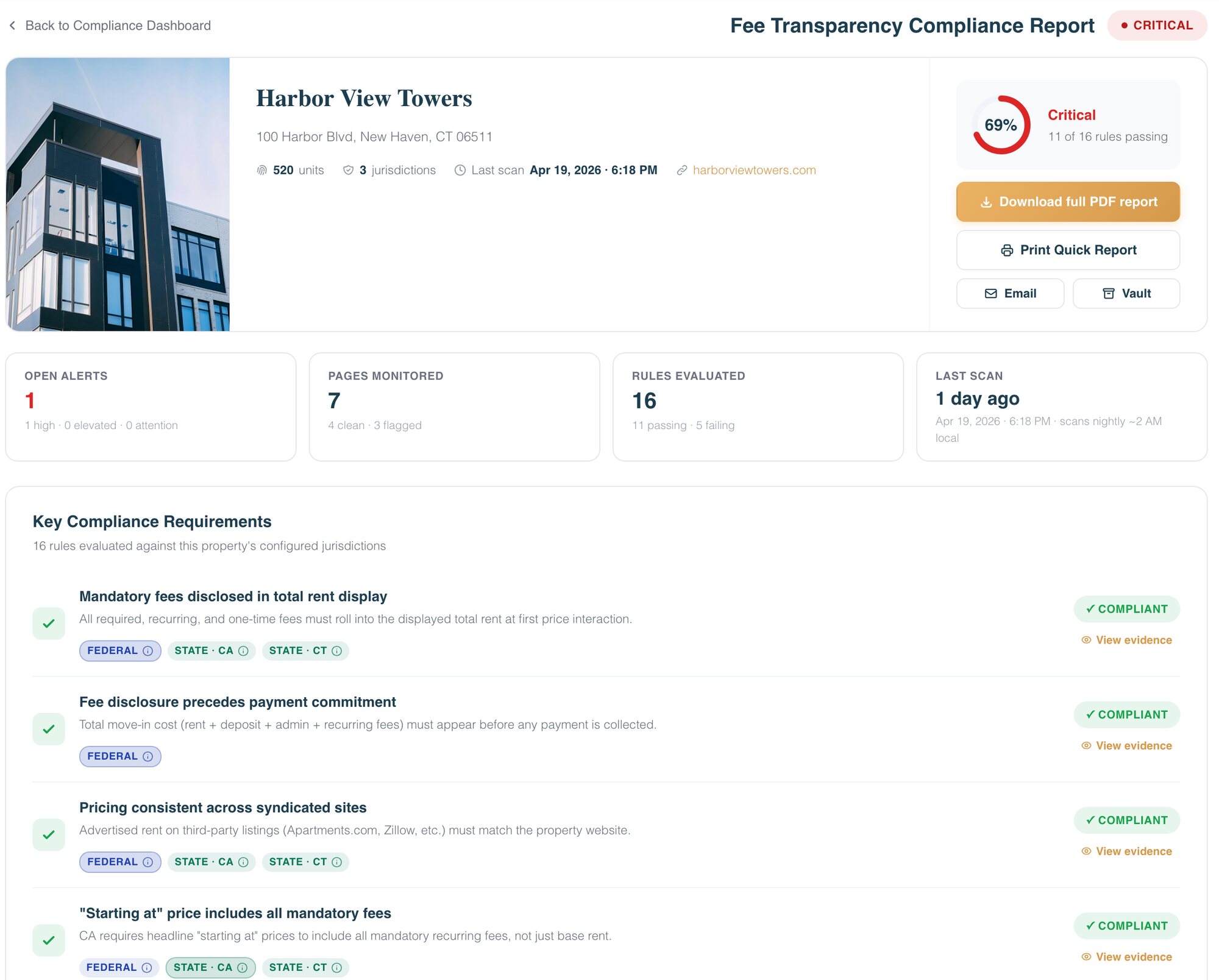
Fee Transparency in Compliance360 checks pricing, floor plan, unit listing and application pages every night against federal, state and city fee rules resolved for each property's address, including California, and stores a timestamped capture with every finding. Listing Consistency catches the same fee drifting across ILS listings, and SiteArchiver keeps a dated record of what each pricing page said. It helps you find and fix gaps; it does not decide what the law requires for you.
Frequently asked questions
The statute does not name rental housing, and the Attorney General's FAQ names short-term rentals but not long-term leases. Whether the CLRA it amended reaches a residential lease of real property is unsettled. The conservative course is to include mandatory recurring fees in advertised rent anyway, because the False Advertising Law and the FTC also police misleading prices.
No. The Attorney General's guidance says fees contingent on later conduct by the consumer are not mandatory and do not need to be in the advertised price. Late, returned-payment and damage charges fall into that group.
Yes, the phrase itself is not the problem. The conservative reading is that the starting figure must include every mandatory recurring fee the cheapest unit carries.
SB 611 (Chapter 287, Statutes of 2024) bans fees for serving, posting or delivering the termination notices covered by Civil Code 1946.1, and fees for paying rent or a security deposit by check. It does not require all-in rent in advertising.
Under Civil Code 1950.6 as amended by AB 2493, a screening fee is allowed only if one of two processes is offered: consider completed applications in the order received and approve the first qualified applicant, or refund every applicant not selected within 7 days of selection or 30 days of submission, whichever is first. The landlord must also give the applicant a copy of any consumer credit report within seven days.
If SB 478 reaches rent at all, it reaches the price wherever you advertise it, including ILS listings built from your feed. Brynson works with Zillow and Apartments.com as partners. Fix fee coding in the PMS so every listing receives the same mandatory fees.
How we checked this
Written by the Brynson Research Team and checked against the primary sources below. Each source shows the date we last read it. We update this page when the rules change; see the change log.
- SB 478 hidden fees: frequently asked questions, California Department of Justice, Office of the Attorney General, 2024. Accessed 2026-10-22.
- California Civil Code 1770 (Consumers Legal Remedies Act, unlawful practices), FindLaw (codified text), 2026-01-01. Accessed 2026-10-22.
- California Civil Code 1761 (CLRA definitions), FindLaw (codified text), 2026-01-01. Accessed 2026-10-22.
- California Civil Code 1780 (CLRA remedies), FindLaw (codified text), 2026-01-01. Accessed 2026-10-22.
- California Business and Professions Code 17500 (False Advertising Law), FindLaw (codified text), 2026-01-01. Accessed 2026-10-22.
- California Civil Code 1946.1 (notice fees), FindLaw (codified text), 2026-01-01. Accessed 2026-10-22.
- California Civil Code 1947.3 (payment by check), FindLaw (codified text), 2026-01-01. Accessed 2026-10-22.
- California Civil Code 1950.6 (application screening fees), FindLaw (codified text), 2026-01-01. Accessed 2026-10-22.
- SB 478 (2023-2024): Consumer Legal Remedies Act: advertisements, CalMatters Digital Democracy, 2023-10-07. Accessed 2026-10-22.
- SB 611 (2023-2024): Residential rental properties, CalMatters Digital Democracy, 2024-09-19. Accessed 2026-10-22.
- AB 2493 (2023-2024): Tenancy: application screening fees, CalMatters Digital Democracy, 2024-09-29. Accessed 2026-10-22.
Change log
- First published.
This guide is general information, not legal advice. Laws and regulator guidance change; check the current rules for your properties with your counsel before acting.