
Which Apartment Fees Must Be Included in Advertised Rent? A Fee-by-Fee Guide for Multifamily Operators
For revenue, marketing, leasing and compliance leads at multifamily operators deciding how each fee on the schedule must be advertised.
Mandatory recurring fees such as trash, valet trash, pest control, technology, package and amenity fees generally belong in the advertised monthly rent under all-in rules and the FTC's Greystar order. Optional fees, contingent fees such as late, pet or transfer fees, and utilities billed at actual cost can usually sit beside the rent, clearly labelled.
- Four questions place any fee: is it mandatory, recurring, contingent on later conduct, or a utility pass-through at cost?
- Colorado and Connecticut require the all-in figure; Minnesota, Illinois and New York City require every non-optional fee to be disclosed in the ad.
- An opt-out does not make a default fee optional in Connecticut, and Illinois bars renaming a fee to escape its rules.
- Some fees are banned outright: Colorado bans common-area maintenance fees, and Illinois caps application fees at $50 from its effective date.
- Show the full breakdown before any application fee, deposit or personal details are taken, and keep the same amounts on every ILS.
This guide is general information, not legal advice. Laws and regulator guidance change; check the current rules for your properties with your counsel before acting.
Four questions that place any apartment fee
Ask these four questions of each line on the PMS fee schedule, in order.
| Question | If yes | Where the test comes from |
|---|---|---|
| 1. Must every renter of this unit pay it to lease? | Mandatory. If also monthly, it generally belongs in the headline rent. | Greystar order Definition K ("all mandatory monthly costs or fees"); Colorado's "not reasonably avoidable" test (C.R.S. 6-1-737(1)(m)) |
| 2. Does it recur (monthly or on another period)? | Prorate it into the advertised rent where all-in rules apply. | Connecticut PA 25-44, Sec. 9(a): periodic fees "shall be prorated and included" |
| 3. Is it triggered only by later conduct or a choice (a late payment, a pet, a lockout)? | Contingent or optional: keep it out of the headline, but disclose when it applies before any payment. | California AG SB 478 guidance; Greystar order Sec. II.C.2.iv ("timing and frequency") |
| 4. Is it a pass-through of a variable utility at actual cost? | It can generally sit beside the rent, with the allocation method stated. | Greystar order Sec. II.C.2.vi; Colorado 6-1-737(2)(d); Connecticut Sec. 9(b)(3) |
What each rule requires of the advertised rent
Some rules require one all-in number; others only require fees listed with the rent.
| Jurisdiction | What the headline must do | Fees that may sit outside it | Source |
|---|---|---|---|
| Federal benchmark (FTC and Colorado v. Greystar) | Total Monthly Leasing Price shown "more prominently than any other representation regarding Pricing Information." Binds Greystar only. | "Variable utility costs and optional fees" | Stipulated order, Def. K and Sec. II |
| California (SB 478) | Bars a price "that does not include all mandatory fees or charges" for "the sale or lease of most goods and services." Reach to residential leases is unsettled. | Government taxes; optional services; fees "contingent on certain later conduct" | California AG, Hidden Fees |
| Colorado (HB25-1090, from January 1, 2026) | Total price "as a single number," more prominent than other pricing. | Government charges; actual utility provider cost | Session Laws Ch. 94, C.R.S. 6-1-737 |
| Connecticut (PA 25-44, Sec. 9, from October 1, 2025) | Every periodic fee prorated into the advertised rent, opt-out or not. | Processing at cost (if a free method exists); pet fees; submetered or direct-pay utilities; damage; lockout-type service fees | Public Act 25-44 |
| Massachusetts (940 CMR 38.00) | Total Price at first presentation; a monthly figure is allowed if the lease period is disclosed. | Government charges; optional fees, labelled with how to avoid them | 940 CMR 38.04 |
| Minnesota (504B.120) | Ads disclose "the nonoptional fees included with the total amount for rent" and whether utilities are included. | Optional fees | Minn. Stat. 504B.120 |
| Illinois (PA 104-0479; ILGA bill status lists January 1, 2027) | Non-optional fees disclosed "in a clear and conspicuous manner" in the listing or a linked page. No single all-in number required. | Optional fees. Owner-occupied buildings of 6 or fewer units are exempt. | Public Act 104-0479 |
| New York City (FARE Act, from June 11, 2025) | Listings disclose "all fees that prospective tenants must pay"; the landlord's broker fee cannot be passed on. | Not addressed in the DCWP FAQ | DCWP broker fee FAQ |
The FTC has also opened rulemaking: its March 2026 advance notice covers fees "from application to moveout"; it is not a rule. For every state, use the rental junk fee laws by state tracker.
The fee-by-fee matrix
Each cell says what the rule generally means for that fee. Minnesota and New York City are omitted because they treat every non-optional fee alike: disclose it in the ad.
| Fee | Greystar benchmark | Colorado | Connecticut | Massachusetts | Illinois (2027) |
|---|---|---|---|---|---|
| Application | Disclose before taking it | Mandatory to apply; check total-price treatment | Not periodic; outside rent | In Total Price at first presentation | Capped at $50, with a narrow pass-through for higher third-party screening cost |
| Admin or move-in | Disclose before payment | Mandatory one-time; check total-price treatment | Outside rent if one-time | In Total Price | Disclose in listing |
| Amenity (mandatory) | In headline | In total; a fee for common-area maintenance is banned | In rent | In Total Price | Disclose in listing and on lease page 1 |
| Technology or package | In headline if required | In total | In rent, even with opt-out | In Total Price | Disclose in listing |
| Trash, valet trash, pest control | In headline if required | In total; check habitability ban | In rent | In Total Price | Pest fee banned where tenant did not contribute |
| Utilities and RUBS | Outside, method disclosed | Actual cost may sit outside; no markup beyond the statute | Submetered or direct-pay may sit outside; landlord-billed RUBS is not named | Treat with counsel | State whether utilities are included |
| Parking | In headline only if required | In total only if required | In rent if required | Optional if avoidable, with instructions | Disclose if non-optional |
| Pet fee or pet rent | Outside; contingent | Outside if avoidable | Excluded by name | Optional, labelled | Disclose if non-optional |
| Transfer | Disclose when charged | Contingent | Outside rent | Disclose | May be a banned modification fee |
| Late, NSF, notice | Disclose when charged | Late fee on non-rent amounts banned | Not periodic; outside rent | Contingent | Eviction-notice fees banned |
| Payment processing | Disclose | Banned unless a free method is reasonably accessible | Excluded at actual cost if a free method exists | Disclose | Disclose if non-optional |
Sources for every cell: Greystar order; C.R.S. 6-1-737 and the Colorado AG utility memo; Connecticut PA 25-44, Sec. 9; 940 CMR 38.04; Illinois PA 104-0479.
11 apartment fees and how each one must be advertised
One entry per row of the matrix, with the operative words from each rule. Cells say "generally" for a reason: confirm the facts at each property with counsel.
- 01
Application fee
One-time and mandatory to apply, so it is never in monthly rent but must be visible before the renter pays it: the Greystar order bars taking "an initial payment or deposit" before the fee breakdown is shown. Illinois caps it at $50, with a narrow exception for higher third-party screening costs billed with receipts within 14 days (PA 104-0479). California limits it to actual cost, capped at $30 adjusted for inflation, and only with first-come approval or refunds to unselected applicants (Civ. Code 1950.6). More on California in the SB 478 guide.
- 02
Admin fee
Usually mandatory and one-time: disclose amount and purpose before any payment; in Massachusetts it counts toward the Total Price. What it may cover is in the apartment admin fee guide.
- 03
Amenity fee
If every resident pays it, it is mandatory and recurring, so it goes in the headline under every all-in rule. Colorado goes further: a landlord may not require a fee "for the maintenance of common areas" at all (6-1-737(4)(i)).
- 04
Technology and package fees
Internet, smart-home and package-locker fees are classic default-enrolment fees: if the unit cannot be leased without them, they are in the headline.
- 05
Trash, valet trash and pest control
Flat charges on every unit: in the headline. Arizona's May 13, 2026 Greystar settlement release invites refund claims for fees charged on top of base rent "such as parking fees, valet trash services, or HOA dues" (Arizona AG). Illinois bans fees "for pest abatement or removal where the tenant has in no way contributed to the infestation" (PA 104-0479); Colorado's ban on fees for what the landlord's habitability duty requires (6-1-737(4)(f)) may reach routine pest control.
- 06
Utilities, utility admin fees and RUBS
Utilities at actual cost can generally sit beside the rent; the Greystar order requires "the method used to apportion the costs among tenants" before payment. Colorado bans utility charges above what the provider bills, except a markup capped at 2% of the bill or $10 a month, not both (C.R.S. 6-1-737(4)(a) and 38-12-801(3)(a)(VI)). Its AG will not pursue RUBS that stays within the provider's total, adds no markup beyond the statute, excludes common areas and discloses the method (AG memo, November 24, 2025). Connecticut excludes only submetered and direct-pay utilities (Sec. 9(b)(3)), so check landlord-billed RUBS there. A flat "utility admin fee" is a mandatory recurring fee, not a utility.
- 07
Parking
Optional parking sits beside the rent, labelled optional. Parking assigned to every unit is mandatory and goes in the headline. In Massachusetts, say how to avoid an optional fee.
- 08
Pet fee versus pet rent
Both depend on having a pet, so neither is in the headline. Connecticut excludes "any fee or deposit imposed for keeping a pet" by name (Sec. 9(b)(2)). Disclose both, with the amount per pet and whether the one-time fee is refundable; Colorado requires refundability to be disclosed for any amount outside the total price (6-1-737(3)(b)(I)).
- 09
Transfer fee
Contingent on a mid-lease move, so it stays out of advertised rent but goes in the fee guide and lease. In Illinois, check it against the ban on fees "for modification or renewal of a lease agreement"; a transfer usually means a new or amended lease.
- 10
Late, NSF and notice fees
Contingent on later conduct, so they are disclosed, not included. Colorado bans late fees on overdue amounts "that is not rent" (6-1-737(4)(e)). Illinois bans fees "for an eviction notice or the filing of an eviction action prior to the court granting an eviction order."
- 11
Payment processing and convenience fees
Connecticut lets a processing fee sit outside the rent only if it "reflects the actual cost" and a fee-free payment method exists; Colorado bans it outright unless a cost-free method "is reasonably accessible" (6-1-737(4)(d)). California bars "any fee for payment by check for rent or security deposit" (Civ. Code 1947.3(b)).
Worked example: fixing a "starting at" price
The usual failure: the card shows base rent; mandatory fees sit in a fee guide.
| Line | Amount | Class | Treatment |
|---|---|---|---|
| Base rent, lowest available unit | $1,450 / month | Rent | In headline |
| Trash (every unit) | $35 / month | Mandatory recurring | In headline |
| Technology package (default, opt-out allowed) | $65 / month | Mandatory recurring | In headline; in Connecticut even with the opt-out |
| Reserved parking | $50 / month | Optional | Beside, labelled optional |
| Pet rent | $40 / month per pet | Contingent | Beside, "if you have a pet" |
| Water and sewer (RUBS) | Varies | Variable utility | Beside, with the allocation method |
| Application | $50 per applicant | Mandatory one-time | Shown before the apply button |
| Admin | $200 once | Mandatory one-time | Shown before any payment |
Before: "1 Bed from $1,450/mo." That understates the minimum monthly price by $100.
After: "1 Bed from $1,550/mo" as the largest price on the card, then one line beneath it: "Includes $1,450 base rent, $35 trash and $65 technology. Optional: parking $50. If applicable: pet rent $40. Water and sewer billed by unit size and occupancy. One-time: $50 application, $200 admin."
On the ILS listing: the rent range starts at $1,550 and the fee fields match. If Zillow still says $1,450, the advertisement is not fixed.
In Colorado the $1,550 must be more prominent than the $1,450; in Massachusetts the card must also state the lease term. In Connecticut, check the RUBS line against the utility exclusion.
How to place every fee on a pricing card
Run this once per property, then again whenever the fee schedule changes.
Time needed: 2 hours
- 1
Export the fee schedule of record
Pull every charge for the property from the PMS, not the website, including default add-ons and per-pet amounts.
- 2
Run the four questions on each fee
Mark each line mandatory or optional, recurring or one-time, contingent or not, and pass-through utility or not.
- 3
Map the property to its rules
List the federal benchmark plus every state and city rule at the property's address, and check the matrix row for each fee.
- 4
Compute the headline price
Add every mandatory recurring fee to the lowest base rent and make that total the largest price on the card, in one number.
- 5
Write the breakdown line
Under the total, list each included fee, each optional and contingent fee with when it applies, the utility method and the one-time fees.
- 6
Move the breakdown ahead of payment
Show the same breakdown on the apply screen before any personal details, application fee or holding deposit are requested.
- 7
Push the same numbers to every ILS
Update the PMS feed, then confirm after the next feed cycle that each listing shows the same rent range and fee amounts.
- 8
Recheck on a schedule
Repeat the check whenever a fee changes and at least monthly, keeping a dated capture of each page.
Opt-out does not make a fee optional, and renaming does not cure it
- Default enrolment with an opt-out. Connecticut is explicit: a fee "charged to the tenant, by default, on a monthly basis shall be included in the advertised, displayed or offered rent, regardless of whether the tenant may opt out" (PA 25-44, Sec. 9(a)). Colorado reaches the same place through its definition of total price, which includes amounts that "are not reasonably avoidable" (6-1-737(1)(m)(II)(B)).
- Renaming. Illinois says "a landlord may not rename a fee or charge to avoid application of this Section" (765 ILCS 705/35(e)).
Massachusetts requires optional fees to be labelled optional and to come with "readily available instructions regarding how to avoid" them (940 CMR 38.04(2)(b)). If you cannot write those instructions for a fee, it is probably not optional.
Where the fees must appear, and when
The fee guide often exists; the failure is that the apply flow takes money first.
| Rule | Disclosure deadline |
|---|---|
| Greystar benchmark | Before "an initial payment or deposit": total monthly price, each fee's amount, purpose, timing and optionality, and the utility apportionment method (Sec. II.C). |
| Massachusetts | Total Price before "requiring a consumer to provide any personal information," with limited exceptions (38.04(4)). |
| Colorado | Fees outside the total price disclosed "before a person consents to pay" (6-1-737(3)(b)). |
| Illinois | In the listing "or in an accompanying weblink at the time of the listing", and on the lease's first page or the fee is unenforceable (705/35(b)). |
| Minnesota | In the ad, and as a "Total Monthly Payment" on the first page of the lease (504B.120). |
| New York City | In the listing, then a signed itemized fee disclosure before the lease is signed, kept for three years (DCWP FAQ, Q6). |
Put the breakdown beside the apply button, before any name or card field. Then run the fee transparency audit checklist.
The same fee, the same amount, everywhere
A correct pricing page does not help if the ILS listing or lease shows a different number. In Brynson's analysis of 6,000 properties and 1.6 million units, nearly 89% of communities described themselves differently depending on which listing site a renter visited. Although 97% of listings had been updated within the previous 90 days, conflicting mandatory fees, missing amenities and contradictory terms persisted (apartment listing accuracy report).
Change fees in the PMS first, check each ILS listing's fee fields after the next feed cycle, and diff the lease fee page against the website fee guide. Brynson works with Zillow, Apartments.com, Apartment List and Zumper as partners; each maps, caches and overrides feed data its own way. For a field-by-field listing review, see the ILS listing audit.
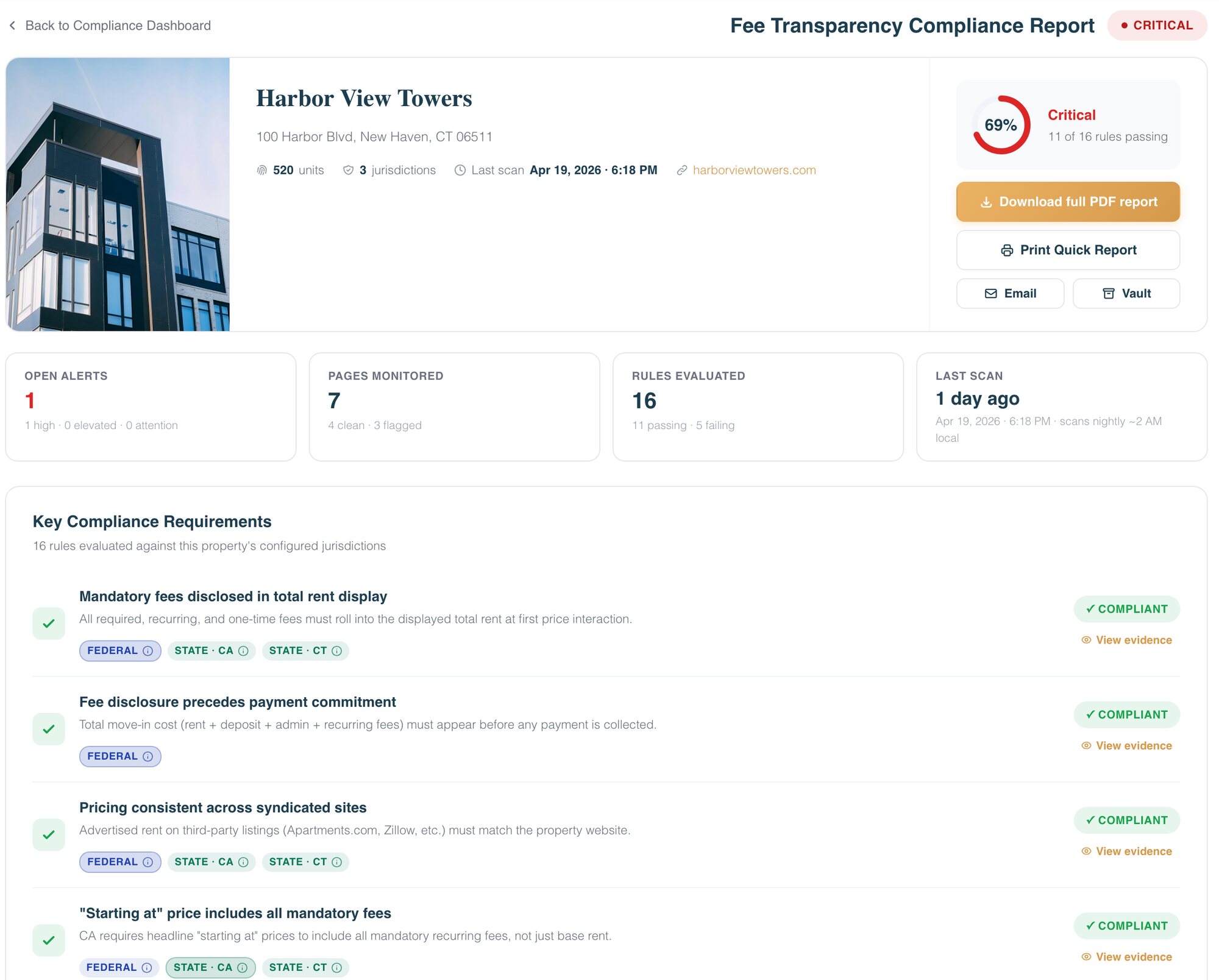
Fee Transparency in Compliance360 checks the pages where rent is advertised every night (pricing, floor plans, unit listings, availability, the fee guide and the application flow) against the fee rules for each property's address, and keeps a timestamped capture of every finding. Listing Consistency compares application, admin and pet fees and the rent range on Apartments.com, Apartment List, Zillow, Zumper and HelloData with your PMS, nightly, so one fee change does not leave five different numbers live.
You only need to fix the ILS side
Listing Consistency shows the PMS value beside the value found on each listing source, field by field, and counts a fix only when the next sync agrees.
You want to classify fees by hand first
Use the four questions and the matrix above on one property's schedule, then the audit checklist to test each page. It works; it just does not scale past a few properties or leave a dated record.
Frequently asked questions
Generally no, because a pet fee or pet rent applies only to residents who choose to have a pet. Connecticut excludes pet fees and deposits from the advertised rent by name. Still disclose the amount per pet and whether a one-time fee is refundable.
If every unit is charged for it, yes in all-in jurisdictions such as Colorado, Connecticut and Massachusetts and under the Greystar benchmark. Arizona's May 2026 Greystar release lists valet trash among the fees charged in addition to base rent that residents of two complexes can claim back.
Not in the advertised rent, because they depend on later conduct. Disclose them, and when they apply, before any payment. Colorado separately bans late fees on amounts that are not rent.
Generally yes for variable utilities at actual cost under the Greystar order and Colorado; Connecticut excludes only submetered and direct-pay utilities by name. Minnesota and Illinois require the ad to say whether utilities are included. A flat utility admin fee is not a utility; it belongs in the headline.
Where all-in rules apply, it is generally allowed but must be in the advertised rent. Colorado bans fees for maintenance of common areas, so an amenity fee that funds common-area upkeep is at risk there.
How we checked this
Written by the Brynson Research Team and checked against the primary sources below. Each source shows the date we last read it. We update this page when the rules change; see the change log.
- Stipulated Order for Permanent Injunction, Monetary Judgment, and Other Relief, FTC and State of Colorado v. Greystar Real Estate Partners, LLC et al., Federal Trade Commission, 2025-12-02. Accessed 2026-10-22.
- Greystar Agrees to Pay $24 Million and Stop Deceptive Advertising Practices as a Result of FTC and Colorado Lawsuit, Federal Trade Commission, 2025-12-02. Accessed 2026-10-22.
- FTC Seeks Public Comment on a Proposed Rulemaking Regarding Unfair or Deceptive Rental Housing Fee Practices, Federal Trade Commission, 2026-03-12. Accessed 2026-10-22.
- HB25-1090, Protections Against Deceptive Pricing Practices, Session Laws 2025, Chapter 94 (C.R.S. 6-1-737 and 38-12-801), Colorado General Assembly, 2025-04-21. Accessed 2026-10-22.
- HB25-1090 bill summary, Colorado General Assembly, 2025. Accessed 2026-10-22.
- Guidance on Enforcement Priorities Related to Utility Billing Under House Bill 25-1090, Colorado Department of Law, 2025-11-24. Accessed 2026-10-22.
- Public Act No. 25-44, An Act Concerning Consumer Protection and Safety (Substitute Senate Bill No. 3), Sec. 9, Connecticut General Assembly, 2025-06-10. Accessed 2026-10-22.
- 940 CMR 38.04, Unfair and Deceptive Fees: Total Price disclosure, Legal Information Institute, Cornell Law School (Massachusetts Regulations), current. Accessed 2026-10-22.
- 940 CMR 38.03, Definitions (Total Price, Product includes dwelling units), Legal Information Institute, Cornell Law School (Massachusetts Regulations), current. Accessed 2026-10-22.
- Minnesota Statutes 504B.120, Prohibited Fees, Minnesota Office of the Revisor of Statutes, 2023. Accessed 2026-10-22.
- Public Act 104-0479 (HB3564), 765 ILCS 705/35, Rental fee transparency and limitations, Illinois General Assembly, 2026-06-26. Accessed 2026-10-22.
- HB3564 bill status (Governor approved June 26, 2026; effective date January 1, 2027; Public Act 104-0479), Illinois General Assembly, 2026-06-26. Accessed 2026-10-22.
- Frequently Asked Questions: Broker Fees (FARE Act, Local Law 119 of 2024), NYC Department of Consumer and Worker Protection, 2025-08-12. Accessed 2026-10-22.
- Hidden Fees (SB 478), California Attorney General, current. Accessed 2026-10-22.
- California Civil Code 1947.3, FindLaw (California Codes), current as of 2026-01-01. Accessed 2026-10-22.
- California Civil Code 1950.6, FindLaw (California Codes), current as of 2026-01-01. Accessed 2026-10-22.
- Attorney General Mayes Announces Settlements with Greystar Over Hidden Rental Charges and Junk Fees, Arizona Attorney General, 2026-05-13. Accessed 2026-10-22.
Change log
- First published.
This guide is general information, not legal advice. Laws and regulator guidance change; check the current rules for your properties with your counsel before acting.