
NYC FARE Act Requirements for Apartment Landlords and Multifamily Operators: Listing Disclosures, Fee Records and the Proposed All-In Rule
For leasing, marketing and compliance leads at operators with New York City apartments, and the counsel who advise them.
The NYC FARE Act (Local Law 119 of 2024), in effect since June 11, 2025, stops landlords passing their own broker's fee to tenants. Every listing must clearly disclose all fees a tenant must pay, and the tenant signs an itemized fee disclosure before the lease, which the landlord keeps for three years.
- Landlords are liable for a fee charged by their agent or a listing agent, and an agent who publishes a listing is presumed authorized.
- The disclosure duty covers every listing: your website, StreetEasy, each ILS and outside broker listings.
- Background and credit checks stay chargeable, capped at actual cost or $20 under Real Property Law 238-a.
- DCWP proposed an all-in pricing rule in July 2026 that would require the total price, mandatory fees included, wherever a price is advertised; it is still proposed as of October 22, 2026.
- Massachusetts made the party who hires a broker pay that broker from August 1, 2025.
This guide is general information, not legal advice. Laws and regulator guidance change; check the current rules for your properties with your counsel before acting.
What the FARE Act requires, duty by duty
The Fairness in Apartment Rental Expenses (FARE) Act, Local Law 119 of 2024, added Subchapter 15 to Chapter 4 of Title 20 of the NYC Administrative Code, effective June 11, 2025 (DCWP FAQ).
| Duty | What the DCWP FAQ says | Source |
|---|---|---|
| Landlord's broker fee stays with the landlord | A landlord's agent, including a listing agent, cannot charge fees to prospective tenants. | Admin. Code 20-699.21 |
| No forced broker | No rental may be conditioned on hiring a broker, a particular agent or a dual agent. | Admin. Code 20-699.21(c) |
| Listing disclosure | No advertisement or listing may include an unlawful broker fee, and "all fees that prospective tenants must pay to rent an apartment must be disclosed in a clear and conspicuous manner." | Admin. Code 20-699.21(d) |
| Itemized written disclosure | All fees owed to the landlord or anyone at its direction, described in writing, signed by the tenant before the lease. | Admin. Code 20-699.22 |
| Retention | Keep the signed disclosure for three years and give the tenant a copy. | Admin. Code 20-699.22 |
The FARE Act leaves background and credit check fees alone (DCWP FAQ, question 2). Real Property Law 238-a(1)(a) bars fees "for the processing, review or acceptance of an application", apart from those screening fees or where a statute or regulation provides for a charge. Subdivision 1(b) caps the combined screening charge at "the actual cost of the background check and credit check or twenty dollars, whichever is less", requires a copy of the report and the screening vendor's receipt or invoice, and waives the fee when the applicant provides a check from the past thirty days (RPL 238-a).
Landlord liability for a broker's fee
A landlord is liable if its own agent or a listing agent charges a tenant a fee to rent an apartment. And "there is a rebuttable presumption that an agent who publishes a listing for the rental of an apartment does so with the permission or authorization of the landlord" (DCWP FAQ, Admin. Code 20-699.21(b), (e)).
A co-broke listing you never saw can still be yours. Three controls:
- Written broker terms. Outside broker agreements say the landlord pays its broker and no tenant fee may be requested on a landlord-side listing.
- A known-listings register. Per building, record which brokers may list it and where; investigate any other listing that week.
- A rebuttal file. Dated proof you did not authorize a rogue listing and asked for its removal.
Channel by channel: where the listing disclosure duty lands
The disclosure rule covers "all advertisements or listings", so every channel below carries it. In Brynson's analysis of 6,000 properties and 1.6 million units, nearly 89% of communities described themselves differently depending on the listing site. Although 97% of listings had been updated within the previous 90 days, properties routinely showed conflicting mandatory fees, missing amenities and contradictory terms across channels.
| Channel | Who controls the text | What to check | Fix at |
|---|---|---|---|
| Property website and unit pages | You or your website vendor | Required fees beside the rent on unit and floor plan pages, not only a fee guide. | Website CMS and PMS fee codes |
| StreetEasy | Your listing feed or the agent who posts it | Fee field and description agree; no old broker fee text. | Feed mapping or the posting agent |
| Zillow, Apartments.com and other ILSs | Your syndication feed, with ILS-side mapping and caching | Same fee names and amounts as the website on every ILS. | PMS and feed, then recheck after the next sync |
| Outside broker and co-broke listings | The brokerage | Only authorized brokers, no tenant fee, same fee line. | Broker agreement and known-listings register |
Brynson works with Zillow, Apartments.com and other major ILSs as partners. To run the same test across every fee, use the fee transparency audit checklist; for what to capture and keep, see compliance evidence retention.
Eight FARE Act mistakes we see operators make
Where multi-channel NYC portfolios slip in practice.
- 01
Saying "no fee" while a co-broke listing still charges one
Your website says no broker fee, but an outside agent's listing of the same unit asks for one. Because a publishing agent is presumed authorized, the landlord carries the exposure. Search your addresses on the portals monthly.
- 02
A different fee line on every channel
The website lists the amenity fee at one amount, one ILS shows an older amount and StreetEasy shows none. The weakest channel sets your risk. Fix the PMS and feed mapping, then recheck after the next sync.
- 03
Fees behind a link labelled "fees may apply"
A footnote, hover or separate PDF is, in our view, a weak answer to "clear and conspicuous". Put required fees beside the rent on the same card.
- 04
Screening charges above the RPL 238-a limits
RPL 238-a allows a background and credit check charge at actual cost or $20, whichever is less, and bars a general application processing fee. An "application fee" that bundles admin or processing costs on top of screening is the line to remove.
- 05
Steering applicants to an in-house or dual agent
Leasing scripts that say "you'll need to work with our agent" break the rule against conditioning a rental on a particular agent or a dual agent. Check scripts and lead auto-replies.
- 06
Signing the disclosure in the same packet as the lease
The tenant must sign the itemized disclosure before the lease. One e-sign packet makes the order hard to prove; send it as its own envelope.
- 07
Losing the signed disclosure at staff turnover
Three years outlasts many leasing teams and software contracts. Store it with the lease and include it in any vendor export.
- 08
Recycled listing descriptions
Descriptions written before June 11, 2025 can still carry "broker fee" or "one month fee" text when a unit is relisted. Search active descriptions for fee words and lock the template.
The itemized fee disclosure: a field list and a three-year file
A field list for counsel to turn into your document, not a compliant form.
| Field | Why it is there |
|---|---|
| Building, unit and applicant names | One rental per record. |
| Each fee: name, amount, payee, when due, written description | Fees paid to anyone at the landlord's direction count. |
| Screening charge with vendor receipt reference | Shows RPL 238-a was followed. |
| Statement that no landlord-side broker fee is owed | Makes the zero explicit. |
| Tenant signature with timestamp | Must precede the lease signature. |
| Copy delivered: method and date | The tenant must get a copy. |
| Retention end date | Three years, set automatically. |
A unit renting at $3,400 carries a $20 screening charge and a $75 monthly amenity fee every resident pays. The listing shows "$3,400/mo + $75 required amenity fee; $20 screening; no broker fee". The disclosure lists the same two fees, signed at 2:14 pm; the lease at 2:31 pm. If StreetEasy said $50, the disclosure is right, the listing is wrong, and the listing is public.
How to bring one NYC building into line with the FARE Act
Run it on one building, then template it for the portfolio. Steps one and three take most of the time.
Time needed: 4 hours
- 1
List every fee a tenant must pay
Export the building's fee codes from the PMS and mark which ones every renter of a unit must pay. Remove any landlord-side broker fee and check the screening charge against RPL 238-a.
- 2
Write one approved fee line
Turn the required fees into a single approved sentence with names and amounts. That sentence is what every channel must show.
- 3
Inventory every channel
Find every live listing for the building: website, StreetEasy, each ILS, outside brokers and ads. Record who controls each one.
- 4
Fix at the source
Correct the PMS fee codes and feed mapping so the approved line reaches each syndicated channel, and send the line to every authorized broker in writing.
- 5
Update broker agreements
Add written terms that the landlord pays its broker and that no tenant fee may be requested for a landlord-side listing.
- 6
Split the disclosure from the lease
Build the itemized disclosure as its own signed document, sent before the lease, with a copy to the tenant and a three-year retention date.
- 7
Keep dated evidence and recheck
Capture each channel after the fix with a date, recheck after the next feed sync and repeat monthly.
Penalties and enforcement
DCWP enforces: it issues a summons heard at the Office of Administrative Trials and Hearings (OATH), and a sustained charge brings a civil penalty and possibly restitution of illegal fees. For violations and penalties, the FAQ points to 6 RCNY 6-89. The law also gives individuals a private right of action in civil court (DCWP FAQ, Admin. Code 20-699.23 and 20-699.24).
We do not quote a dollar figure here: check the current 6 RCNY 6-89 schedule with counsel. For obligations signed before June 11, 2025, the FAQ says the ban "may not apply" depending on circumstances: a counsel question, not a policy.
The next layer: DCWP's proposed all-in pricing rule
On July 8, 2026, DCWP published a proposed rule that would add 6 RCNY 5-16, "General Fee Disclosures" (DCWP release). The comment deadline and public hearing were both August 7, 2026 (Notice of Public Hearing). What the text says:
- Scope. It "applies to any person who offers, displays or advertises goods or services in New York City, or to a New York City consumer", except where federal or state law preempts it. The rule text does not name rental housing; the statement of basis lists "rental housing" among industries with common junk fees and calls the rule "industry-neutral".
- Total price. Every advertised price must show the total price, mandatory fees included, at least as prominently as other pricing. For monthly charges that is one month's total, plus the total of one-time mandatory fees. Government taxes and fees are excluded from the total.
- Mandatory. Fees not reasonably avoidable, plus fees for parts a reasonable person expects included.
- Before payment. A breakdown of excluded fees and the final amount.
- Records. The basis for every fee, on request; a missing record creates a presumption that DCWP's alleged fact is true.
- Other laws. The rule does not replace existing price disclosure requirements in other sections of Title 6 of the Rules of the City of New York or in Title 20 of the Administrative Code, where the FARE Act sits.
- Penalties. The proposed 6 RCNY 6-47 row lists $525, $1,050 and $3,500 for first, second and later violations, while the July 10 release says junk fee fines start "at $350 per violation". The adopted rule will settle it.
If the rule is adopted as proposed and applies to rentals, a "$3,400/mo" card with a $75 mandatory amenity fee would need to show $3,475 at least as prominently, plus one-time mandatory fees as a total.
Status: as of October 22, 2026, the NYC Rules site still lists the rule as proposed; the August 7 comment deadline has passed (NYC Rules: Junk Fees). No adoption or effective date has been published.
Massachusetts comparison: the 2025 broker fee change
Massachusetts, from August 1, 2025. Section 43 of the FY2026 budget (Chapter 9 of the Acts of 2025) amended General Laws chapter 112, section 87DDD1/2 so that a broker contracts solely with the tenant or solely with the landlord, and "any fee shall only be paid by the party, lessor or tenant who originally engaged and entered into a contract with the licensed broker or salesperson." Section 136 sets the August 1, 2025 effective date (Acts of 2025, ch. 9, secs. 43 and 136).
Section 43 adds no listing disclosure, signed itemized disclosure or listing-agent presumption. Massachusetts' general junk fee regulation, 940 CMR 38.00, is separate; DCWP's statement of basis cites it as a similar approach. See the state fee law table.
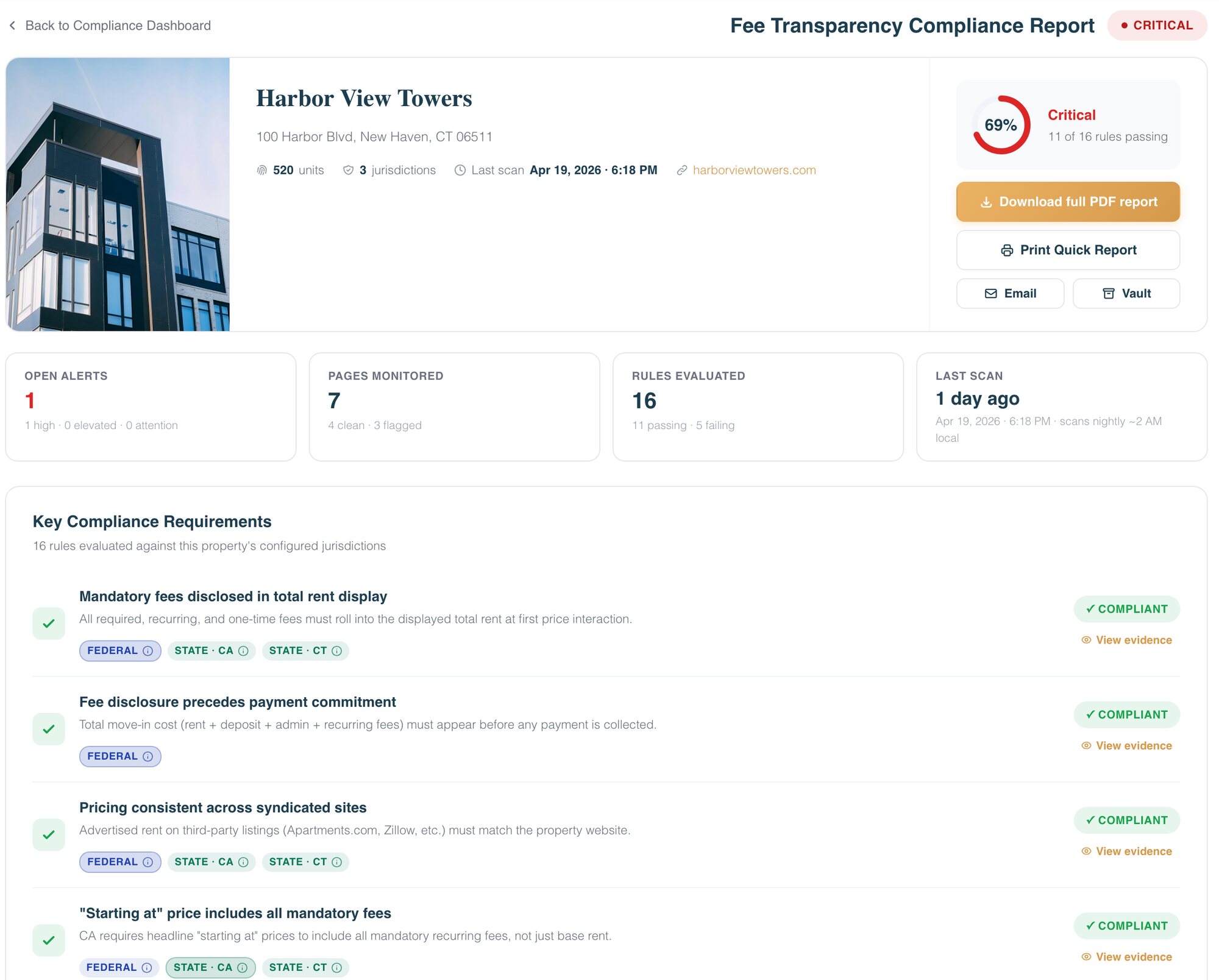
Fee Transparency in Compliance360 checks your website's pricing, floor plan, unit and application pages every night against fee rules resolved for each property's address, including New York City's FARE Act, and keeps a timestamped capture with every finding. Listing Consistency compares fee fields with your PMS on Apartments.com, Apartment List, Zillow, Zumper and HelloData; it does not cover StreetEasy, so keep that channel in your manual check. SiteArchiver keeps a dated, replayable record of what your property website said. These tools help you find and fix gaps; counsel decides what the law requires.
Frequently asked questions
The landlord pays its own agent. Since June 11, 2025, a landlord's agent, including a listing agent, cannot charge the tenant a fee. DCWP says a tenant who chooses to hire their own broker can still pay that broker.
Every fee a tenant must pay to rent, disclosed clearly and conspicuously, and no unlawful broker fee. It applies to all advertisements and listings, including StreetEasy, ILSs and outside brokers.
Only for background and credit checks. Real Property Law 238-a bars application processing fees and caps screening at actual cost or $20, whichever is less. The applicant gets a copy of the report and the vendor's receipt, and the fee is waived if they provide a check from the past 30 days.
Three years. The tenant signs the itemized fee disclosure before signing the lease, and the landlord or its agent gives the tenant a copy.
Yes. DCWP's FAQ says the landlord is liable when its agent or a listing agent charges the tenant, and an agent who publishes a listing is presumed to have the landlord's permission. The presumption is rebuttable, so keep dated records of which brokers you authorized.
Yes, from August 1, 2025. Chapter 9 of the Acts of 2025, section 43, says a broker's fee is paid only by the party who engaged the broker. It adds no FARE Act style listing disclosure or signed itemized disclosure.
How we checked this
Written by the Brynson Research Team and checked against the primary sources below. Each source shows the date we last read it. We update this page when the rules change; see the change log.
- Frequently Asked Questions: Broker Fees (FARE Act, Local Law 119 of 2024), NYC Department of Consumer and Worker Protection, 2025-08-12. Accessed 2026-10-22.
- Broker fees (FARE Act) FAQ page, NYC Department of Consumer and Worker Protection, 2025. Accessed 2026-10-22.
- Notice of Public Hearing and Opportunity to Comment on Proposed Rules: Rules Regarding Junk Fees (proposed 6 RCNY 5-16), NYC Department of Consumer and Worker Protection, 2026-07-08. Accessed 2026-10-22.
- Mamdani administration landmark consumer protection rules ban subscription traps and junk fees (release 048-26), NYC Department of Consumer and Worker Protection, 2026-07-10. Accessed 2026-10-22.
- Junk Fees (proposed rule page, status and comments), NYC Mayor's Office of Operations, NYC Rules, 2026-07-08. Accessed 2026-10-22.
- New York Real Property Law section 238-a, New York State Senate, current. Accessed 2026-10-22.
- Acts of 2025, Chapter 9 (FY2026 budget), sections 43 and 136, Massachusetts General Court, 2025-06-30. Accessed 2026-10-22.
Change log
- First published.
This guide is general information, not legal advice. Laws and regulator guidance change; check the current rules for your properties with your counsel before acting.