
Fair Housing Words and Phrases to Avoid in Apartment Listings, With Compliant Rewrites
For leasing, marketing and compliance teams, and the agencies writing listing copy for multifamily operators.
Avoid words that describe who should live in an apartment rather than the apartment: "no kids", "adults only", "perfect for young professionals", "Christian community", "no wheelchairs" and, where source of income is protected, "no Section 8". Describe the units, amenities, rent and policies instead, and check each phrase against the property's state and city classes.
- Federal law bars ads that indicate a preference based on race, color, religion, sex, disability, familial status or national origin.
- States and cities add classes such as source of income, age, marital status, matriculation and criminal record, so a phrase that clears federal review can still be a violation in New York or DC.
- Feature words like walk-in closet, family room and wheelchair-accessible are generally fine when they describe the unit.
- Context decides, so a reviewer should check each flagged use rather than delete words from a list.
This guide is general information, not legal advice. Laws and regulator guidance change; check the current rules for your properties with your counsel before acting.
The one rule: describe the apartment, not the renter
Every row below comes back to one test from 42 U.S.C. 3604(c): does the notice, statement or advertisement "indicate any preference, limitation, or discrimination" based on race, color, religion, sex, handicap, familial status or national origin? HUD's regulation, 24 CFR 100.75(c)(1), extends that to "words, phrases, photographs, illustrations, symbols or forms which convey that dwellings are available or not available to a particular group of persons."
"Convey" is the working word: the regulation asks what the words communicate, so a phrase written to sound appealing can still read as a limit. "Ideal for young professionals" was meant as a selling point; read by a parent with two kids, it says the unit is not for them. The fair housing advertising guide covers the wider rules for apartment marketing.
Context matters, so review each use. A word list is a starting point for a reviewer, not a filter that decides. The same word can describe a feature in one sentence and a renter in the next, and the same phrase can be lawful in Austin and a violation in Brooklyn.
Table 1: phrases to remove in every market
These conflict with the seven federal classes, so they are a problem at every property. Each row gives a phrase as it shows up in real apartment copy, not in a for-sale listing, and a rewrite that keeps the selling point.
| Phrase seen in apartment copy | Protected class | Why it is a problem | Compliant rewrite | Basis |
|---|---|---|---|---|
| "No kids", "adults only", "not suitable for children" | Familial status | Excludes households with a child under 18, the group the statute defines as familial status | "Maximum occupancy follows local code." Then describe the unit: "Two bedrooms, 940 sq ft, in-unit laundry." | 42 USC 3602(k), 3604(c) |
| "Perfect for singles or couples", "ideal for young professionals", "great for empty nesters" | Familial status (and age or marital status where a state adds them) | Describes who should live there, which tells families they are not the intended renter | "Studio with a work-from-home nook, two blocks from the Red Line." | 24 CFR 100.75(c)(1) |
| "Christian community", "near St. Mary's, perfect for parishioners" | Religion | States a religious preference; naming a church as a selling point can read the same way | "Close to shops, parks, transit and places of worship." | 3604(c); GA Realtors counsel |
| "English speakers only", "no immigrants", "ideal for American families" | National origin (and immigration status in NY, NYC) | Language and nationality limits can indicate a national origin preference; Seattle lists "No Immigrants" as a prohibited ad | "Our leasing team speaks English and Spanish." | 3604(c); Seattle |
| "No wheelchairs", "must be able to climb stairs", "not suitable for the handicapped" | Disability (the statute says "handicap") | Sets an ability requirement on the renter instead of describing the building | "Third-floor walk-up, no elevator." | 3604(c), 3602(h) |
| "Female tenants preferred", "bachelor pad", "perfect for a working man" | Sex | States or implies a sex preference for a whole unit | "One-bedroom with a private balcony and secure bike storage." | 24 CFR 100.75(a) |
| "Exclusive neighborhood", "traditional community", "safe, homogeneous area" | Race and color, by implication | Coded words can convey who belongs; the regulation reaches words that "convey" availability to a group, not only explicit ones | Name the facts: "Gated entry, staffed front desk, 0.4 miles to the park." | 24 CFR 100.75(c)(1) |
Table 2: lawful federally, risky in some states and cities
Federal law is the floor. These phrases mostly pass federal review but conflict with classes added by a state or city. This is where national templates and shared agency copy fail, because a phrase approved for a Texas property gets syndicated to a New York one.
| Phrase | Class added | Where it escalates (verified in this article) | Compliant rewrite | Basis |
|---|---|---|---|---|
| "No Section 8", "no vouchers", "no housing assistance" | Source of income | California (Section 8 vouchers named in the definition), New York, Washington, DC and NYC. Colorado bars source-of-income limits in rental ads under CRS 24-34-502(1)(n), except for landlords with three or fewer units | "We accept all lawful sources of income." Or state the screening criteria applied to every applicant | CA Gov. 12955(c), (p); NY Exec. 296; RCW 59.18.255; DC 2-1402.21; CO 24-34-502(1)(n), (1.5) |
| "Mature community", "young professionals", "retirees welcome" (outside qualifying senior housing) | Age | New York lists age in its housing ad ban (its age provisions do not apply to people under 18); DC lists age, defined as 18 or older, in its housing ad ban | Describe features: "Elevator building, on-site fitness center, quiet hours 10pm to 7am." | NY Exec. 296; DC 2-1402.21; DC OHR |
| "Perfect for couples", "suits a single professional", "married couples only" | Marital status | New York, California, Colorado, DC; Seattle lists "Suits a single professional" as prohibited | "One-bedroom, 680 sq ft, with a walk-in closet." | NY; CA; DC; CO 24-34-502; Seattle |
| "No students", "students only", "not for grad students" | Matriculation | DC protects matriculation (enrollment in a college, university, or vocational, professional or adult education program) and lists it in its housing ad ban | "Twelve-month leases; ten-month leases available on select floor plans." | DC 2-1402.21; DC OHR |
| "No felons", "clean record required" | Criminal record | NYC lists criminal record as a protected class in housing | "Screening criteria are provided with the application." Have NYC counsel set the criteria | NYC CCHR |
| "No doctors from the hospital", "no musicians", or any line about the renter's job | Lawful occupation | NYC lists lawful occupation as a protected class in housing | Describe soundproofing or quiet hours as building facts, not as a job filter | NYC CCHR |
| "US citizens only", "green card required" | Citizenship or immigration status | New York State lists citizenship or immigration status in its housing ad ban; NYC lists immigration status as a protected class in housing | "Applicants verify identity and income per our written screening policy." | NY Exec. 296; NYC CCHR |
| "Veterans only", "no military" | Military or veteran status | New York (military status), California and Colorado (veteran or military status) list it in their ad bans; Seattle lists "Veterans welcome" as allowed | "Veterans welcome" where you want to signal inclusion, never as a limit | NY; CA; CO; Seattle |
This is not a complete map. Many more states and cities add classes. Check each property's address against protected classes by state and, for vouchers, source of income laws by state.
Table 3: false alarms you can usually keep
Over-flagging has a cost too. Teams that strip every feature word end up with listings that say nothing, and reviewers learn to ignore a tool that flags "walk-in closet."
| Phrase | What it describes | Status | Basis |
|---|---|---|---|
| "Family friendly" | Openness to households with children | Listed as allowed by Seattle's city guidance. Signals inclusion, not a limit | Seattle |
| "Section 8 welcome", "veterans welcome" | Inclusion of a group | Listed as allowed by Seattle. Inclusive statements are not limitations | Seattle |
| "Accessible for people with disabilities", "wheelchair-accessible units" | A building feature | Seattle lists "Accessible for people with disabilities" as allowed. Describe only what is true of the unit | Seattle |
| "Walk-in closet", "family room", "great view", "jogging trails", "third floor walk-up" | Physical features of the unit or site | Georgia Realtors general counsel reports HUD has historically treated these as physical descriptions, not discriminatory terms | GA Realtors |
| "Master bedroom" | The largest bedroom | Same counsel article: the term appears to mean the largest bedroom and to date from about 1926, with no link to slavery, but it suggests "primary bedroom" as an easy swap | GA Realtors |
| "No pets" | A pet policy | A pet policy is not a protected-class limit, but denying an assistance animal under it can be a refusal to accommodate; the regulation's own example is a blind applicant with a seeing eye dog in a no-pets building | 24 CFR 100.204 |
"Allowed" here means the phrase does not, on its own, indicate a limit. Context still matters: "family room" is a feature; "family room, no kids" is a problem.
Seven rewrite rules for apartment listing copy
Use these when a reviewer flags a phrase and someone has to write the replacement.
- 01
Swap the renter for the feature
Ask what the phrase was trying to sell. "Perfect for young professionals" usually means a small unit near transit with fast internet. Write that: "Studio, 1 Gbps fiber included, 0.3 miles to the train."
- 02
Turn ability requirements into building facts
"Must be able to climb stairs" becomes "Third-floor walk-up, no elevator." The renter gets the same information, and the ad no longer sets a condition tied to disability under 3604(c).
- 03
Replace occupancy shorthand with the standard
"No kids" and "adults only" are often a clumsy way to say the unit is small. 3607(b)(1) leaves reasonable occupancy limits in place, so cite the limit itself.
- 04
State policies as rules for everyone
"No Section 8" becomes "We accept all lawful sources of income" where source of income is protected. Screening lines name the criteria, not the people: "Screening criteria are provided with the application."
- 05
Name places by category, not by faith or culture
"Near St. Mary's" becomes "near places of worship." The same goes for cultural centers and ethnic grocery stores used as a selling point.
- 06
Write inclusion as welcome, never as a limit
"Section 8 welcome" and "veterans welcome" are on Seattle's allowed list (Seattle). "Veterans only" turns the same idea into a limit.
- 07
Write once to the strictest address
When one template runs in many states, review it against the property with the most protected classes. A version that clears New York and DC copy review will usually clear Texas too.
Amenity, location and policy wording that needs a second look
Most risk in multifamily copy is not in the unit description. It sits in the neighborhood paragraph and the policy lines.
- Schools. "Top-rated school district" describes a location. "Perfect for families with school-age kids" describes renters. Keep the first, drop the second.
- Places of worship. Georgia Realtors counsel reports HUD has discouraged naming religious institutions except well-known landmarks used for directions (GA Realtors). "Places of worship nearby" is the safe form.
- "Safe", "quiet", "exclusive". List the facts behind them: controlled access, quiet hours, a staffed desk. "Quiet adult building" combines a feature with a familial status limit.
- Occupancy. 42 U.S.C. 3607(b)(1) preserves reasonable local, state or federal limits on the maximum number of occupants. Cite the occupancy standard; do not write "no kids" as shorthand for it.
- 55+ language. "Adults only" is only defensible where the property qualifies as housing for older persons under 3607(b)(2); for 55+ that includes at least 80 percent of occupied units having at least one occupant 55 or older, and published policies and procedures the property follows. See 55+ apartment advertising.
- Income requirements. State them as criteria applied to every applicant. Where source of income is protected, have counsel confirm how a voucher's portion of rent is treated before you publish a multiple-of-rent rule.
Worked example: one listing, reviewed for four addresses
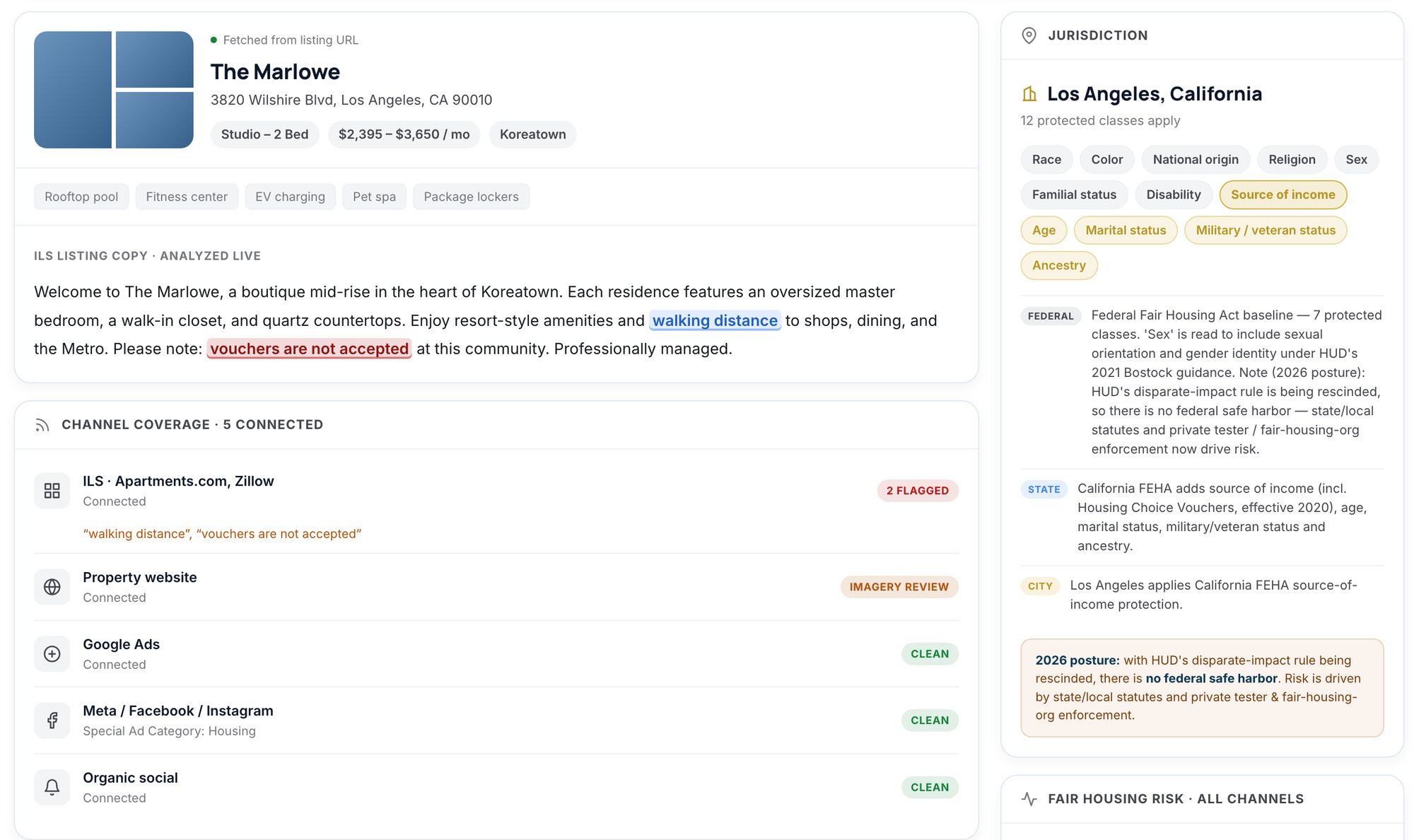
Original copy on a national template: "Quiet, mature community perfect for young professionals and couples. Near St. Anne's. No Section 8. Students welcome to apply. Master bedroom with walk-in closet."
| Phrase | Austin, TX | Brooklyn, NY | Washington, DC | Los Angeles, CA |
|---|---|---|---|---|
| "perfect for young professionals and couples" | Familial status | Familial status, age, marital status | Familial status, age, marital status | Familial status, marital status |
| "mature community" | Review in context | Age | Age | Review in context |
| "Near St. Anne's" | Religion (review) | Religion (review) | Religion (review) | Religion (review) |
| "No Section 8" | Not a federal class; check Texas, local and program rules | Source of income | Source of income | Source of income |
| "Students welcome to apply" | Keep | Keep | Keep | Keep |
| "Master bedroom with walk-in closet" | Keep (consider "primary") | Keep (consider "primary") | Keep (consider "primary") | Keep (consider "primary") |
Rewrite used at all four: "Elevator building with quiet hours and a staffed front desk. One-bedroom, 720 sq ft, primary bedroom with walk-in closet. Two blocks from the Metro, near shops and places of worship. We accept all lawful sources of income."
The rewrite is one version for the whole portfolio, written to the strictest address. That is usually cheaper than maintaining four.
How to review a flagged phrase in five steps
A repeatable loop for leasing, marketing or compliance reviewers.
Time needed: 15 minutes
- 1
Read the phrase in its sentence
Decide whether it describes the unit or the renter. A feature word inside a sentence about who should live there is a flag.
- 2
Match it to a class
Name the protected class it touches, federal first, then the state and city classes at the property's address.
- 3
Write the rewrite
Keep the selling point and state it as a fact about the building, the unit or the policy.
- 4
Find every copy
Search the website, each ILS listing, ad accounts and CRM templates for the same phrase and fix them together.
- 5
Record the decision
Save the original, the rewrite, the rule basis, the reviewer and the date, so the reasoning survives staff changes.
Why the fix rarely holds: syndicated copies
Fixing the phrase on the website is half the job. In Brynson's analysis of 6,000 properties and 1.6 million units, nearly 89% of communities described themselves differently depending on the listing site, and although 97% of listings had been updated within the previous 90 days, properties still showed conflicting mandatory fees, missing amenities and contradictory terms (listing accuracy report). Description text travels through the same syndication feeds, so an old "no Section 8" can survive on one ILS months after marketing removed it everywhere else.
After every rewrite, search each listing site, ad account and CRM template for the old phrase, starting with the ILSs that receive edits by hand. The ILS listing audit covers the field-by-field version of that check.
Compliance360 Fair Housing reads listing, website, ad and social copy span by span rather than keyword by keyword, with guards against false positives like "master bedroom" and "wheelchair-accessible." Each flag shows the protected class, the rule basis for that property's address and a suggested rewrite, plus every other listing and ad carrying the same phrase. Every output is a flag for a person to review, recorded with a date, as part of Compliance360.
Frequently asked questions
Generally no. Seattle's fair housing marketing guidance lists "family friendly" as an allowed phrase, because it signals that families are welcome rather than limiting anyone. It becomes a problem when paired with a limit, such as "family friendly, but quiet adults preferred."
Students are not a federal protected class, but DC protects matriculation, meaning enrollment in a college, university, or vocational, professional or adult education program, and lists it in its housing advertising ban. Describe lease terms instead, such as twelve-month leases, and check the property's state and city rules before using any student language.
No federal rule bans it. Georgia Realtors general counsel found no discriminatory origin for the term and reports HUD has historically treated feature words like it as physical descriptions. The same article suggests "primary bedroom" as an easy swap if the term might offend anyone.
Yes. Seattle's guidance lists "Section 8 welcome" as an allowed phrase, and an inclusive statement is not a limitation. Where source of income is protected, "We accept all lawful sources of income" covers vouchers and other assistance in one line.
"Quiet building" describes a feature, so it is usually fine when it stands alone; quiet hours are an even clearer fact to state. "Mature community" points to age, which New York and DC protect, and to familial status everywhere, so avoid it unless the property qualifies as housing for older persons.
Naming a specific religious institution as a selling point can read as a religious preference. Georgia Realtors counsel reports HUD has discouraged such references except for well-known landmarks used for directions. "Near places of worship" keeps the location benefit without the risk.
How we checked this
Written by the Brynson Research Team and checked against the primary sources below. Each source shows the date we last read it. We update this page when the rules change; see the change log.
- 42 U.S. Code 3604: Discrimination in the sale or rental of housing, Cornell Law School Legal Information Institute (U.S. Code), current. Accessed 2026-10-22.
- 24 CFR 100.75: Discriminatory advertisements, statements and notices, Cornell Law School Legal Information Institute (eCFR), current. Accessed 2026-10-22.
- 42 U.S. Code 3602: Definitions, Cornell Law School Legal Information Institute (U.S. Code), current. Accessed 2026-10-22.
- 42 U.S. Code 3607: Religious organization or private club exemption; housing for older persons, Cornell Law School Legal Information Institute (U.S. Code), current. Accessed 2026-10-22.
- 24 CFR 100.204: Reasonable accommodations, Cornell Law School Legal Information Institute (eCFR), current. Accessed 2026-10-22.
- New York Executive Law 296, New York State Senate, current. Accessed 2026-10-22.
- D.C. Code 2-1402.21: Prohibited real estate practices, Council of the District of Columbia, current. Accessed 2026-10-22.
- 23 Protected Traits Under the DC Human Rights Act, DC Office of Human Rights, 2026-07-01. Accessed 2026-10-22.
- Protected Classes fact sheet, NYC Commission on Human Rights, 2025-01-23. Accessed 2026-10-22.
- California Government Code 12955, Public.Law (reproduction of California statute), current. Accessed 2026-10-22.
- RCW 59.18.255: Source of income, Washington State Legislature, current. Accessed 2026-10-22.
- Colorado Revised Statutes 24-34-502, Public.Law (reproduction of Colorado statute), current. Accessed 2026-10-22.
- Marketing your unit, City of Seattle, Renting in Seattle, current. Accessed 2026-10-22.
- A Way With Words: Choose Your Phrases Carefully in Real Estate Advertising (Seth Weissman, GAR General Counsel), Georgia REALTORS (secondary source), 2021. Accessed 2026-10-22.
Change log
- First published.
This guide is general information, not legal advice. Laws and regulator guidance change; check the current rules for your properties with your counsel before acting.