
Virtual Staging and AI Photo Disclosure Laws for Apartment Listings: State and City Tracker for Multifamily
For marketing, leasing and compliance leads at multifamily operators with properties in more than one state.
As of October 22, 2026, California requires real estate licensees advertising a sale to label digitally altered photos and link to the original, and Wisconsin's licensee rule starts January 1, 2027. Bills in New Jersey, New York and DC and a New York City proposal would reach landlords or rental listings directly, so label staging now.
- California Business and Professions Code 10140.8 is the only statute in force, and it binds licensees and people acting for them in advertising for sale.
- New Jersey A4728, as amended, would bind landlords advertising for rent, allow only furniture staging with disclosure, and cap photo age at five years.
- New York S9584 would reach anyone who uses or publishes an altered image, including video and virtual tours.
- California, CRMLS and New York exclude routine edits such as lighting and cropping; New Jersey targets software "intended to fundamentally alter an image".
- One baseline covers every text read: label on or next to the image, original alongside, never alter the property itself.
This guide is general information, not legal advice. Laws and regulator guidance change; check the current rules for your properties with your counsel before acting.
Virtual staging disclosure laws by state and city: the tracker
Each row links to the primary text we read on October 22, 2026. "Binds" is the party the text names.
| Jurisdiction | Status | Binds | Rentals? | What it requires | Penalty in the text | Source |
|---|---|---|---|---|---|---|
| California: Bus. and Prof. Code 10140.8 (AB 723, Ch. 497, Stats. 2025) | In force since January 1, 2026 | Real estate brokers and salespersons, or a person acting on their behalf | Text covers advertising "for the sale of real property"; see the AB 723 guide | Conspicuous statement on or adjacent to the image plus a link, URL or QR code to the original; on sites the licensee controls, the originals in the posting | None in the section; willful Real Estate Law violations are a crime | chaptered text and status; Senate Judiciary analysis |
| Wisconsin: Wis. Stat. 452.136(1m) (2025 Wis. Act 69) | Enacted December 9, 2025; effective January 1, 2027 | Licensees | Text says "all advertising" and does not split sale from lease | Disclose when technology, including AI, was used to add, remove or change elements of the property in a way that creates a false or misleading impression | Not stated in the section | 2025 Wis. Act 69 |
| New York State: S9584 (Sen. May), same as A11403 | Pending; reported from Consumer Protection and committed to Judiciary April 28, 2026 | Anyone who uses or publishes the image (General Business Law 349 and 350); licensees face added discipline | Covers "real property" with no sale-only limit | Clear and conspicuous disclosure of material alterations; staging must say furnishings or finishes were added; conceptual tour elements labelled | Attorney General enforcement; for licensees, Department of State fine up to $2,000, suspension or revocation | bill text; status |
| New Jersey: A4728 (Morales, Drulis, Abdelaziz) | Pending; reported with amendments by Assembly Housing May 14, 2026 | Sellers, defined to include landlords, and seller's agents | Yes: amended to cover advertising for sale, rent or lease | No AI or software edits that fundamentally alter an image, except disclosed furniture staging; originals on request; photos current and no older than five years | Seller: $500 first offense, up to $1,000 for each later offense; seller's agent: Real Estate Commission discipline | second reprint; committee statement |
| Washington, DC: B26-0858, Restricting Editing and Alterations in Listing Photos Amendment Act of 2026 | Introduced October 9, 2026; referred to Public Works and Operations and to Housing | Not yet verified in bill text | Not yet verified in bill text | Bill text not yet read; we will add the requirements once it is | Not yet verified | LIMS record |
| New York City: Rental Ripoff Report recommendation | Recommendation, July 16, 2026; no rule or bill text yet | Landlords | Yes, rental listings | Recommends requiring landlords to disclose when rental listings were altered using AI or other digital tools | None yet | Mayor's Office release |
The two enacted laws bind licensees, which is why sale-focused summaries skip apartments. The pending texts name landlords or anyone who publishes.
In force: California 10140.8 and the CRMLS rule
California: the only statute in force
AB 723 was chaptered on October 10, 2025 as Chapter 497, Statutes of 2025, adding Business and Professions Code 10140.8 (chaptered text). A broker or salesperson, or a person acting on their behalf, who uses a digitally altered image in an advertisement for the sale of real property must say the image was altered, "reasonably conspicuous and located on or adjacent to the image", and give a link, URL or QR code to the clearly identified original. On a website the licensee controls, the unaltered images go in the posting, or a link to them.
The final text is broader than the July 2025 version in the Senate Judiciary analysis: covered elements now include fixtures, paint color, landscape, facade, floor plans and views through windows. CRMLS dates the law's effect to January 1, 2026. The open question for operators is reach, because the text says "for the sale of real property"; the AB 723 guide for apartment rentals covers it.
The MLS layer: CRMLS Rule 11.5.2
CRMLS Rule 11.5.2 (FAQ updated February 13, 2026) requires the original immediately before or after the altered image, and a label such as "Virtually Staged" or "AI Altered" in the photo's text field. It bans altering flooring, walls, cabinetry, fixtures and similar elements unless the property will be improved to match at close, and bans altering views through windows or neighboring properties. There is no fine yet; the Rules Committee will revisit fines in 2026. Few apartment communities list in an MLS, but this is the most specific working definition of "labelled" in force.
Enacted and pending: Wisconsin, New York and New Jersey
Wisconsin: enacted, effective January 1, 2027
2025 Wisconsin Act 69 creates Wis. Stat. 452.136(1m): "A licensee shall in all advertising disclose if the advertising has been altered or modified using technology, including artificial intelligence, to add, remove, or change elements of the property that creates a false or misleading impression of the property." The duty turns on a misleading impression, and the section sets no label wording.
New York State: S9584, the broadest text on the table
S9584 would add General Business Law 349-i. It is a consumer protection rule, so it reaches anyone who uses or publishes a "digital representation" of real property, not only licensees. It covers video, virtual tours and immersive media, not just stills. And a "material alteration" is one "that would affect a reasonable consumer's understanding of real property's condition, features, or layout". It would take effect immediately on enactment.
New Jersey: A4728, a prohibition that names landlords
As introduced, A4728 defined "seller" to include a landlord but applied its photo rule to ads "for sale". Committee amendments extended it to sale, rent or lease, and the Assembly Housing Committee reported the second reprint on May 14, 2026. It bars photos edited with generative AI "or other photo editing software intended to fundamentally alter an image", except adding or removing furniture and non-fixed items, disclosed in each ad and never to disguise a flaw. Originals go to renters on request, and photos must show the current state and be five years old or less. Sellers face $500 for a first offense and up to $1,000 after; agents face Real Estate Commission discipline (committee statement). It would apply to listings first posted after it takes effect.
City proposals: Washington, DC and New York City
Washington, DC: B26-0858
The Restricting Editing and Alterations in Listing Photos Amendment Act of 2026 was introduced on October 9, 2026 by Councilmember Henderson and six colleagues and referred to the Committees on Public Works and Operations and on Housing, according to the DC Council legislative listing. We have not yet read the bill text, so this tracker lists no requirements for it.
New York City: a recommendation, not a rule
The Mayor's Office Rental Ripoff Report release of July 16, 2026 lists among its recommendations "requiring landlords to disclose when rental listings have been altered using artificial intelligence or other digital tools". It names no agency or mechanism for this item.
What "housefishing" means
Housefishing, or house-fishing, is a coined term, after catfishing, for listing photos that make a home look better than it is. No statute, bill or government release we read uses it.
Licensee, landlord or publisher: who each rule binds
| Model | Examples | Operator is bound when |
|---|---|---|
| Licensee rule | California 10140.8, Wisconsin 452.136(1m) | A licensee, or someone acting for one, advertises the unit (in California, for sale). Ask counsel whether your management company's license brings you inside it. |
| MLS rule | CRMLS 11.5.2 | You or your agent list in that MLS. Rare for apartments. |
| Consumer protection rule (anyone who publishes) | New York S9584 | You use or publish the image, on your site or an ILS, whether or not a licensee is involved. |
| Landlord rule | New Jersey A4728, NYC recommendation | You advertise a unit for rent. Direct liability under New Jersey's amended text. |
The 2025 laws bind agents; the 2026 bills bind landlords and publishers.
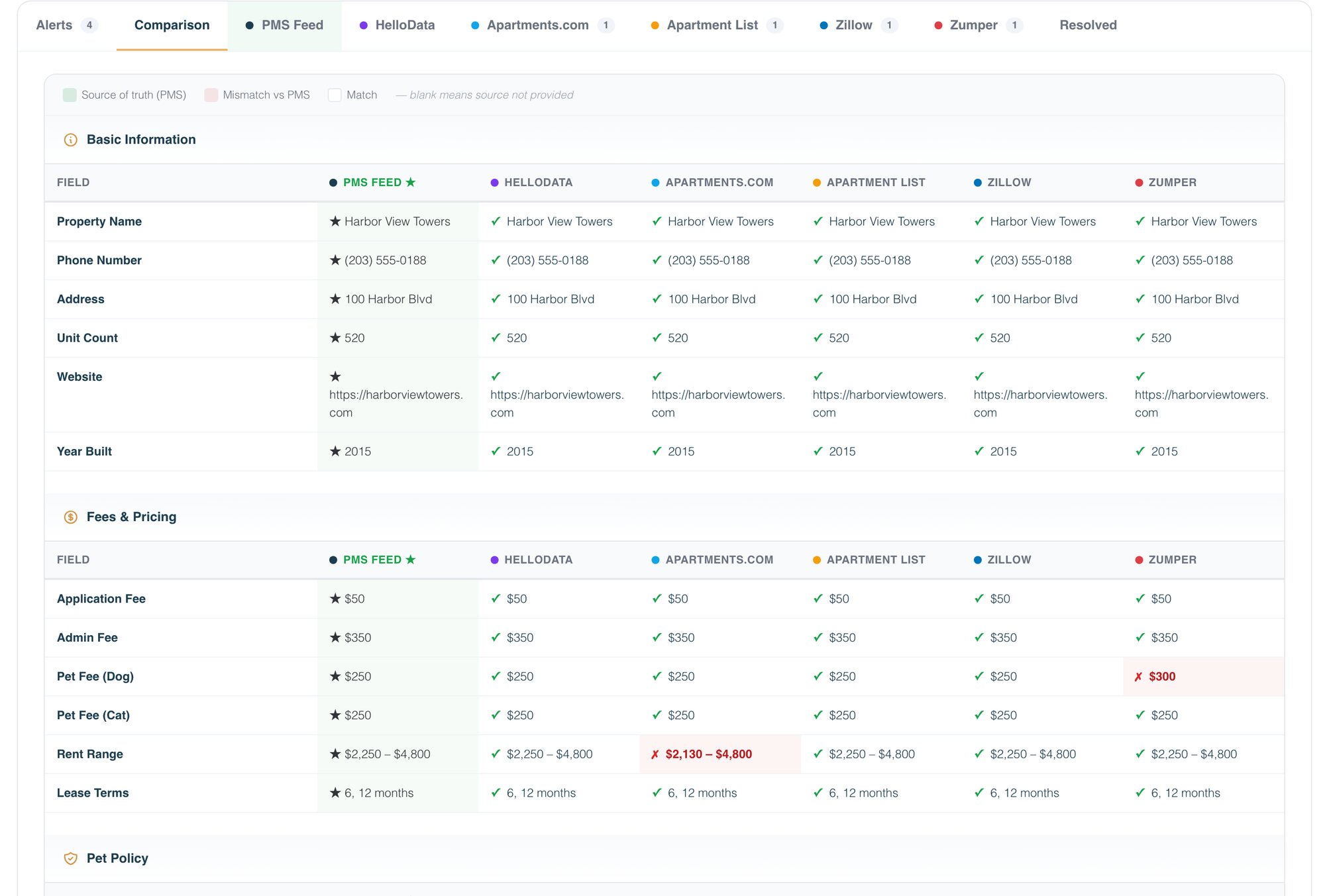
Syndication is the operational problem. In Brynson's analysis of 6,000 properties and 1.6 million units, nearly 89% of communities described themselves differently across listing sites, and although 97% of listings had been updated within the previous 90 days, conflicting mandatory fees, missing amenities and contradictory terms persisted. A label on your website reaches an ILS only if the feed carries it. See the apartment listing accuracy report.
Eight common listing photo edits and the disclosure each needs
Ranked from what every text allows with a label to what no label fixes.
- 01
Virtual staging an empty unit
Allowed in every text we read, with a label. Put the label next to the image, say furnishings were added (New York S9584) and show the empty original on your own site.
- 02
Swapping finishes, flooring or cabinets
California names fixtures, flooring, walls and paint color, so the edit needs a label and a link to the original. CRMLS bans it unless the unit will be upgraded to match, and New Jersey A4728 would allow only furniture changes. Quartz counters in a laminate unit are the clearest case.
- 03
Removing defects, stains or damage
Removing a water stain or cracked tile removes an element of the property. New York S9584 bars concealing known material defects without clear disclosure, and New Jersey A4728 bars edits that disguise a flaw. Fix and re-shoot.
- 04
Replacing the view or the sky
California lists views through windows and neighboring properties as covered elements, and CRMLS 11.5.2 bans altering them. A fake skyline view from a unit facing a parking structure is the clear case.
- 05
Adding appliances or amenities
California and CRMLS name appliances, and New York S9584 bars adding non-existent features without clear disclosure. A phantom in-unit washer or a pool rendered into a courtyard is the textbook case.
- 06
Renderings of units or amenities not yet built
New York S9584 permits them when clearly labelled as conceptual or proposed. Label every rendering "Artist rendering" and replace it once real photos exist.
- 07
Using model-unit photos for every floor plan
Not an edit, but the same misleading-impression risk, and New Jersey A4728 requires photos of the unit's current state. Caption them "Model unit; finishes vary" and keep them off listings for units that differ.
- 08
Photos more than five years old
New Jersey A4728 would cap photo age at five years for listings first posted after it takes effect. Add capture date to your asset library now.
What counts as altered, and what is routine editing
Most texts draw the same line: edits that change how the property looks are covered, edits that change how the photo looks are not.
| Text | Covered | Excluded | Label | Original |
|---|---|---|---|---|
| California 10140.8 | Add, remove or change elements, from furniture and fixtures to paint, floor plans and window views | Lighting, sharpening, white balance, color correction, angle, straightening, cropping, exposure | Reasonably conspicuous, on or adjacent to the image | Link, URL or QR code to the original in every ad; unaltered images in the posting on sites the licensee controls (source) |
| CRMLS 11.5.2 | Furniture or appliances; real property elements and views banned unless the property will be improved to match | Same list as California | "Virtually Staged", "Digitally Altered" or similar in the photo text field | Displayed immediately before or after (source) |
| Wisconsin 452.136(1m) | Add, remove or change elements in a way that creates a false or misleading impression | Anything that does not mislead | Disclosure, form not specified | Not required (source) |
| New York S9584 | Material alterations to condition, features or layout, in stills, video and tours | Visual enhancements that do not affect understanding; labelled concept renderings | Clear and conspicuous; staging must say furnishings or finishes were added | Not required (source) |
| New Jersey A4728 (second reprint) | Generative AI or other software intended to fundamentally alter an image | Adding or removing furniture and non-fixed items, if disclosed; no list of routine edits | Disclosure in each advertisement | On request; photos must show the current state and be five years old or less (source) |
New Jersey is the outlier: it lists no permitted routine edits, leaving color correction to Real Estate Commission rules due within a year, and it alone caps photo age.
A baseline that meets the strictest version
One baseline that meets the strictest version of each text is cheaper than a policy per state.
- Label on or next to the image, in the caption or alt text field that syndicates, using one of "Virtually staged", "Digitally altered" or "AI altered".
- Say what changed for staging: "Furnishings digitally added. Unit is unfurnished."
- Original next to it on any site you control, immediately before or after, and a link or QR code to it in every other ad.
- Never alter the property itself: finishes, fixtures, appliances, views, signage, amenities.
- Retire photos older than five years and any photo that no longer shows the current state.
- Keep the record: original, edit, approver and live dates.
An operator has 40 communities: 12 in California, 6 in New Jersey, 9 in New York and 13 in Texas. Today the only statute in force is California's, and it covers ads for sale, so its reach to the 12 California rent listings is the AB 723 guide's question. If S9584 and A4728 pass as written, 15 more properties come under rules that bind the operator directly. With the baseline in place, the 6 New Jersey properties need one extra check before their next new listing: no photo more than five years old.
Our listing photo policy template turns this baseline into an approval workflow for photographers and agencies.
How to put the baseline in place across a portfolio
Six steps, run once, then on every new photo.
- 1
Inventory every image
Export every photo, tour and rendering from your website, asset library and ILS feeds, with property and capture date.
- 2
Find the originals
Match each edited image to its unedited source. Any edited image without an original gets re-shot or removed.
- 3
Classify each edit
Sort each image into routine editing, staging, rendering or property alteration, using the table above.
- 4
Label and pair
Add the label in the caption field that syndicates, and place the original immediately before or after on sites you control.
- 5
Remove what no label fixes
Take down altered finishes, fixtures, views and amenities, and photos older than five years in New Jersey.
- 6
Record and re-check
Keep the original, the edit, the approver and the live dates, and re-check this tracker monthly.
FrameCheck registers each listing photo against the original in your own archive, shows exactly which region changed, flags possible virtual staging, and records a reviewer's disclosure decision with the evidence. SiteArchiver records which image a page showed on a given date. Both are part of Compliance360, so photo findings share one rulebook and one audit trail with your fee and listing findings.
Frequently asked questions
California's statute requires it when a licensee advertises a property for sale; our AB 723 guide covers rentals. New Jersey A4728 and New York S9584 would require it from landlords and publishers directly. Elsewhere, a label and the original on file cost almost nothing.
As of October 22, 2026, California's Business and Professions Code 10140.8 is in force and Wisconsin's 452.136(1m) takes effect January 1, 2027. New York S9584 and New Jersey A4728 are pending, DC introduced B26-0858 on October 9, 2026, and New York City has recommended a landlord rule.
Housefishing is a coined term, after catfishing, for listing photos that make a home look better than it is. No statute, bill or government release we read uses it, so it names the problem, not a legal standard.
No. Every text we read allows adding furniture to an empty room if it is disclosed. What they target is undisclosed staging and edits that change the property itself, such as finishes, fixtures, defects or views.
None of the texts we read binds the ILS itself; they bind the licensee, the landlord or whoever publishes the image, so your ILS photos are your advertising. California requires the label and a link to the original in each ad. Put the label in the caption field your feed sends, or it will not reach the ILS. Brynson works with ILSs, including Zillow and Apartments.com, as partners.
How we checked this
Written by the Brynson Research Team and checked against the primary sources below. Each source shows the date we last read it. We update this page when the rules change; see the change log.
- AB 723: Real estate: digitally altered images: disclosure (chaptered text, Chapter 497, Statutes of 2025), CalMatters Digital Democracy, October 10, 2025. Accessed 2026-10-22.
- AB 723 (Pellerin), Senate Judiciary Committee analysis, California Senate Judiciary Committee, July 15, 2025. Accessed 2026-10-22.
- 2025 Wisconsin Act 69 (Wis. Stat. 452.136(1m)), Wisconsin State Legislature, 2025. Accessed 2026-10-22.
- S9584: digital representations in real estate listings (bill text), New York State Senate, March 26, 2026. Accessed 2026-10-22.
- S9584 bill status and actions, New York State Senate, April 28, 2026. Accessed 2026-10-22.
- Assembly Bill A4728, second reprint (as reported by the Assembly Housing Committee), New Jersey Legislature, May 14, 2026. Accessed 2026-10-22.
- Assembly Housing Committee statement to A4728 (1R), New Jersey Legislature, May 14, 2026. Accessed 2026-10-22.
- Assembly Bill A4728 (introduced text), New Jersey Legislature, March 10, 2026. Accessed 2026-10-22.
- B26-0858, Restricting Editing and Alterations in Listing Photos Amendment Act of 2026, Council of the District of Columbia (LIMS), October 9, 2026. Accessed 2026-10-22.
- DC Council legislative listing for B26-0858, Council of the District of Columbia, October 19, 2026. Accessed 2026-10-22.
- Mayor Mamdani releases Rental Ripoff Report, New York City Mayor's Office, July 16, 2026. Accessed 2026-10-22.
- Digitally Altered Images (New Rule 11.5.2) FAQs, CRMLS, February 13, 2026. Accessed 2026-10-22.
- Release on A4728, AI-generated real estate photos, New Jersey Assembly Democrats, May 15, 2026. Accessed 2026-10-22.
Change log
- First published. Rows for California (chaptered text), Wisconsin, New York S9584, New Jersey A4728 (second reprint), DC B26-0858 and the NYC recommendation verified against primary texts.
This guide is general information, not legal advice. Laws and regulator guidance change; check the current rules for your properties with your counsel before acting.