
Fair Housing Advertising Checklist for Apartment and Multifamily Marketing Teams (Free Template)
For marketing, leasing and compliance leads at multifamily operators who review ads, listings and scripts before and after they run.
A fair housing advertising checklist for apartments tests every channel (ILS listings, website, Google and Meta ads, social, email and text, signage and phone scripts) for words and images that indicate a preference based on a protected class. It checks each property's state and city classes, paid-ad settings and logo use, and records reviewer, date, change and evidence.
- Review against each property's jurisdiction row, because state and city classes such as source of income vary by address.
- 24 CFR 100.75 covers written and oral statements, so phone scripts, emails and agency briefs belong on the checklist.
- The Equal Housing Opportunity logo is a best practice under 24 CFR 100.75, but 24 CFR 200.620 requires it in all advertising for projects in FHA programs.
- Every row records pass or flag, rule basis, a named reviewer, dates and a before-and-after capture.
This guide is general information, not legal advice. Laws and regulator guidance change; check the current rules for your properties with your counsel before acting.
What the checklist covers, and when to run it
The federal rule is short. 42 U.S.C. 3604(c) makes it unlawful to publish any notice, statement or advertisement for the rental of a dwelling "that indicates any preference, limitation, or discrimination" based on race, color, religion, sex, handicap, familial status or national origin. HUD's regulation, 24 CFR 100.75, says that reaches "all written or oral notices or statements", including flyers, brochures, signs, banners and applications. That is why this checklist is organized by channel, not by word list: the leasing phone script is as much in scope as the Zillow description. The rules behind each check are explained in the fair housing advertising guide for apartments.
The template has five check groups (copy, imagery, channel setup, logo and statement, sign-off and evidence) and one row per property, per channel. Run it on these triggers:
| Trigger | Scope | Owner |
|---|---|---|
| New listing, campaign or template | That asset, before it goes live | Marketing reviewer |
| Template or boilerplate change | Every property that inherits it, on every channel it syndicates to | Marketing lead |
| Property acquired or taken over | All channels for that property, from scratch | Onboarding or compliance |
| New state or city law at a property | All properties in that jurisdiction | Compliance |
| Quarterly sweep | A sample of live ads per property, plus every channel marked "not reviewed" | Compliance |
Before you start: one jurisdiction row per property
The seven federal classes are the floor, not the list you review against. States and cities add classes, and the commonest addition that shows up in apartment copy is source of income. Seattle's guidance for housing providers lists "Does not accept housing vouchers" and "No Section Eight" as violating language, and "Section 8 welcome" as acceptable (Seattle Office for Civil Rights). The same sentence on a property in another state needs that state's rule checked, which is the reason for a jurisdiction column.
For each property, record the address, state, city or county, and the protected classes in force there, from the protected classes by state table and the source of income laws by state table. Reviewers check copy against that row, not against memory.
A 40-property operator reuses one ILS description: "Quiet community, perfect for young professionals. No vouchers." The jurisdiction rows show 6 properties in Seattle and 34 in other cities. "Perfect for young professionals" is flagged at all 40 under familial status (federal). "No vouchers" is flagged at the 6 Seattle properties under Seattle's guidance and routed to compliance for the other 34, with the state and city rows attached. The template is fixed once; the evidence column holds 40 before-and-after captures.
Fixing the template is not the end. Brynson's analysis of 6,000 properties and 1.6M units found about 89% of communities described themselves differently across listing sites (apartment listing accuracy report), so a phrase removed from the website can keep running on an ILS that was never updated. Check every channel the template reached.
The 12 checks, with what fails each one
Each check has an ID that goes in the template's Check column. C1 to C5 are copy, C6 and C7 imagery, C8 and C9 channel setup, C10 to C12 scripts, briefs and the logo.
- 01
C1. Describe the unit, not the resident
Flag any words about who should live there: "young professionals", "empty nesters", "perfect for singles", "mature community". Rewrite to features: "two bedrooms, home office nook, quiet floors". Seattle lists "Suits a single professional" as a violation (seattle.gov).
- 02
C2. Location and amenity wording
Describe distances and places by what they are ("0.4 miles to the light rail"), not by who uses them. Flag neighborhood descriptions that characterise residents, and amenity copy that names a religion, nationality or age group as the audience. Full phrase lists are in fair housing words to avoid.
- 03
C3. Policies stated as rules about people
Occupancy, guest and pet policies belong in the unit's terms, not in headlines like "no kids" or "adults only". Unless the property operates under the 55+ exemption (see 55+ apartment advertising), any reference to children is a familial status flag.
- 04
C4. Source of income
Check the property's jurisdiction row before reviewing. "No vouchers", "No Section 8" and "employment income only" are flagged wherever source of income is protected; Seattle names "Does not accept housing vouchers" as a violation (seattle.gov).
- 05
C5. Disability and accessibility language
Describe features ("step-free entry", "elevator to all floors", "roll-in shower in units 104 and 204"). Seattle lists "Accessible for people with disabilities" as acceptable. Flag statements about who can or cannot live there, such as "must be able to climb stairs", which can read as a limitation based on handicap under 24 CFR 100.75(c)(1).
- 06
C6. People in photos and video
The rule names "photographs, illustrations, symbols" (100.75(c)(1)). Review the gallery as a set: if every person across the property's images appears to be of one race, age group or family type, flag it for a person to review and refresh. For projects in FHA programs, 24 CFR 200.620 requires that advertising depicting persons show majority and minority groups, including both sexes.
- 07
C7. AI-generated and virtually staged images
Record whether each lifestyle image is a real photo, staged, or generated, and check the disclosure rules at the property's address in virtual staging disclosure laws. Generated people are reviewed under C6 like any model; AI copy is reviewed under C1 to C5 (see AI listing copy and fair housing).
- 08
C8. Paid channel setup
For every live housing campaign: Meta special ad category set to housing, location radius of at least 15 miles, no ZIP codes and no lookalike audiences (Meta documentation); Google campaigns with no targeting by gender, age, parental status, marital status or ZIP code (Google Ads policy).
- 09
C9. Media mix
24 CFR 100.75(c)(3) covers "selecting media or locations for advertising" that deny information to protected groups. Record which channels each property runs on and flag a property whose only paid channel is a narrow audience or publication, or whose ILS presence was cut without a reason on file.
- 10
C10. Instructions to agencies, ILS coordinators and staff
Briefs, ad requests and internal messages count: 100.75(c)(2) covers preferences expressed to agents, brokers and employees. Add the agency brief and any ILS coordinator notes to the review, not only the published ad.
- 11
C11. Phone, tour and follow-up scripts
Oral statements are in scope under 100.75(b). Review the leasing phone script, the tour talk track and email and text follow-up templates once a quarter, and whenever a new script is issued. Flag any line that describes the current resident mix.
- 12
C12. Logo or statement present and consistent
Recommended on every channel; required in all advertising for projects in FHA programs under 24 CFR 200.620. Mark the row "required" or "recommended" from the property record so the reviewer does not have to decide.
The template: columns and how to fill them
Each row is one property, one channel, one check. These are the columns, with what a completed row looks like.
| Column | What to record | Example entry |
|---|---|---|
| Property and jurisdiction | Name, address, state and city classes row | Property 12, Seattle, WA (SOI protected) |
| Channel and asset | Where it ran and a link or ID | ILS listing, description field |
| Check | Check ID from the list below | C4 Source of income |
| Result | Pass, flag or not reviewed | Flag |
| Finding | The exact words or image | "No vouchers" |
| Rule basis | Statute, regulation or local guidance, with link | Seattle OCR guidance; state SOI row |
| Change made | New wording or replaced image | Removed; added "Housing vouchers welcome" |
| Reviewer and date | Named person, not a team | Compliance lead, 2026-10-22 |
| Evidence link | Dated capture before and after | Archive link, both dates |
| Re-check date | When the fix was confirmed on the live channel | Next scheduled sweep |
Use "reviewed" and "recorded" in the sign-off field. A checklist documents diligence; it does not make an ad lawful, and wording that claims more invites a dispute about what the review covered.
How to run the checklist for one property
Run these steps in order. For a portfolio, do step 1 once for every property, then batch steps 2 to 8 by template.
- 1
Fill the jurisdiction row
Record the property's address, state and city, and the protected classes in force there from the state table. Mark whether it is a project in an FHA program covered by 24 CFR 200.620, which makes the logo check required.
- 2
Inventory every live asset
List each ILS listing, website page, Google and Meta campaign, social account, email and text template, print piece and script that names the property. Any channel you cannot open is marked not reviewed.
- 3
Run the copy checks
Apply checks C1 to C5 to every text asset and record the exact words for each flag.
- 4
Run the imagery checks
Apply C6 and C7 to the full gallery on each channel, as a set, and record which images are photos, staged or generated.
- 5
Confirm paid channel setup
Apply C8 and C9 to every live campaign and save a dated screenshot of the targeting settings.
- 6
Check scripts, briefs and the logo
Apply C10 to C12 to agency briefs, leasing scripts and every channel's footer or profile.
- 7
Record, fix and sign off
The compliance reviewer marks pass or flag, approves the rewrite and signs the row with name and date. Capture the asset before and after the change.
- 8
Re-check on the live channel
Confirm the fix on every channel the template reached, including ILSs, and record the re-check date. Set the next review from the trigger table.
Channel by channel: what to check and where it fails
| Channel | Flag if | Rule basis |
|---|---|---|
| ILS listing copy | Describes who should live there, or carries a source-of-income exclusion where protected | 24 CFR 100.75(c)(1) |
| ILS and website photos | People shown are all of one apparent group across the gallery (staged and generated images go to C7) | 100.75(c)(1) ("photographs, illustrations") |
| Property website (home, amenities, pet, FAQ pages) | FAQ or pet page states a policy as who may live there ("adults only", "no kids") rather than as unit terms | 100.75(a) |
| Google Ads | Campaign targets by age, gender, parental status, marital status or ZIP code | Google housing ads policy (US and Canada) |
| Meta ads | Housing special ad category not set; radius under 15 miles; ZIP codes or lookalikes used | Meta special ad category; 100.75(c)(3) media selection |
| Organic social | Staff or agency posts use resident-describing language or one-group imagery | 100.75(b) |
| Leasing email and text templates | Follow-ups steer ("you might prefer our other community") or vary by prospect | 100.75(b), (c)(2) |
| Brochures, banners, signage | Printed copy predates the last template fix | 100.75(b) ("flyers, brochures... signs, banners") |
| Phone and tour scripts | Script or call recording describes the resident mix or asks about children | 100.75(b) ("oral notices or statements") |
Platform settings for paid channels are covered in depth in Meta and Google housing ad rules for apartments. The checklist only records that each campaign was set up correctly and who confirmed it.
The Equal Housing Opportunity logo and statement
For most market-rate apartment advertising, the logo is a recommended practice, not a federal requirement in the advertising rule. 24 CFR 100.75 prohibits discriminatory content but does not require a logo, and HUD removed its advertising guidelines (former 24 CFR Part 109) from the CFR in 1996 as nonbinding guidance (61 FR, April 1, 1996). Seattle's guidance recommends using "the Equal Housing Opportunity logo or slogan" (seattle.gov).
Two federal rules do require something:
- Projects in FHA programs. HUD's affirmative fair housing marketing rules (24 CFR Part 200, Subpart M) apply to FHA subsidized and unsubsidized multifamily projects of five or more units (200.615). For those, 24 CFR 200.620 requires that all advertising include "the Department-approved Equal Housing Opportunity logo or slogan or statement", that advertising depicting persons show majority and minority groups and both sexes, and that a sign with the logo, slogan or statement be posted on the project site. Mark the logo check as required on those rows.
- The fair housing poster. 24 CFR 110.10 requires covered persons to post and maintain a fair housing poster at any place of business where the dwelling is offered for rental and at the dwelling itself. That is a leasing office and property check, not an ad check, but it belongs on the same sweep.
Template rule: use the logo or the words "Equal Housing Opportunity" consistently across the website footer, ILS profile where the field exists, print and signage, so its absence on one channel is never the question.
Sign-off and evidence: what to keep
Every flag needs the exact words or image, the change, dated captures before and after, and a named reviewer. Retention periods, capture formats and legal hold are covered in apartment compliance evidence retention; link the evidence column there, not to a folder of screenshots.
Assign three roles: a preparer (marketing or the agency) who fills in the rows, a reviewer (compliance) who decides pass or flag, and an escalation contact (counsel) for anything that turns on a state or city rule the reviewer is unsure of. Agencies and ILS coordinators fill rows; they do not sign them off, so no one approves their own copy. Their briefs are reviewed too, because 100.75(c)(2) reaches preferences expressed to agents and employees as well as to renters (check C10).
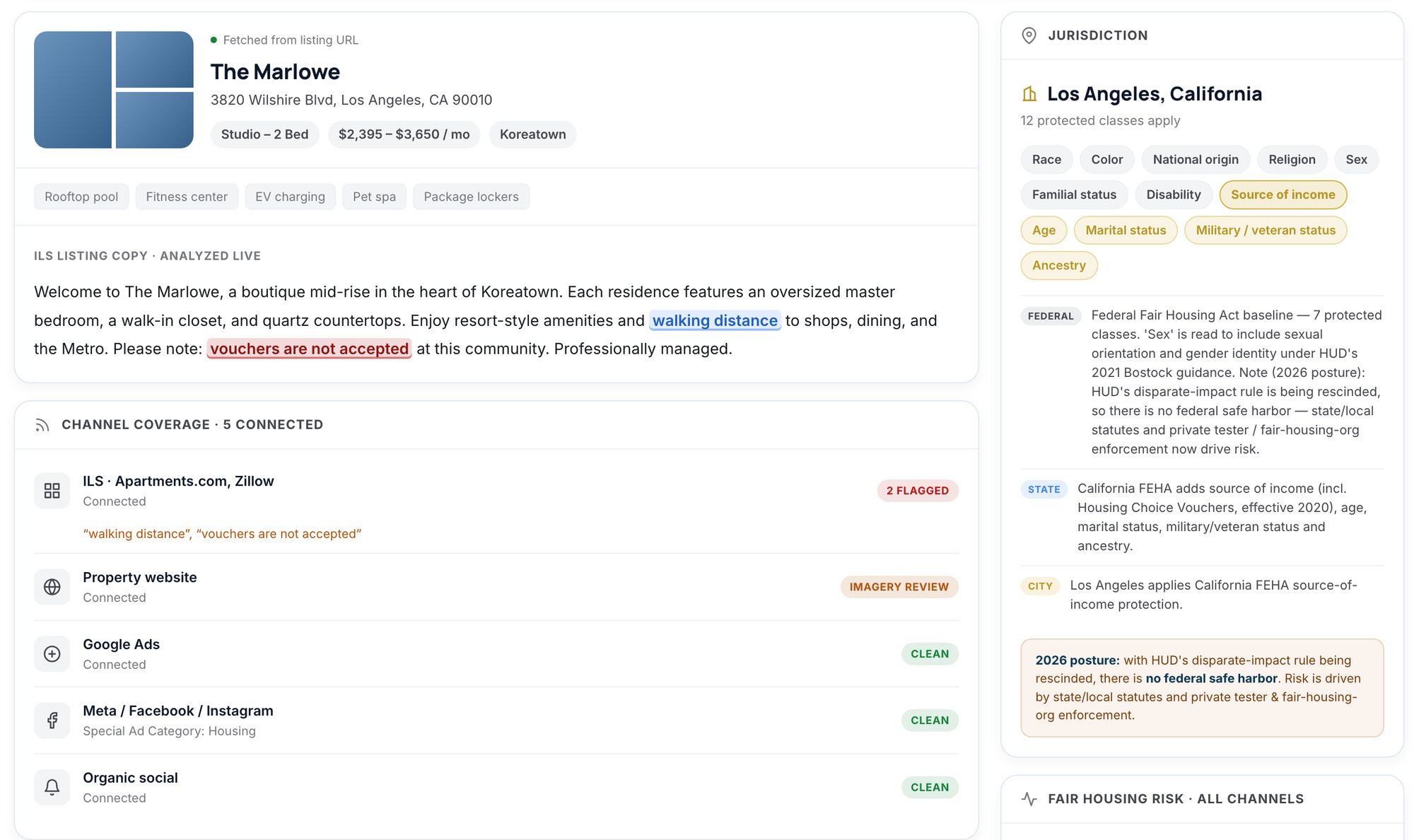
Compliance360 Fair Housing runs the copy checks across ILS listings, the property website, Google Ads, Meta and organic social, resolves each phrase against the federal, state and city classes for that property, and marks each channel clean, flagged or not connected. Each flag carries its protected class, rule basis and a suggested rewrite for a person to review, and findings with the reviewer's sign-off export as a dated PDF or JSON record. SiteArchiver, part of Compliance360, keeps daily, hash-chained captures of property pages for the evidence column.
Frequently asked questions
Not under the federal advertising rule itself: 24 CFR 100.75 prohibits discriminatory content but does not require a logo, so for most market-rate properties it is a best practice. Projects in FHA programs are different, because 24 CFR 200.620 requires the logo, slogan or statement in all advertising and on a project-site sign. Check your loan, regulatory agreement and state rules, and use it consistently either way.
Review every new listing, campaign and template before it goes live, and re-review every property that inherits a template when the template changes. Add a quarterly sweep of live ads on each channel and a full review when a property is acquired or a new state or city law applies. Copy drifts across ILSs, so a one-time review goes stale quickly.
A named compliance reviewer, not the person or agency who wrote the ad. Marketing or the agency prepares the rows, compliance decides pass or flag, and counsel takes questions that turn on a state or city rule. Record the reviewer's name and date on every row.
For each flag keep the exact wording or image, the rule basis, the change made, dated captures before and after, and the reviewer's name. For passes, keep a dated capture of what was reviewed. Store captures in an archive that shows when they were taken, not a folder of undated screenshots.
Yes, when staff post about the property. 24 CFR 100.75(b) applies to all written or oral notices or statements by a person engaged in the rental of a dwelling, so a leasing agent's post about an available unit is in scope. Add staff and agency accounts that promote the property to the channel inventory and review a sample in each quarterly sweep.
No. An affirmative fair housing marketing plan is the outreach plan HUD requires from applicants in FHA programs under 24 CFR 200.625, setting out how the project will attract tenants of all minority and majority groups. An ad review checklist tests what each ad says and shows. Properties covered by a plan need both, and the plan's rules make some checks, such as the logo, mandatory.
How we checked this
Written by the Brynson Research Team and checked against the primary sources below. Each source shows the date we last read it. We update this page when the rules change; see the change log.
- 42 U.S. Code 3604: Discrimination in the sale or rental of housing, Cornell Law School Legal Information Institute (U.S. Code), current. Accessed 2026-10-22.
- 24 CFR 100.75: Discriminatory advertisements, statements and notices, Cornell Law School Legal Information Institute (eCFR), current. Accessed 2026-10-22.
- 24 CFR 200.620: Affirmative fair housing marketing requirements (FHA programs), Cornell Law School Legal Information Institute (eCFR), current. Accessed 2026-10-22.
- 24 CFR Part 200, Subpart M: Affirmative Fair Housing Marketing Regulations (200.600 to 200.640), Cornell Law School Legal Information Institute (eCFR), current. Accessed 2026-10-22.
- 24 CFR 110.10: Persons subject to the fair housing poster requirement, Cornell Law School Legal Information Institute (eCFR), current. Accessed 2026-10-22.
- HUD final rule removing 24 CFR Parts 106 and 109 (FR Doc. 96-7786), Federal Register via GovInfo, 1996-04-01. Accessed 2026-10-22.
- Marketing your unit, City of Seattle, Renting in Seattle, current. Accessed 2026-10-22.
- Special Ad Category (Marketing API), Meta for Developers, current. Accessed 2026-10-22.
- Google Ads housing policy, Google Advertising Policies Help, current. Accessed 2026-10-22.
Change log
- First published.
This guide is general information, not legal advice. Laws and regulator guidance change; check the current rules for your properties with your counsel before acting.