
How to Advertise 55+ and Active Adult Apartments Under Fair Housing Rules
For marketing, leasing and compliance leads at operators of 55+ and active adult rental communities.
Advertise a qualifying community as housing for persons 55 or older, in those words. HUD's rule at 24 CFR 100.306(b) says phrases like "adult living" or "adult community" are not consistent with 55+ intent. The exemption lifts familial status rules only, so disability, race, religion and state age protections still govern every ad, photo and audience.
- Use "55+" or "housing for persons 55 and older" on every surface; "adult", "mature" and "senior-style" wording undercuts the intent test.
- The exemption rests on three federal tests: 80 percent occupancy by someone 55 or older, published intent, and age verification refreshed at least every two years.
- Ads describe amenities and services, never the physical or mental abilities a resident must have.
- New York and DC protect age in housing, so check state wording before copying a national 55+ template.
- Meta and Google ads still reach all adults; the copy, not the audience setting, carries the 55+ signal.
This guide is general information, not legal advice. Laws and regulator guidance change; check the current rules for your properties with your counsel before acting.
Say "55+", not "adult": the one rule most 55+ ads break
24 CFR 100.306(b) reads: "Phrases such as 'adult living', 'adult community', or similar statements in any written advertisement or prospectus are not consistent with the intent that the housing facility or community intends to operate as housing for persons 55 years of age or older."
That matters because intent is one of the three things a community must prove to use the exemption, and 100.306(a) lists "any advertising designed to attract prospective residents" and "the manner in which the housing facility or community is described to prospective residents" as evidence of intent. Every ILS description, website hero and brochure is an exhibit.
What the housing-for-older-persons exemption requires
42 U.S.C. 3607(b)(1) says "any provision in this subchapter regarding familial status" does not apply to housing for older persons. For 55+ housing, 24 CFR 100.304 and the three sections after it set the conditions.
| Test | What the rule says | Where marketing touches it |
|---|---|---|
| Occupancy | "At least 80 percent of its occupied units must be occupied by at least one person 55 years of age or older" (24 CFR 100.305(a)). Under 100.305(e), units held by under-55 employees who perform substantial management or maintenance duties, and by under-55 people needed to provide a reasonable accommodation to disabled residents, do not defeat the exemption. | Leasing tracks the ratio before accepting under-55 households. |
| Intent | The community must "publish and adhere to policies and procedures that demonstrate its intent" to operate as 55+ housing; advertising, descriptions to prospects, lease rules and posted statements are all factors (24 CFR 100.306(a)). | Every ad, listing and brochure. |
| Verification | Compliance is shown "through reliable surveys and affidavits", updated "at least once every two years", and a summary "shall be available for inspection upon reasonable notice and request by any person" (24 CFR 100.307(a), (c), (i)). | Online applications collect the age document or signed household statement listed in 100.307(d). |
Two details operators miss. The statute's good faith defense shields a person from personal liability for money damages only if they had no actual knowledge that the community fails to qualify and the community "has stated formally, in writing," that it complies (42 U.S.C. 3607(b)(5)(B)); a written exemption statement is cheap insurance. And 62+ housing is a separate test: "intended for, and solely occupied by, persons 62 years of age or older" (3607(b)(2)(B)).
8 before-and-after copy rewrites for 55+ apartment ads
Each pair shows a common line, a rewrite and the rule behind it.
- 01
"Adult community" becomes "A 55+ apartment community"
Before: "Upscale adult community near the lake." After: "An upscale 55+ apartment community near the lake." 100.306(b) names "adult community" as inconsistent with 55+ intent.
- 02
"Adult living" becomes "Housing for persons 55 and older"
Before: "Resort-style adult living." After: "Resort-style apartments for persons 55 and older." "Adult living" is the other phrase 100.306(b) names. The rewrite mirrors the statute's own wording in 3607(b)(2)(C).
- 03
"Adults only, no kids" becomes a pointer to the age policy
Before: "Adults only. No children." After: "A 55+ community. Ask about our age and occupancy policy." "Adults only" is the "adult" wording 100.306(b) flags, and because the 80 percent test in 100.305(a) counts units with at least one resident 55 or older, a blanket age line can also misstate your own occupancy policy.
- 04
"Mature" or "seasoned" becomes the number
Before: "Sophisticated living for mature residents." After: "Sophisticated apartments for residents 55 and older." Vague age words are likely to read as the "similar statements" 100.306(b) warns against, and they do not state the eligibility rule.
- 05
"For active, independent seniors" becomes the amenity list
Before: "Designed for active, independent seniors." After: "Fitness studio, heated pool, walking trails and weekly group classes." Describing who a resident must be can indicate a limitation based on handicap under 100.75(c)(1); describing what the property has does not.
- 06
"Must be able to live independently" becomes a services statement
Before: "Residents must be able to live independently. No motorized scooters." After: "This community does not provide medical, personal care or meal services." 100.202(c) bars asking about the nature or severity of a disability.
- 07
"Near St. Mark's" becomes neutral landmarks
Before: "Walk to St. Mark's Parish and the Senior Center." After: "Walk to Main Street shops, the public library and Riverside Park." A named congregation as a selling point can read as a religious preference under 100.75(c)(1).
- 08
A one-look gallery becomes a varied one
Before: every lifestyle photo shows residents of one race, often one couple. After: a gallery that shows residents of different races and both single residents and couples. 100.75(c)(1) lists "photographs, illustrations" alongside words.
What the exemption does not cover
The exemption removes familial status from the analysis. 24 CFR 100.75(c)(1) still bars "words, phrases, photographs, illustrations, symbols or forms" that convey availability based on "race, color, religion, sex, handicap, familial status, or national origin".
| Class | Status in a qualifying 55+ community | Where 55+ copy usually slips |
|---|---|---|
| Familial status | Not applied (3607(b)(1)) | Only if the community fails a test; then "no children" becomes a violation |
| Disability | Fully applies (100.75(c)(1)) | "Active", "independent", "must be able to" and no-scooter rules |
| Race, color, sex, national origin | Fully applies (100.75(c)(1)) | Galleries and brochures that show one group of older residents |
| Religion | Fully applies (100.75(c)(1)) | Naming a parish or congregation as a selling point |
Disability needs the most care because 55+ marketing sells vitality. 24 CFR 100.202(c) bars asking about an applicant's handicap or its severity, and age-restricted housing is not among its exceptions, so a 55+ application asks for a birth date, not a health history.
State and city age protections: check the address before the template
The federal Fair Housing Act does not list age, but some states and cities do. Two we read in the primary text:
| Jurisdiction | Age in housing ads | 55+ carve-out wording |
|---|---|---|
| New York State | Bars any advertisement that "expresses, directly or indirectly, any limitation, specification or discrimination as to" age, among other classes (Executive Law 296(5)(a)(3)) | Exempt "solely with respect to age and familial status": housing for persons 62 or older and their spouses, or "housing intended and operated for occupancy by at least one person fifty-five years of age or older per unit" (296(5)(a)). As read, that exemption sentence names subparagraphs one and two; the advertising ban is subparagraph three, so confirm the 55+ advertising position with counsel |
| District of Columbia | Bars ads that indicate a preference, limitation or discrimination based on age, source of income and other classes (D.C. Code 2-1402.21(a)(5)) | "Nothing in this chapter regarding familial status applies to housing for older persons" (2-1402.21(c)(3)); the text we read ties the carve-out to familial status, so confirm the age position with counsel |
Note the New York wording: it describes occupancy per unit, which is not the same phrasing as the federal 80 percent test. For the classes protected in other states, see the protected classes by state table.
Paid social and search: the platforms do not know you are 55+
Meta's documentation says age options for housing ads are "generally fixed to include ages 18 through 65+" and lists no senior housing exception (Meta Marketing API docs). Google's housing policy, which names retirement residential communities as housing, says that in the US and Canada "you can't target using: Gender, Age, Parental status" or ZIP codes (Google Ads policy).
So a 55+ campaign reaches all adults. The headline and first line must say "55+", the landing page must repeat it, and leasing answers under-55 inquiries with the published age policy. Choosing media to deny a group information is itself covered by 100.75(c)(3). The full targeting rules are in Meta and Google housing ad rules.
A 180-home 55+ community runs a Meta lease-up campaign at the 15-mile minimum radius. Version A headline: "Adult living, reimagined." Version B headline: "A 55+ apartment community in Riverside." Version A uses the wording 100.306(b) calls inconsistent with 55+ intent; Version B states eligibility in the first four words.
How to review a 55+ campaign before it goes live
Run these for every new campaign, listing refresh or brochure reprint.
- 1
Confirm the exemption file is current
Check that the community's written exemption statement exists and that the last age-verification survey update is less than two years old under 24 CFR 100.307(c).
- 2
Search every draft for adult wording
Search headlines, body copy, alt text and hashtags for "adult", "mature" and similar statements, and replace each with "55+" or "persons 55 and older".
- 3
Strike ability language
Remove words that describe what a resident must be able to do, such as "independent" or "must be able to", and describe amenities and services instead.
- 4
Check the address for state age rules
Look up whether the property's state or city protects age in housing and whether its senior housing carve-out uses different wording from the federal test.
- 5
Review the images
Look at the full gallery and ad creative together and confirm it shows a range of residents, not one race, sex or household type.
- 6
Match the copy to the channel settings
Confirm the ad runs in Meta's Housing category or under Google's housing policy, and that the first line of copy states 55+ because the audience cannot.
- 7
Record what ran
Save a dated copy of each approved ad, listing and landing page with the reviewer's name, so the intent evidence exists if anyone asks.
One description on every surface
Because HUD weighs "the manner in which the housing facility or community is described" (100.306(a)), a 55+ community that calls itself "55+" on its website and "active adult" or "adult living" on three ILSs has mixed evidence of intent. In Brynson's analysis of 6,000 properties and 1.6 million units, about 89 percent of communities described themselves differently across listing sites (apartment listing accuracy report).
| Surface | Description found | Action |
|---|---|---|
| Property website | A 55+ apartment community | Keep |
| ILS listing 1 | Luxury adult living | Rewrite at the source feed |
| ILS listing 2 | Senior apartments, independent living | Rewrite; remove "independent living" |
| Leasing brochure (2023 print) | Adult community | Retire and reprint |
Fix descriptions at the feed or PMS record, or old wording returns on the next sync. The fair housing advertising checklist covers the review record.
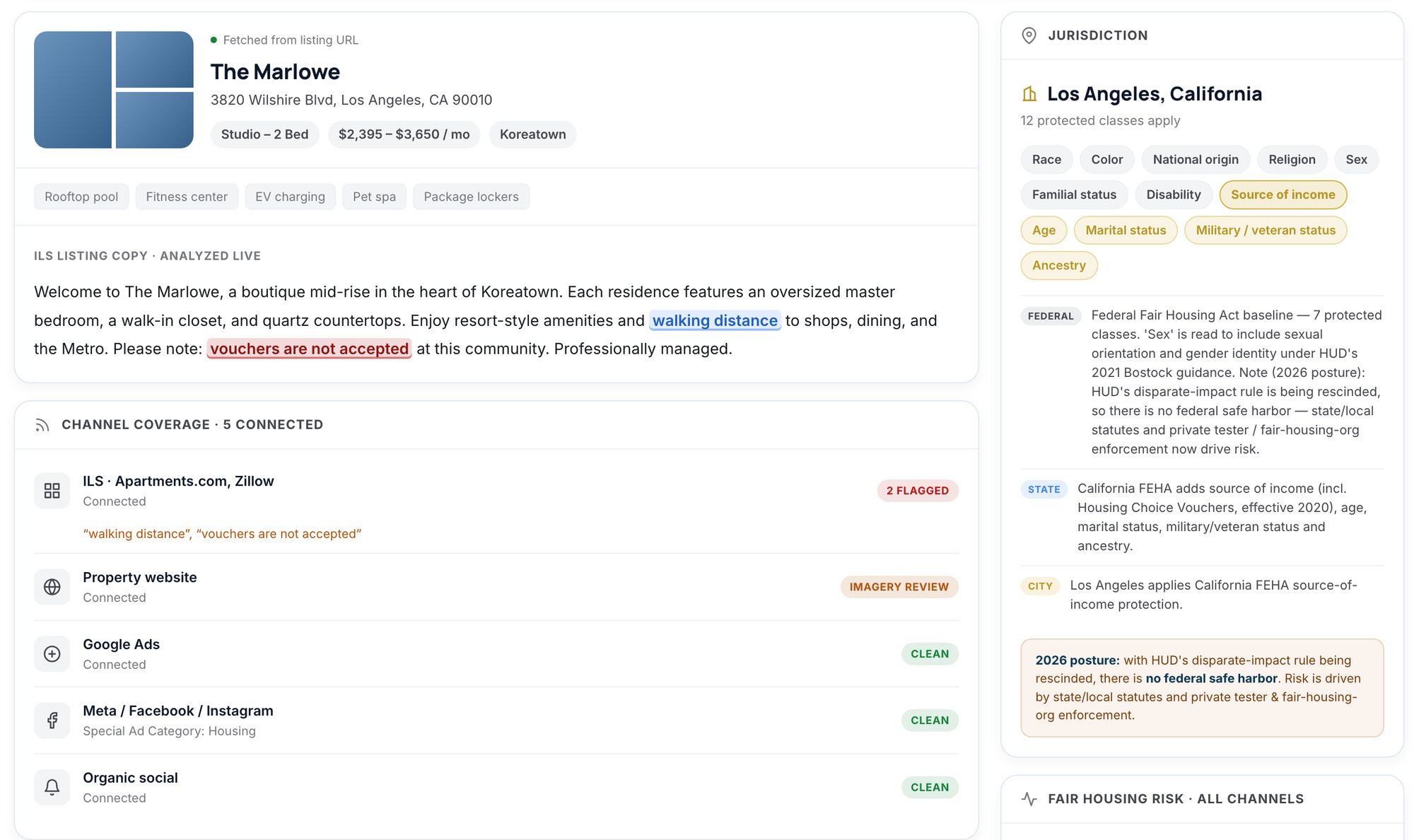
Compliance360 Fair Housing analyses listing, website, ad and social copy for protected-class language such as familial status, disability and religion, resolves each phrase against the federal, state and city rules in force where the property sits, and attaches a rule basis and a suggested rewrite to every flag. SiteArchiver captures property website pages daily and whenever they change, keeping a record of what each page actually said, which is the record a 55+ community needs when its advertising is part of the intent evidence.
Frequently asked questions
Only a community that qualifies as housing for older persons should limit occupancy by age, and even then HUD's rule at 24 CFR 100.306(b) says "adult" wording is not consistent with 55+ intent. Say "55+" or "housing for persons 55 and older" instead. In a community that does not qualify, "adults only" indicates a familial status limitation under 42 U.S.C. 3604(c).
"55+" states the eligibility the exemption is built on, while "adult community" only says no children, which is the familial status limitation the exemption has to justify. HUD names "adult community" and "adult living" as inconsistent with 55+ intent.
"Active adult" is common industry shorthand, but in an ad it carries two risks: "adult" is the wording HUD flags, and "active" can suggest a resident must have certain physical abilities. Describe the amenities and programs instead.
No. The exemption lifts only the familial status provisions of the Fair Housing Act, so disability, race, color, religion, sex and national origin protections apply in full. Ads should not require residents to be independent or able-bodied, and applications should not ask about the nature or severity of a disability.
Yes. 24 CFR 100.307 requires reliable surveys and affidavits, updated at least once every two years, and lists acceptable proof such as a driver's license, passport or a signed household statement. A survey summary must be open to inspection on reasonable request.
The federal test requires at least 80 percent of occupied units to have at least one resident 55 or older, so some units may house younger households if the community's own policy allows it. Many communities set a stricter policy. Ads should point to that policy rather than restate it.
How we checked this
Written by the Brynson Research Team and checked against the primary sources below. Each source shows the date we last read it. We update this page when the rules change; see the change log.
- 24 CFR 100.306: Intent to operate as housing designed for persons who are 55 years of age or older, Electronic Code of Federal Regulations (eCFR), current. Accessed 2026-10-22.
- 24 CFR 100.305: 80 percent occupancy, Electronic Code of Federal Regulations (eCFR), current. Accessed 2026-10-22.
- 24 CFR 100.307: Verification of occupancy, Electronic Code of Federal Regulations (eCFR), current. Accessed 2026-10-22.
- 24 CFR 100.304: Housing for persons who are 55 years of age or older, Cornell Law School Legal Information Institute (eCFR), current. Accessed 2026-10-22.
- 42 U.S. Code 3607: Religious organization or private club exemption; housing for older persons, Cornell Law School Legal Information Institute (U.S. Code), current. Accessed 2026-10-22.
- 42 U.S. Code 3604: Discrimination in the sale or rental of housing, Cornell Law School Legal Information Institute (U.S. Code), current. Accessed 2026-10-22.
- 24 CFR 100.75: Discriminatory advertisements, statements and notices, Cornell Law School Legal Information Institute (eCFR), current. Accessed 2026-10-22.
- 24 CFR 100.202: General prohibitions against discrimination because of handicap, Cornell Law School Legal Information Institute (eCFR), current. Accessed 2026-10-22.
- New York Executive Law 296: Unlawful discriminatory practices, New York State Senate, current. Accessed 2026-10-22.
- D.C. Code 2-1402.21: Prohibitions (real estate transactions), Council of the District of Columbia, current. Accessed 2026-10-22.
- Special Ad Categories: audience restrictions, Meta for Developers, current. Accessed 2026-10-22.
- Housing ads policy, Google Ads Help, current. Accessed 2026-10-22.
Change log
- First published.
This guide is general information, not legal advice. Laws and regulator guidance change; check the current rules for your properties with your counsel before acting.