
Facebook (Meta) and Google Housing Ad Rules for Apartment Marketers: Special Ad Category and Targeting Limits
For digital marketing managers, paid media agencies and compliance reviewers at multifamily operators.
Apartment ads on Meta must run in the Housing special ad category: ages 18 to 65+, all genders, a 15-mile minimum radius, and no ZIP codes, lookalikes or exclusions. Google bars age, gender, parental status, marital status and ZIP targeting for US housing ads. Neither makes an ad lawful; copy and audiences still fall under the Fair Housing Act.
- Meta's minimum radius is 15 miles; Google's is 1 km, so the two platforms need different geographic plans.
- Lookalikes and Special Ad Audience left Meta housing ads under the 2022 DOJ settlement; custom audiences remain only if eligible.
- 24 CFR 100.75(c)(3) bars choosing media or locations that deny parts of the market housing information because of a protected class, whatever the platform allows.
- Meta has published active housing ads in its Ad Library since December 2019, so a fair housing tester can search what a property runs.
- Document each radius centre, audience source and landing page at launch; that record is your defence.
This guide is general information, not legal advice. Laws and regulator guidance change; check the current rules for your properties with your counsel before acting.
Meta versus Google: the housing targeting limits side by side
Both platforms treat apartment rentals as housing. Google defines housing as "a place a person would reside as well as products or services enabling the sale or rental of homes" (Google Ads policy). Meta's 2022 settlement with the Justice Department defines a Housing Advertisement as one "offering a specific opportunity to rent, lease, sell" a residential dwelling (settlement agreement, para. 3(e)). If the ad is for a community, a unit, a special or an open house, it is a housing ad on both.
| Setting | Meta (Housing special ad category) | Google Ads (housing, US and Canada) |
|---|---|---|
| Where it applies | Advertisers based in the US, or ads reaching the US, Canada or Europe (Meta docs) | United States and Canada (Google housing policy, personalized advertising policy) |
| Age | "Generally fixed to include ages 18 through 65+" (Meta docs) | Age targeting not allowed (Google policy) |
| Gender | "Specific gender cannot be chosen" (Meta docs) | Gender targeting not allowed (Google policy) |
| Parental and marital status | Behavior and demographic targeting not allowed (Meta docs) | Parental status and marital status targeting not allowed (Google policy) |
| ZIP codes | Not supported, along with neighborhood, subcity and other small-area location types (Meta docs) | Not allowed; in Canada the first three characters of a postal code (FSA) are acceptable (Google policy) |
| Radius minimum | 15 miles (25 km) in the US and Canada, 15 km in Europe; the selection must include the whole area inside that radius (Meta docs) | 1 km around any selected location; city and country targeting allowed (Google policy) |
| Location exclusions | "Location exclusion is not supported" (Meta docs) | Not addressed on the housing policy page |
| Interests | Only interests from a previously approved list; interest and detailed targeting exclusions not allowed (Meta docs) | Predefined Google audiences allowed, minus the restricted demographics (Google policy) |
| Lookalikes | "Lookalike audiences are unavailable" for housing ads (Meta docs) | Not addressed on the housing policy page |
| Customer lists and website visitors | Customer list custom audiences only if eligible (Meta exposes an is_eligible_for_sac_campaigns check); saved audiences unavailable (Meta docs) | Not addressed on the housing policy page |
"Not addressed" means the housing policy page we read is silent, not that the feature is permitted. Platforms change these settings without notice. We re-read both pages quarterly and date the table.
Why the rules exist: NFHA 2019, DOJ v. Meta 2022 and the VRS
2019: the NFHA settlement
Meta's own settlement with the Justice Department records that, under a March 29, 2019 settlement in National Fair Housing Alliance v. Facebook, Meta began limiting housing targeting options from December 2019, removing any option it judged a "direct descriptor" of, or "semantically or conceptually related to," a protected class, and publishing active housing ads in its Ad Library (settlement agreement, paras. 7 and 9(a)).
2022: United States v. Meta Platforms
The Justice Department sued in the Southern District of New York on June 21, 2022, and the court approved a settlement on June 27, 2022 (DOJ case page). The terms that shape today's campaigns:
- Special Ad Audience retired. Special Ad Audience was the housing version of lookalikes, building audiences "with commonalities to a group of users, such as the advertisers' current customers, visitors to their websites, or people who like their Facebook pages." By December 31, 2022 Meta had to stop delivering housing ads targeted with it and stop offering it or Lookalike Audience in housing ad flows (para. 9(c)).
- Variance Reduction System (VRS). Meta agreed to build a system to reduce the gap, for sex and estimated race or ethnicity, between the audience an advertiser's targeting makes eligible and the audience that actually sees the ad (para. 10). The parties reached a VRS compliance agreement on January 9, 2023, and the independent reviewer, Guidehouse, issued verification reports from June 2023 to an update dated December 19, 2024 (DOJ case page).
- Penalty. $115,054, which DOJ described as the maximum civil penalty available under the Fair Housing Act at the time (DOJ case page).
- Advertiser attestation. Since October 2018, anyone placing a housing ad on Meta must confirm compliance with its policies prohibiting discrimination and with applicable federal, state and local anti-discrimination laws (para. 11).
The VRS term matters for media plans: the United States alleged that the variances were introduced by Meta's ad delivery system (para. 10(a)), not by the advertiser's settings. Neutral targeting is not proof of a neutral audience, so keep the record of what you chose and why.
The legal layer the platform settings do not cover
Platform limits govern what the tool lets you select, not whether the ad is lawful. Three federal rules apply to every campaign:
| Rule | What it covers | Where paid social and search trip it |
|---|---|---|
| 42 U.S.C. 3604(c) | Any notice, statement or advertisement that "indicates any preference, limitation, or discrimination" based on race, color, religion, sex, handicap, familial status or national origin (source) | Headline and primary text, video voiceover, comment replies |
| 24 CFR 100.75(c)(1) | "Words, phrases, photographs, illustrations, symbols or forms" conveying a dwelling is or is not available to a group (source) | Carousel images, lifestyle stock, AI-generated people |
| 24 CFR 100.75(c)(3) | "Selecting media or locations for advertising" that "deny particular segments of the housing market information about housing opportunities" because of a protected class (source) | Radius choices, placement choices, which properties get paid budget and which do not |
HUD's 2024 guidance on digital platform advertising was withdrawn effective September 17, 2025; the withdrawal notice says actions that do not comply with the text of the Fair Housing Act "continue to be subject to enforcement" (HUD notice FR-6571-N-01). See the fair housing advertising pillar. State and city laws add classes on top, such as source of income; check the property's address in the protected classes by state table.
One more exposure platform guides skip: Meta has published active housing ads in its Ad Library since December 2019, and the 2022 settlement required it to keep doing so (settlement, para. 7). A fair housing tester can search the live ads a property runs without ever seeing them in a feed.
Six multifamily campaigns, worked through under the housing rules
Each scenario pairs what the platforms allow with where the legal risk actually sits.
- 01
Urban lease-up: when 15 miles covers half a city
On Meta, the smallest circle you can draw in the US is 15 miles, about 707 square miles (Meta docs). Around a downtown tower that circle usually spans neighborhoods with very different demographics, and you cannot carve any of them out, because location exclusion is not supported.
On Google, a 1 km radius is allowed, so search campaigns can stay tight around the address. Tight is fine; uneven is the risk. If the combined plan consistently leaves parts of the metro without paid reach, write down why: 24 CFR 100.75(c)(3) prohibits selecting media or locations that deny segments of the market housing information because of a protected class (source).
- 02
Suburban garden community: commuter radius, not school-district radius
Pick radius centres you can defend in writing: the property, the main employer cluster, the transit hub. A centre picked for who lives there, such as a school district, can read in a complaint as selecting locations by protected class.
Illustrative example A garden community 9 miles from a hospital campus and 14 miles from downtown runs two 15-mile Meta circles, one on the property and one on the hospital, and a 5 km Google radius on the property. The media plan gives each centre a one-line reason, which is what you show an investigator.
- 03
Student housing: no age dial, so let geography and copy do the work
You cannot narrow a housing ad to 18 to 24 on Meta (ages are fixed at 18 to 65+) or target age at all on Google (Meta, Google). Use a radius around campus, which Google allows down to 1 km, and copy about the product: walk time, by-the-bed leasing, furnished units.
Copy is where student campaigns slip. "No families" or "perfect for young singles" can indicate a familial status preference under 42 U.S.C. 3604(c) (source).
- 04
55+ community: the exemption covers familial status, not the ad tool
Under 42 U.S.C. 3607(b)(1), the Act's familial status provisions do not apply to housing for older persons. The 55+ test in 3607(b)(2)(C) requires that at least 80 percent of occupied units have at least one resident 55 or older, that the community "publishes and adheres to policies and procedures" showing that intent, and that it complies with HUD's rules for verifying occupancy (source).
The platforms do not know your community qualifies. The Meta documentation we read lists no 55+ exception to the fixed 18 to 65+ age range, and Google's policy lists none to its age ban. The ad reaches all adults, so the copy is where the community says it is 55+. The exemption gives no cover for the other protected classes, and state or city law may add age as a class. See the 55+ apartment advertising guide for the copy side.
- 05
Retargeting website visitors and past leads
Meta offers an eligibility check for customer list custom audiences in special ad category campaigns, and saved audiences are unavailable (Meta docs). Google's housing page is silent on remarketing and customer lists, so confirm in the account before you plan around them.
The legal question is the same on both: who is in the list. A list uploaded from current residents, or from leads one leasing office "qualified," carries whatever skew that population has. The tool the 2022 settlement retired, Special Ad Audience, built audiences "with commonalities to" current customers and website visitors (settlement, paras. 3(g) and 9(c)). Run retargeting alongside broad prospecting, never instead of it.
- 06
Compliant targeting, non-compliant creative
A correctly configured campaign can still be undone by its copy or images: "ideal for young professionals," a gallery that shows one narrow group of people, or "no vouchers" in a market where source of income is protected. Regulation 100.75(c)(1) reaches photographs and illustrations as well as words (source).
See the fair housing words to avoid for recurring phrases.
How to make your paid media agency document a housing campaign
Six things to require from whoever builds your Meta and Google campaigns, before launch and on file afterwards.
Time needed: 45 minutes
- 1
Declare the category on every housing campaign
Confirm the Meta campaign has the Housing special ad category set and the right country, and that no apartment campaign runs outside it. Ask for a screenshot of the setting at launch.
- 2
Write down each radius centre and why
For every location, record the centre, the radius and a one-line business reason such as property, employer cluster or campus. Do not accept centres chosen by neighborhood demographics.
- 3
List every audience source
For each custom audience or customer list, record where it came from and how it was built. Reject lists built from current residents or hand-picked leads used without broad prospecting alongside.
- 4
Match the channel mix across properties
Compare which properties get Meta, Google and ILS budget. If one area of a metro consistently gets no paid reach, document the reason or fix the plan.
- 5
Review copy, images and landing page together
Check headline, primary text, images, video and the landing page against the classes protected at the property's address before launch.
- 6
Keep a dated launch record
Save the ad as it ran, the targeting summary and the landing page on launch day, with the reviewer's name, so you can show what was approved if a complaint arrives months later.
The ad is only as clean as the page it sends people to
Most apartment ads send the click to a property website or an ILS listing, so the ad inherits whatever those pages say. Brynson analysed 6,000 properties and 1.6 million units: nearly 89% of communities described themselves differently across listing sites, and although 97% of listings had been updated within the previous 90 days, conflicting mandatory fees, missing amenities and contradictory terms persisted (listing accuracy report).
Clean targeting and copy can still land a prospect on a page that says "great for young professionals" or quotes rent without mandatory fees. Review the landing page with the ad and keep a launch-day record.
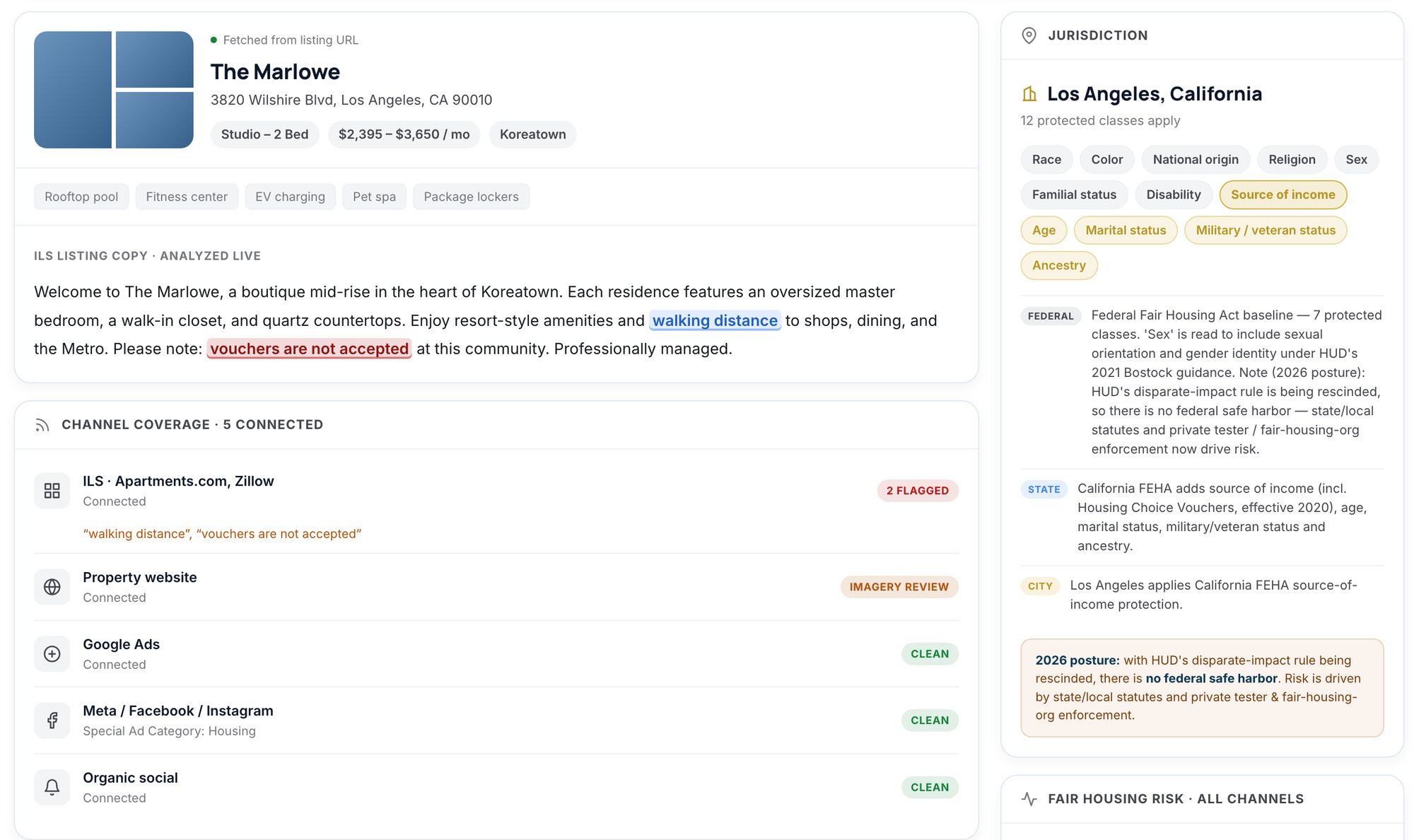
Compliance360 Fair Housing reviews listing, website, ad and social copy, including Google Ads and Meta copy and creative where those channels are connected for the property, against the federal, state and city classes protected at its address, with the rule basis and a suggested rewrite on every flag and a dated audit record of the review. It does not configure or audit ad-platform targeting settings such as radius, audiences or special ad category; those stay with your media team and the checklist above. SiteArchiver, part of Compliance360, captures your property websites daily and whenever they change, including the pages your ads link to.
Frequently asked questions
Meta requires advertisers to self-identify the category, and its developer documentation applies the limited housing audience options to advertisers based in the US or running ads that reach the US, Canada or Europe. Meta also uses human reviewers and machine learning to identify housing ads, and an incorrect category risks the ads being paused. Its 2022 settlement with DOJ defines a housing ad as one offering a specific opportunity to rent, lease or buy a dwelling.
No, not in the US. Meta's Housing category does not support ZIP, neighborhood or other small-area location types and requires at least a 15-mile radius. Google's housing policy bars ZIP code targeting in the US and Canada but allows a radius of 1 km or more, plus city targeting.
Not on Meta. Its documentation says lookalike audiences are unavailable for housing ads, and the 2022 settlement required Meta to stop offering both Lookalike Audience and its housing replacement, Special Ad Audience, by December 31, 2022. Google's housing policy page does not address them.
No. Meta fixes housing ads at ages 18 to 65+ and Google bars age targeting for US housing ads, and neither policy we read has an exception for senior housing. A community that qualifies under 42 U.S.C. 3607(b) can still say it is a 55+ community in the copy, because the Act's familial status provisions do not apply to qualifying housing for older persons. The exemption gives no cover for other protected classes.
The Fair Housing Act does not mention retargeting, and Meta offers an eligibility check for customer list custom audiences in housing campaigns. The risk is the list itself: an audience built from current residents or hand-selected leads can carry a demographic skew. Pair it with broad prospecting.
No. The category limits what you can select in the ad tool. The copy, images, landing page and choice of where to run still fall under 42 U.S.C. 3604(c) and 24 CFR 100.75, and state and city laws add protected classes.
How we checked this
Written by the Brynson Research Team and checked against the primary sources below. Each source shows the date we last read it. We update this page when the rules change; see the change log.
- Special Ad Categories (Marketing API: Audiences), Meta for Developers, current. Accessed 2026-10-22.
- Housing in personalized advertising, Google Ads Policy Help, current. Accessed 2026-10-22.
- Personalized advertising policy, Google Ads Policy Help, current. Accessed 2026-10-22.
- United States v. Meta Platforms, Inc., f/k/a Facebook, Inc. (S.D.N.Y.), U.S. Department of Justice, Civil Rights Division, 2022-06-21. Accessed 2026-10-22.
- Settlement Agreement and Final Judgment, United States v. Meta Platforms, U.S. Department of Justice, 2022-06-27. Accessed 2026-10-22.
- 42 U.S. Code 3604: Discrimination in the sale or rental of housing, Cornell Law School Legal Information Institute (U.S. Code), current. Accessed 2026-10-22.
- 42 U.S. Code 3607: Religious organization or private club exemption (housing for older persons), Cornell Law School Legal Information Institute (U.S. Code), current. Accessed 2026-10-22.
- 24 CFR 100.75: Discriminatory advertisements, statements and notices, Cornell Law School Legal Information Institute (eCFR), current. Accessed 2026-10-22.
- Notification of Withdrawal of Fair Housing and Equal Opportunity Guidance Documents, Docket FR-6571-N-01, HUD via Federal Register Public Inspection, 2026-04-06. Accessed 2026-10-22.
Change log
- First published. Platform limits read from Meta and Google documentation on this date.
This guide is general information, not legal advice. Laws and regulator guidance change; check the current rules for your properties with your counsel before acting.