
How to Audit ILS Spend Across an Apartment and Multifamily Portfolio: A 30-Day Checklist
For marketing directors, VPs of marketing and asset managers at multifamily operators reviewing ILS budget at budget season, renewal or after an acquisition.
An ILS audit takes about 30 days: list every contract and package by property and listing site, reconcile invoices against what you bought, check pay-per-lease charges against PMS move-ins, compare each property's cost per lease with the portfolio rate, and spot check listings. The output is a short, approved list of package changes per property.
- Week 1 builds a property x ILS register with package, price, term, renewal date, notice window and contract owner.
- Week 2 reconciles billed against contracted, and every pay-per-lease charge against a signed lease that moved in.
- Week 3 compares each property's cost per lease on each ILS with that ILS's portfolio rate, flagging small samples.
- Week 4 checks that each listing matches the PMS before any ILS is blamed for weak results.
- Billing variances are credit requests, not performance findings, and dollars at stake are not savings until a change is made.
When to run an ILS audit, and what each trigger changes
Run it yearly and after any of these events; the trigger decides where you start.
| Trigger | Why it matters | Start with |
|---|---|---|
| Budget season | Next year's ILS line is often rolled forward from last year's without a property-level check | Week 3: cost per lease against the portfolio rate |
| Acquisition or management takeover | Contracts may sit with the prior owner or manager, on terms nobody in your team has read | Week 1: who signed, who is billed, when it renews |
| Renewals in the next 90 days | Subscription agreements often renew on their own, sometimes at new rates | Week 1: notice windows |
| Lease-up moving to stabilization | Packages bought to fill a building keep billing after it is full | Week 3 and the decision table |
| Disposition | Sold properties can stay on an invoice that covers many communities | Week 2: invoice lines by property |
CoStar, which owns Apartments.com, says its services are typically distributed to clients under "subscription-based license agreements that typically renew automatically, a majority of which have a term of at least one year", and that "upon renewal, many of the subscription contract rates may change" (CoStar Group 10-K, FY2025). Zumper's premium listings, by contrast, are month to month and cancelled by emailing Zumper "before the start of your next billing cycle" or from account settings (Zumper). Brynson works with Apartments.com, Zillow, Apartment List and Zumper as partners.
The 30-day ILS audit checklist, day by day
One owner runs it, with accounting on week 2 and regional managers on week 4. Use six months or more of data.
Time needed: P30D
- 1
Days 1 to 3: collect contracts
Request every ILS contract, amendment and insertion order for every property, from your files and from each ILS. Record missing ones as findings.
- 2
Days 4 to 7: build the register
Create one row per property per ILS with package, add-ons, basis, price, term, notice date, contracting entity and owner. Highlight notice dates in the next 90 days.
- 3
Days 8 to 11: billed vs contracted
Match every invoice line to a register row and a property you still manage. Log each variance as a credit request.
- 4
Days 12 to 15: reconcile pay-per-lease
Match each billed lease to a PMS lease credited to that source with a move-in date. Dispute cancellations, renewals and transfers with records attached.
- 5
Days 16 to 20: cost per lease
Calculate cost per lease for each property on each ILS, complete-invoice months only, and band it against that ILS's portfolio rate. Flag cells under 3 leases.
- 6
Days 21 to 25: listing spot check
For every above-band cell, compare rent, mandatory fees, beds and baths, availability and amenities with the PMS. Send conflicts to be fixed at the source.
- 7
Days 26 to 28: decide
Apply the decision table to every cell and give each action an owner and a date before the notice deadline.
- 8
Days 29 to 30: approve and log
Get approval for package changes, log who asked, which ILS, which property and status, and set the monthly reconciliation and quarterly review cadence.
Week 1: build the contract and package register
One row per property per ILS. If a property is on four sites, it gets four rows.
| Column | Why the audit needs it | Where it lives |
|---|---|---|
| Property and ILS | The unit of every later decision | Your property list, then each ILS's account list |
| Package or tier, and add-ons | Week 2 compares this with the invoice | Insertion order or contract; ILS account manager |
| Billing basis | Subscription, pay-per-lease and per-listing are audited differently | Contract |
| Contracted price | The baseline for billed vs contracted | Contract, latest amendment |
| Term start, end, auto-renew and notice date | A missed notice date can lock in another term | Contract terms; ask the ILS in writing if unclear |
| Contracting entity and contract owner | After a takeover, the signer may be the previous manager | Signature page; accounts payable vendor record |
| Billing frequency | CoStar says some customers pay "on a quarterly or annual basis" rather than monthly | Invoice history |
| Property | ILS | Package | Basis | Price | Renews | Notice by | Owner |
|---|---|---|---|---|---|---|---|
| Property 1, 240 units | ILS A | Tier 3 + featured | Subscription | $1,450 a month | 2027-01-31 | 2026-12-01 | Regional marketing |
| Property 1, 240 units | ILS C | Standard | Pay per lease | $500 a lease | Month to month | None | Corporate marketing |
| Property 2, 180 units | ILS A | Unknown | Subscription | Unknown | Unknown | Unknown | Prior manager |
Property 2 is a takeover: a finding before any invoice is opened.
Week 2: reconcile invoices, including every pay-per-lease charge
Two checks, in this order. First, billed vs contracted: does each invoice line match the package and price in the register, for a property you still manage? Second, for pay-per-lease sources, does each billed lease match a signed lease in your PMS, credited to that source, that was not cancelled? Apartment List sells its marketplace as "Only Pay for Leases" (Apartment List), and Zillow Group's annual report describes a rentals "Pay-Per-Lease" product (Zillow Group 10-K, FY2025), so for many portfolios this is the larger check.
Property 1, July. ILS C bills 6 leases at $500 ($3,000). The PMS shows 4 signed leases that moved in, 1 application cancelled before move-in, and 1 existing resident transferring units. Two charges ($1,000) go back to ILS C with the PMS records attached. Separately, ILS A was downgraded from $1,900 to $1,450 a month in May, but the invoice still shows $1,900: $450 a month for three months, $1,350, is a credit request.
Keep both out of the performance analysis: a billing variance means the invoice is wrong, not the ILS. Read your contract's credit terms first.
Nine places ILS money leaks, and the test for each
These are the findings a first audit usually produces. Each comes with a test you can run on the register, the invoices or the PMS.
- 01
Auto-renewal at an old or higher rate
A subscription renews because no one sent notice. Test: list every row with a notice date in the next 90 days and a named owner who will act on it.
- 02
A package change that never reached the invoice
A downgrade agreed by email keeps billing at the old price. Test: for every change in the last 12 months, does the next invoice show the new price?
- 03
Pay-per-lease charges for cancelled leases
An application cancelled before move-in can still be billed. Test: match every billed lease to a PMS lease with a move-in date, then read your contract's definition of a billable lease.
- 04
Pay-per-lease charges for renewals and transfers
A current resident who views a listing, then renews or transfers, is not a new lease from that source. Test: check billed names against current residents and dispute under your contract's lease definition.
- 05
Sold or transferred properties still on the invoice
Multi-property invoices hide one extra line. Test: compare invoice property lines with your current managed-property list each month.
- 06
Unused add-ons
Featured placement, extra photos or premium slots bought for lease-up stay on after stabilization. Test: list every add-on, why it was bought, and whether that still applies.
- 07
Per-listing plans sized for the wrong count
Per-listing pricing, such as Zumper's tiers from $10 a listing for 5 listings to $4 a listing for 200 (Zumper), charges for slots, not leases. Test: compare listing slots paid for with units actually available.
- 08
Quarterly or annual billing read as monthly
An invoice covering three months makes one month look expensive and two look free. Test: allocate every invoice to the months it covers before calculating cost per lease.
- 09
Paying for exposure on a listing that misstates the property
A wrong rent or a missing mandatory fee costs leads, and an advertised fee that does not match what you charge is a fee-disclosure problem too (see rental junk fee laws by state). Test: the five-field check in week 4 on every above-band cell.
Week 3: cost per lease by property against the portfolio rate
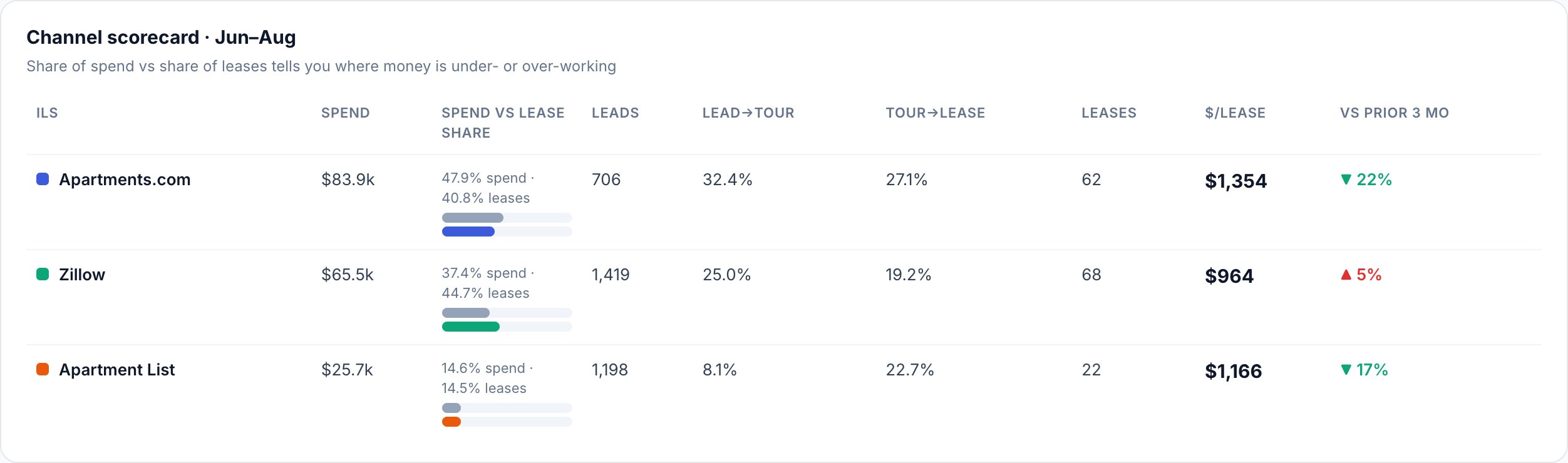
Divide each property's spend on each ILS by the PMS leases credited to that ILS over the same complete-invoice months. Compare the result with that ILS's portfolio rate, not with other ILSs. The ranking can reverse from one property to the next; see the best ILS for multifamily. The full method is in cost per lease by source.
- Band each cell: below the portfolio rate, within 15%, or above it.
- Flag small samples: a cell built on fewer than 3 leases is low confidence. Widen the window before acting on it.
- Put billing models on one basis: add platform fees to pay-per-lease charges and add-ons to subscriptions. See ILS pricing models.
Week 4: spot check listings before you blame the channel
Across 6,000 properties and 1.6 million units, Brynson found that, at origination, nearly 89% of communities described themselves differently across listing sites. 97% of those listings had been updated within the previous 90 days, yet conflicting mandatory fees, missing amenities and contradictory terms persisted (listing accuracy report). "Recently updated" does not mean accurate.
For every above-band cell, compare five fields with the PMS: starting rent, mandatory fees, beds and baths, available units, and headline amenities. An above-band cell on a listing with conflicts is a data problem first: fix it at the source and re-measure. The full field checklist is in the ILS listing audit.
Turning findings into package changes: cut, downgrade, hold or upgrade
Each property x ILS cell gets one action and one owner.
| Finding | Action | When |
|---|---|---|
| Billed more than contracted, or a disputed pay-per-lease charge | Credit request with records attached | Now |
| Above band, 3 or more leases, listing clean | Downgrade one tier, or cut if a second ILS covers the property | Before the notice date |
| Above band, listing has conflicts | Fix the listing, hold the package, re-measure in 60 days | Fix now, decide later |
| Above band, fewer than 3 leases | Hold and widen the window | Next review |
| Within band | Hold | Renewal |
| Below band at a property short of occupancy target | Test an upgrade at that property only | Next billing cycle |
"At stake" is the gap between a cell and its portfolio rate: a reason to look, not savings. Nothing is saved until a package changes and the leases hold.
Reducing ILS dependency without losing leases
Test a downgrade at a few properties before you cut across the portfolio.
- Pick two to four above-band properties with clean listings and enough traffic to measure.
- Downgrade one tier rather than cancel, and change nothing else there during the test.
- Agree the restore rule first: for example, restore if leads, tours and leases all fall over 60 to 90 days.
- Track leads, tours and signed leases by source from the PMS, not the ILS dashboard.
- Roll out only what held, property by property, timed to each notice date.
ILS Management™ keeps the register, consolidated billing and the property x ILS cost per lease grid in one place, with pay-per-lease charges audited against lease counts before invoices are paid. That audit is run by Brynson's team as a service. Each signal shows what was measured, the formula and a confidence level, and package changes are submitted for approval and logged. Listing Consistency in Compliance360 covers the week 4 check across ILSs.
A handful of properties and one or two ILSs
The register, the decision table and a monthly invoice check in a spreadsheet are enough. Keep the notice dates in a shared calendar.
A portfolio with takeovers and pay-per-lease sources
The monthly reconciliation is the step that slips. Use a process or service that matches every billed lease to the PMS before payment, and keeps one record per package change.
Frequently asked questions
Run the full audit once a year, ideally before budget season, and again after any acquisition or management takeover. Reconcile invoices and pay-per-lease charges monthly, and review cost per lease by property every quarter.
Match every billed lease to a lease in your PMS that is credited to that source and has a move-in date. Dispute charges for cancelled applications, renewals and internal transfers, attach the PMS records, and check your contract's credit terms first.
We have not found a published percentage or per-unit figure built on a disclosed method, so we do not quote one. Set the ILS line from your own cost per lease by property and the leases each property needs, not from a rule of thumb.
Not on a small sample. Below 3 leases, widen the window, check the listing against the PMS and confirm attribution. If it stays above its portfolio rate on a clean listing, downgrade or cut before the notice date.
Test a one-tier downgrade at two to four properties with clean listings, agree a restore rule in advance, and track leads, tours and leases by source from the PMS for 60 to 90 days. Roll out only the changes that held.
One corporate owner, usually marketing, should hold the register and notice dates, with accounting reconciling invoices and regional managers requesting changes. Keep one record per contract and per package change so agreed changes reach the invoice.
How we checked this
Written by the Brynson Research Team and checked against the primary sources below. Each source shows the date we last read it. We update this page when the rules change; see the change log.
- CoStar Group, Inc. Form 10-K for fiscal year 2025, U.S. Securities and Exchange Commission (EDGAR), 2026-02-26. Accessed 2026-10-22.
- Zillow Group, Inc. Form 10-K for fiscal year 2025, U.S. Securities and Exchange Commission (EDGAR), 2026-02-11. Accessed 2026-10-22.
- Premium listings, Zumper. Accessed 2026-10-22.
- A-List Market: Only Pay for Leases, Apartment List. Accessed 2026-10-22.
- Brynson Launches Compliance360 for Multifamily Operators, Brynson, 2026-10-22. Accessed 2026-10-22.
- ILS Management, Brynson. Accessed 2026-10-22.
Change log
- First published.